Nancy Pearl's 'More Book Lust' gets 'Today' show nod
There will be even more book lust in July. Librarian Nancy's Pearl's second volume of her highly personal book picks, "More Book Lust," has been picked as the July featured title of the "Today" show book club.
It was chosen by best-selling suspense writer Lisa Scottoline.
Pearl, who recently left her longtime post at the Seattle Public Library, was in the NBC studios in New York Tuesday when the selection was announced. "This exciting moment is an open invitation for anyone to delve into the wonderful world of reading and find books to love," said Pearl.
"More Book Lust," published by Seattle's Sasquatch Books, follows in the trail of its best-selling predecessor, "Book Lust," which now has more than 80,000 copies in print. The new $16.95 paperback includes more than 1,000 book recommendations in 150 categories and lists.
"More Book Lust" is the second title by a Seattle author to be picked recently by "Today's" book club. Stephanie Kallos' debut novel, "Broken for You," was the club's January selection, chosen by popular novelist Sue Monk Kidd.
Nancy Pearl's 'More Book Lust' gets 'Today' show nod
Thursday, June 23, 2005


Thursday, June 16, 2005
Brazilian doctors uncover 'Michelangelo code'
Jun 16, 11:31 AM (ET)
By Carlos A. DeJuana
SAO PAULO, Brazil (Reuters) - Two Brazilian doctors and amateur art lovers believe they have uncovered a secret lesson on human anatomy hidden by Renaissance artist Michelangelo in the Sistine Chapel's ceiling.
Completed nearly 500 years ago, the brightly colored frescoes painted on the Vatican's famous sanctuary are considered some of the world's greatest works of art. They depict Biblical scenes such as the "Creation of Adam" in which God reaches out to touch Adam's finger.
But Gilson Barreto and Marcelo de Oliveira believe Michelangelo also scattered his detailed knowledge of internal anatomy across 34 of the ceiling's 38 panels. The way they see it, a tree trunk is not just a tree trunk, but also a bronchial tube. And a green bag in one scene is really a human heart.
The key to finding the numerous organs, bones and other human insides is to first crack a "code" they believe was left behind by the Florentine artist. Essentially, it is a set of sometimes subtle, sometimes overt clues, like the way a figure is pointing.
"Why wasn't this ever seen before? First, because very few people have the sufficient anatomical knowledge to see these pieces like this. I do because that's my profession," said Barreto, who is a surgeon in the Brazilian city of Campinas.
PAST DISCOVERIES
Barreto and his friend Oliveira are not the first physicians to see depictions of human organs in the Sistine Chapel, the Vatican church where popes are elected.
Fifteen years ago, U.S. doctor Frank Meshberger pointed out the figure of God and his surrounding angels in the "Creation of Adam" panel resembled a cross-section of the human brain.
He believes Michelangelo was equating God's gift of a soul for Adam with the divine gift of intelligence for mankind.
Packing up his desk as he prepared to move houses, Barreto came across Meshberger's theory.
"I said to myself, 'If there's a brain, he surely didn't just paint a brain. There have to be others,'" Barreto said.
Thumbing through books and pictures of the chapel all night, Barreto said he found five or six other anatomical depictions. He presented his findings to Oliveira the next day and the two probed further for three months.
The project culminated with their book "The Secret Art of Michelangelo," which was published in Brazil last year and has so far sold 50,000 copies, a very high number for Brazil. It is being negotiated for U.S., Spanish and Portuguese publication.
As part of their research, they discovered another U.S. doctor, Garabed Eknoyan, had found the figure of a kidney in the panel entitled "Separation of the Earth from the Waters."
CRACKING THE CODE
Eventually Barreto and Oliveira came to believe Michelangelo had left behind coded messages in each panel to help viewers find the hidden body part.
Some clues are thematic, such as "Creation of Adam" or "Creation of Eve," in which a tree trunk looks like a bronchial tube and God's purple robe is a representation of a lung when viewed from the side. One could say God is imparting the "breath of life" into Eve in the scene, Barreto said.
Another part of the code is to look at what figures surrounding the main character of each panel are doing.
In the "Cumaean Sibyl" scene, two cherubic figures embrace behind a bulky, muscular woman representing a mythological oracle. One cherub has his hands on the other's chest. Meanwhile, four other cherub-like figures underneath a painted pillar raise their arms to reveal their chest.
According to Barreto and Oliveira, a bag with a red frilly border and white rolled up scrolls inside hanging beside the Sibyl is a depiction of a heart, the diaphragm and the aorta.
Sometimes Michelangelo "points" to the hidden body part.
In the "Libyan Sibyl," a cherub pointing to his shoulder stands next to a twisting woman, her shoulder blade in the spotlight. Two other cherubs beneath the pillars point to their shoulders too.
If looked at upside down, the fold of the Sibyl's dress and the bottom of her trunk look like a rendition of the arm bone, or humerus, and the socket into which it fits on the shoulder.
"We've said it's actually a very infantile language, because it's all about looks, light, pointing," Barreto said.
When faced with the paintings and photographs of the anatomical body part side-by-side, Barreto and Oliveira's theory is conceivable, although some matches require a little bit of creativity. Some might say too much.
"The problem, and art historians too are certainly often guilty of this, is simply that we often see what we want to see," said Dennis Geronimus, a specialist on Renaissance art at New York University who had a chance to examine some of Barreto and Oliveira's "de-coded" matches.
Their proposals, he said, "stretch the visual evidence far beyond Michelangelo's own specific vocabulary of poses, gestures and symbolic relationships."
Indeed, why would Michelangelo hide drawings of human organs in the Sistine Chapel?
Barreto and Oliveira say they aren't sure, but it is well known that Michelangelo and other Renaissance artists were obsessed with human anatomy and the human body. There are also other examples of artists "hiding" objects in their paintings, images that can only be seen from a certain perspective.
Still, the two doctors have sent their book to art historians and anatomical specialists in Portugal to get their opinion, and plan to eventually get the Vatican's opinion too.
"We're not here to play around. We believe this is a great discovery for the arts," Barreto said. "The only thing we want to do is spread this knowledge."
Excite News
Wednesday, June 15, 2005
Victory! Freedom to Read Amendment Passes by 238 - 187 Vote
In a vote that sends a clear message to the Bush administration that Section 215 of the USA Patriot Act needs to be amended to protect Americans' right to privacy, the House today passed Rep. Bernie Sanders' (I-VT) Freedom to Read Amendment to the Commerce, Justice, State (CJS) Appropriations Bill by a vote of 238 - 187. The Sanders amendment cuts Justice Department funds for bookstore and library searches under Section 215 of the USA Patriot Act. On Tuesday, the Bush Administration had warned that it would veto the House Appropriations Bill if it included any amendments that would weaken the Patriot Act, as reported by the Washington Post.
Today's vote represents a significant victory for Sanders and the many free speech groups and civil liberties advocates, including the Campaign for Reader Privacy, who believe that Section 215 is a dangerous erosion of constitutional rights. "This victory clearly shows that you can fight city hall and win, and demonstrates the enormous power of booksellers to influence public policy," said ABA COO Oren Teicher. "We'd like to congratulate and thank Rep. Sanders, as well as booksellers and all those who participated in the Campaign for Reader Privacy. As was said at ABA's Celebration of Bookselling 10 days ago, America's readers have never had a better friend or stronger supporter than we have in Bernie."
While the victory was significant, Teicher stressed that today's vote does not mean the fight to amend Section 215 is over. "The battle will continue as Congress looks to reauthorize 215 and the other sunsetting provisions of the Patriot Act at the end of this year," he said. "We need to redouble our efforts, and we urge booksellers to continue to collect signatures on reader privacy petitions and to contact their congressional representatives to ask them to support an amendment to Section 215 to protect readers' First Amendment rights."
The debate prior to the vote was an intense one, with those in favor of the amendment emphasizing that civil liberties do not have to be sacrificed for the sake of security and those opposed to the amendment warning that it would give terrorists a safe haven in bookstores and libraries. "This amendment seeks to build a sanctuary for terrorists," declared Tom Feeney (R-FL), "that's all it does."
However, Butch Otter (R-ID) retorted that, like any former prosecutor who worked for the government, "my colleague seems frustrated by the Constitution."
And Dennis Kucinich (D-OH) cautioned, "It's time to remember where we come from as a nation … a nation that stands up for civil liberties!"
In conclusion, Sanders stressed that, not only are the American Library Association and ABA in favor of amending Section 215, but that "seven states in America have gone on record expressing serious concerns" regarding the provision. Furthermore, he continued, hundreds of thousands of citizens have informed their representatives that they are concerned about Section 215, as well.
For more information about the Campaign for Reader Privacy, go to http://www.bookweb.org/read/7679
Sunday, June 12, 2005
The University of Minnesota Libraries presents the unveiling of the largest book ever made
Bhutan: A Visual Odyssey Across the Last Himalayan Kingdom
Witness the unveiling of Bhutan: A Visual Odyssey Across the Last Himalayan Kingdom, the newest acquisition by the rare books department of the University of Minnesota Libraries.
Bhutan is the largest book ever made, according to Guinness World Recordsª, weighing more than 130 pounds and measuring 5 feet by 7 feet.
But Bhutan is more than just a big book. It features stunning, full-color photographs of the architecture, dance festivals, native costumes and people of Bhutan, a tiny kingdom northeast of India which some have called ‘the last shangri-la’ because of its rich ecology and unspoiled culture.
This unique book was printed in an edition of 500 copies, one of which was recently donated to the University of Minnesota Libraries. Creator and photographer Michael Hawley, professor at the Massachusetts Institute of Technology, will discuss how his scientific expeditions to Bhutan led to the creation of this wondrous book.
For more information:
The University of Minnesota Libraries : Bhutan the largest book ever made
Friday, June 10, 2005
Risk-taking start-up company goes one up over publishing giants
From his tiny London office, Peter Ayrton is quietly snapping up books rejected by the world’s publishing giants and turning them into major success stories.
His Serpent’s Tail Publishing has now set the literary world abuzz by recently scooping two of the coveted spots on the shortlist for the Orange Prize, the English-speaking world’s top award for fiction by women.
That is a third of the shortlist, an impressive record for a company with four employees and a self-proclaimed commitment to “extravagant, outlaw voices neglected by the mainstream”.
But if editors at big publishing houses envy Serpent’s Tail’s Orange Prize shortlist success, Ayrton said they have no one to blame but themselves.
“People don’t sell us rights without having tried the big houses first. So most of these books have been turned down by quite a few editors before they come to us,” he said.
“The big publishers are cutting back on the number of titles they publish. They are counting more and more on big books that their marketing people think can sell a shed-load of copies. They’ve become more conservative, which is good news for us.”
Take We Need to Talk About Kevin, Lionel Shriver’s shortlisted novel, which is about a teenage mass murderer, described acidly through the eyes of his mother, who despises him, and suspects that he is evil from the moment he is born.
“A lot of women editors at big houses turned down Kevin because of what they perceived to be its narrator’s negative spin on motherhood. And that’s not their job,” said Ayrton.
With wicked satire of suburbia and an unflinchingly grim look at parenthood, Kevin became a lightning rod for debate, and a word-of-mouth hit on both sides of the Atlantic.
“I’ve been with Lionel Shriver to darkest Essex in the middle of winter with reading groups of 50-60 women. You should have heard the questions. They all had strong feelings about this book.”
So did critics. The New York Times called it “a fearless whack at the shibboleths of family”.
Now, some publishing giants that turned it down have been on the phone to Ayrton trying to buy the rights.
That Kevin ended up with a tiny publisher like Serpent’s Tail is a sign of the industry’s increasing impatience with authors who may take a few books to find an audience, said Liz Thomson, editor of trade journal Publishing News.
Kevin is Shriver’s seventh novel, and her earlier books were published by major houses such as HarperCollins and Faber and Faber. Although her previous sales were disappointing, once upon a time one of those big name publishers might have stuck by her.
Ayrton’s other Orange Prize candidate is Billie Morgan, a murder story about, and by Joolz Denby, a female ex-member of a motorcycle gang in tough working-class northern England.
Both books, with their body counts, give the lie to a media stereotype of women’s literature as tame, Ayrton explained. And they defy a cultural obsession with glamorous young female writers, promoted by major publishers looking for the next hit.
“There is a preconception that what women writers do best is write mostly about domestic issues,” he said. “I think the Orange Prize judges deliberately turned away from youth and ‘babes’.” – Reuters
The Star Online: Lifestyle
BookSlap
Something new. Something annoying. Something so rotten that it deserves the...
BookBitch BookSlap
And the first unlucky recipient is.... Otto Penzler
Sexism at the Edgars? The Debate on Whether Women Mystery-Writers Are Worthy
April 28, 2005
By Gerald Bartell
Genteel? Or bloody? That distinction between two sub-genres of mystery books—“cozies” and “hard-boiled”—may determine who wins the Edgar Award for Best Novel tonight. And the outcome could go to the heart of a debate within the industry: Are female mystery-writers—most often the authors of the more non-threatening, proper cozies—even worthy of the award? Otto Penzler, dean of mystery-writing in America, says no.“The women who write [cozies] stop the action to go shopping, create a recipe, or take care of cats,” he says. “Cozies are not serious literature. They don’t deserve to win. Men take [writing] more seriously as art. Men labor over a book to make it literature...
Read the rest of the article here: THE BOOK STANDARD. If you have the stomach for it.
Thursday, June 09, 2005
Embarrassing Errors In Printed Matter Go to the Book Doc
Dunn & Co. Replaces Pages, Redoes Bindings by Hand, One Tome at a Time
Jeffrey A. Trachtenberg. Wall Street Journal. (Eastern edition). New York, N.Y.: Jun 8, 2005. pg. A.1
CLINTON, Mass. -- A publisher misspelled the word "Massachusetts" in the title of a guidebook, rendering it "Massatusetts." A bindery glue in a nursing handbook failed to hold, and the pages fell out. Thousands of copies of a quilting book printed overseas developed an awful smell while sitting in the hold of a ship during a dockworker's strike. A Chinese printer transformed "Grow Your Own Trees" into "Grow Your Own Tres."
All of these casualties found their way to a former cotton mill in this old industrial town, where a little business called Dunn & Co. has carved out an unusual niche it calls "book trauma."
Modern book publishers have high-tech distribution and just-in-time warehouses, but their wares remain old-fashioned products that roll off big printing presses. In writing and editing, mistakes can be taken care of with the click of a mouse, but books with problems must be fixed by hand, one at a time.
It is labor-intensive work few want to do. Some manufacturers and binderies do small repair jobs, but primarily as a courtesy to their customers. "I can't think of any other companies that do what [Dunn does]," says John Edwards, chief executive officer of Edwards Brothers Inc., a book manufacturer in Ann Arbor, Mich.
"If a book isn't ready for prime time, you call Dunn to fix it," says Andrew Weber, senior vice president of operations and technology at Bertelsmann AG's Random House Inc.
Dunn's caseload offers a window into a world of books gone wrong. A few years ago, John Wiley & Sons Inc. slipped up by providing the wrong academic credentials for an author on the title page of a new college textbook. "We put the books on hold at the warehouse, called Dunn and asked how fast they could pick them up, rip out the title pages, and tip in new ones," says Elizabeth Doble, vice president of production and manufacturing. Dunn fixed the problem by manually removing each title page with a sharp blade, and then inserting a newly printed, corrected page.
When the spine of a book called "Heaven & Earth: Unseen by the Naked Eye" wouldn't tear off, Dunn bought cans of compacted air, turned them upside down, and used the cold accelerant to freeze the glue so the spine would be easy to remove.
Esther Margolis, president of a small, independent New York publisher called Newmarket Press, a unit of Newmarket Publishing & Communications Corp., says she relied on Dunn to remove a printed exchange between an editor and an author that was inadvertently included in a finished book. "It was cheaper than reprinting, and quicker," she says. Dunn removed the page, printed a new one, and glued it in by hand. "Readers were never able to tell," says Ms. Margolis.
A salesman for a Buffalo, N.Y., phone book sold a full-page ad to an escort service, and it was printed in nearly 800,000 copies of the directory. Dunn was enlisted to replace the offending pages, which it did by hand. Dunn did the same service for a medical textbook that labeled a cancerous tumor benign.
Sometimes Dunn rescues publishers from their own miscalculations about how many books to publish. In October 2002, Random House's Villard imprint published "Mysterious Stranger" by magician David Blaine. The stacks that didn't sell were sent to Dunn, which converted them into paperbacks by tearing off the spine and hardcover "boards" and then gluing on a new cover. Every month Dunn transforms an estimated 600,000 hardcover books that way.
Founded in 1976 by David Dunn, a former book manufacturing executive, the company originally focused on book binding. In 1983, after several accounts went out of business, Mr. Dunn began targeting publishers' mistakes. The company employs about 125 people full time, including three of Mr. Dunn's nephews, a brother-in-law, Mr. Dunn's sister, his wife, his three daughters and their three husbands. The business generates about $7 million in revenue and grows an estimated 5% annually.
Its Web site features a hospital door with the words "Emergency Entrance" emblazoned on it. Viewers who click on the doors are then directed to a menu of specialists described as "book physicians." The list includes Head Book Nurse, Head Book Trauma Surgeon and Medical Book Billing.
It performed one operation earlier this year when Syracuse University Press sent 800 copies of Ghada Samman's novel "The Night of the First Billion" to Dunn. The problem: The last line of the book was inadvertently left out. "Nobody caught the mistake until it was too late," says Mary Peterson Moore, the press's manager of design and production. Inside Dunn's factory, a skilled worker used a blade to cut out the offending page. She then ran a line of glue to the area where the page had been excised. The new page was then set into the glue, and the book closed. The operation left no scar.
Saturday, June 04, 2005
We Mapped Manhattan
By RANDY COHEN
IN 1857, members of the Philological Society of London proposed the creation of a dictionary built upon quotations contributed by readers. The Book Review's project to make a literary map of Manhattan was wildly more modest than the Oxford English Dictionary, but our reliance on reader submissions was as great, and our gratitude to participants as genuine. The response to our announcement on May 1 (''We'll Map Manhattan'') was both enthusiastic and far flung. Submissions arrived from across the country and around the world (Paris, Tampico, Singapore), from general readers, university departments (English, of course, but also German and forestry), and from the third-grade classes of Ms. Chapnick in Ardsley, N.Y., and Mrs. Rosee and Mrs. Absgarten in Scarsdale.
Celia Hartmann, a New Yorker, wrote in an e-mail message, ''I am obviously not the only one who walks around town with a world of fictional locations imprinted on top of the so-called real geography of the city.'' She suggested Jack Finney's novel ''Time and Again'' and E. L. Konigsburg's ''From the Mixed-Up Files of Mrs. Basil E. Frankweiler,'' as did enough other readers to make those books -- along with F. Scott Fitzgerald's ''Great Gatsby'' -- the three most frequently submitted. Also much cited were Caleb Carr and Lawrence Block. Some other books and authors we thought emblematic of New York went nearly unmentioned: only two readers proposed Jay McInerney's ''Bright Lights, Big City,'' about the number for Isaac Bashevis Singer's stories (for citations to these and more authors, see the expanded listings at nytimes.com/literarymap)
Mapmaking is a process of omission -- if it were not, a map of the United States would be 3,000 miles wide. Our design allowed the display of only 49 books, plus a very nice epigraph from Melville (with thanks to Rob Tally of Durham, N.C.). In deciding what to include, we wanted to represent many genres and many eras, and to be guided by reader preferences. The triage was painful, necessarily excluding many wonderful books and authors. But one pleasure of devising the map was discovering the personal connection readers often felt to the books they proposed. In an e-mail message, Bernie Lynch praised Paul Auster's ''Moon Palace'': ''The restaurant and the book both much loved. It was my neighborhood Chinese restaurant and helped me through my undergraduate years. Appreciated more for the waiters than the food but a wonderful communal atmosphere.''
Erin E. Foster enjoyed having lived in an apartment overlooking that of a character in Judy Blume's ''Tales of a Fourth Grade Nothing'': ''If Peter were 10 years old when 'Tales' was published in 1972, he would have been in his 30's during my tenure on the block. I liked to think that he came back every once in a while . . . to visit his folks.''
Readers often displayed nimble analytical skill in discovering their favorite fictional addresses. Kim Herzinger drew on an intimate bond with the novel and the neighborhood to locate the 10th Street home of Clarissa Vaughan from ''The Hours,'' by Michael Cunningham (see Web map). Herzinger ''counted 72 steps from #10 to the corner of Fifth, but I am going to assume that Louis'' -- who had an affair with Clarissa's friend Richard -- ''is slightly shorter than I am.'' She eliminated one building because ''#12 (which is, however, handsomer than #10) is right next to #14 where Mark Twain once lived. Surely someone as literate as Clarissa would have mentioned she lived right next door to Twain's house.''
Some mysteries remain -- the apartment of J. D. Salinger's nomadic Glass family, who seem to move from East to West Side; the address of the Xenophon, where William Dean Howells's March family found a sublet in ''A Hazard of New Fortunes.'' Nor could we confidently pin down the office of Bartleby the Scrivener, despite many good suggestions from readers, including Ann Sullivan-Cross's. Having had a job at 14 Wall Street -- ''like working in a dead letter office, at the depths of a dark world governed by dark laws'' -- she felt sure she recognized the spot; she pointed out, moreover, that Melville's brother Allan had a law office at that address.
These readers see no impermeable boundary between the actual city and the city of the imagination. Meg Wolitzer, one of many writers who volunteered the home addresses of their characters -- we display some of them on the Web map -- expresses a similar idea from the author's perspective. Discussing the apartment at 16 Charles Street she found for the Castlemans in her novel ''The Wife,'' she writes, ''It's the weird thing about being a writer: a strong sense of specificity even though everything is made up.''
This articulates what could be our cartographic motto: a strong sense of specificity, even though everything is made up.
Randy Cohen writes ''The Ethicist'' for The Times Magazine.
THE MAP:
http://www.nytimes.com/packages/html/books/20050605_BOOKMAP_GRAPHIC/
We Mapped Manhattan - New York Times
Cash Up Front
By RANDY KENNEDY
June 5, 2005
If you walk around any Barnes & Noble or other large bookseller right about now, there's a good chance you will notice prominent stacks of a thick hardcover with an eye-catching jacket and the title ''Running the World: The Inside Story of the National Security Council and the Architects of American Power.'' The book, written by a former Clinton administration official, David J. Rothkopf, and published by PublicAffairs, is based on interviews with foreign policy insiders like Henry Kissinger, Madeleine Albright and Condoleezza Rice, and offers itself as a definitive study of the council, sometimes called the most powerful group of people in the history of the world.
Like many other customers, you might have thought the book was on display simply because the booksellers believed it was important, particularly relevant now and would practically sell itself.
This is also what Peter Osnos, the chief executive of PublicAffairs, would like to think. But he has been in the publishing business long enough to know that it's never that simple. In order to ensure the book was on display on the front tables, his company had to pay a total of about $11,000 to the large bookstore chains. Last fall the company also paid what Osnos called ''a significant amount of money'' for prominent placement of a new boxed edition of Lou Cannon's two-volume biography of Ronald Reagan, after the former president died in June.
''Had we not done that,'' Osnos said recently, ''there's no guarantee where the book would be. It could have been in the back somewhere.''
Osnos takes great pains to stress that he is not complaining about the arrangement, but simply describing a complicated kind of machinery that has evolved over the last 15 years in the world of American bookselling. Over that period, the amount of retail space devoted to selling books has quadrupled -- from superstores like Barnes & Noble and Borders to the growing book sections of big-box stores like Wal-Mart and Costco, and even of supermarkets. And with this expansion the once humble conventions of book display -- the neighborhood bookstore window, the recommended-books table near the cash register -- have also been supersized beyond recognition. In fact, many publishers say that the tables and flashy cardboard displays that crowd the front of chain bookstores have emerged as a marketing force fully as powerful as the traditional ways of trying to bring a book to the public's hard-won attention -- through newspaper and magazine ads, reviews, author tours and radio and television interviews.
But this promotional device, like most others, comes with a cost. It is known, somewhat deceptively, as a cooperative advertising agreement. In plain terms, it means that many of the books on display at the front of a store or placed face out at the end of an aisle are there because the publisher paid for them to be there, not necessarily because anyone at the bookstore thought the book was noteworthy or interesting.
Under such programs, booksellers -- mostly chains, but also larger independent stores -- keep a certain percentage of a publisher's net sales, usually 3 percent to 5 percent annually, depending on the agreement with the publisher. This money is then parceled out for various purposes, to help, for example, defray the bookseller's advertising costs, when a chain takes out ads or prints fliers to promote certain books. But the publisher's money may also buy coveted space on the store's front tables or on tall, highly visible racks, known as stepladders, announcing to customers that these books are considered the most important in the store.
''The Barnes & Noble stepladder is the best piece of real estate there is,'' said one veteran publishing executive -- who, like most others interviewed for this article, did not want his name used when talking about the world of book display. ''Now, when I go into a store I practically genuflect in front of the stepladder.'' (As an example, he said that one of his books with sales of about 800 copies a week immediately jumped to 3,000 to 4,000 copies a week once he paid for its placement on stepladders in stores across the country.)
Pay-for-display programs are nothing new in the retail world. Supermarkets have long extracted money from manufacturers to put their boxes of cereal or detergent in eye-catching spots. But the practice seems less savory in bookselling, where bookstore owners and managers were once assumed to serve as an editorial presence, recommending and featuring books they liked. Besides, publishers complain that, despite its name, cooperative advertising is not a cooperative exercise in the least. Some compare it to a tax or even to extortion -- evoking the practice of ''payola'' in the radio industry. Which is not to say that co-op is actually under-the-table, illegal or even unethical -- it's just that bookstores don't tell customers about it.
Co-op advertising has thus acquired a reputation as a kind of dirty secret of the publishing business. In 1999, Amazon.com, which also charges publishers for prominent placement and promotion of books on its Web site, dealt with complaints about the policy by saying it would disclose which titles had been paid for, but it has since stopped doing so. A disclaimer on the site (it takes some searching to find) informs customers that Amazon accepts payments, but, it adds, ''We don't sell our reviews -- and we don't say a book is good just because it's a publisher-supported title.'' Barnes & Noble likewise says that while its ''Discover Great New Writers'' program is supported by money from publishers, the company would never allow a publisher to ''buy'' a spot on this list; it reserves the right to choose the books itself.
Trying to get publishers or booksellers to talk about display agreements, even off the record, is like trying to persuade Mafiosi to break the oath of omertá. One respected New York publishing executive contacted by this reporter couldn't get off the phone fast enough when asked about it. But among themselves, publishers complain bitterly that display programs are just another way that the big bookstores are dictating how they do business. Booksellers, meanwhile, hate to talk about display arrangements because they feel that they have been unfairly portrayed as somehow dishonest or mercenary in a highly competitive business with paper-thin profit margins.
''At no point in time do we put a book on display unless we think it's going to sell,'' said Stephen Riggio, the chief executive of Barnes & Noble, who bristled at questions about the practice. Gregory P. Josefowicz, the chief executive of Borders Group -- which has a chain of about 500 bookstores -- agreed. ''If we just keep displaying things that don't meet customer needs but are there because of the availability of co-op, that would be a bad strategy,'' he said. He didn't dispute the prevalence of co-op, however, noting that he and other booksellers felt that sharing some display costs with publishers was justified. ''Space does cost,'' he said.
''The rearrangement of the products in the store by store staff is an investment in money for us,'' Josefowicz added.
The phenomenon of co-op advertising was born during the Depression, when book sales dropped sharply and publishers and bookstores willingly joined hands to share advertising and promotion costs. Later, when sales improved, some booksellers insisted on keeping the agreements. ''And that was the first step down the slippery slope from many publishers' points of view,'' said one publishing executive with more than 20 years' sales experience. For years, as bookselling remained largely in the hands of independent stores, pay-for-display was rare, but with the rise of chains and the explosion of display space the arrangements have become more complex and costly.
Publishers have had a love-hate relationship with the idea almost from the beginning. ''I have to say that there were probably some publishers at the time who saw someone else's book in the front window and thought, 'Hey, I'd pay for that if I could,' '' said the veteran executive. And indeed now, displays in superstores are seen by some publishers, especially smaller houses, as an increasingly reliable way to promote their books. ''The promotions cost a fair amount,'' said George Gibson, the publisher of Walker & Company -- known for making successful books like Dava Sobel's ''Longitude'' -- ''but you're buying space, and they have every right to sell that space, and in this day and age when there are so many books being published -- literally every day -- the trick is to try to get a book to stand out in the crowd.''
He added, of the agreements, ''Sure, it might be nice if they cost less, but you use them judiciously.''
The veteran publishing executive said he believes that in many Barnes & Noble superstores, about 70 percent of the books on front-of-store tables are there because co-op money secures their spot. (In New York City, the percentage is less because store clerks have traditionally retained more autonomy to promote books they personally like and think will sell well.) Stephen Riggio declined to say what percentage of books on display tables in Barnes & Noble were generally part of cooperative programs, but maintained that it was ''a small amount system-wide'' and added that ''it's not the driving force behind our merchandising.''
But many publishers disagree and say that costs for certain types of display arrangements with large booksellers are becoming too high. Numbers are very hard to come by, but some publishers said that the price for placement on front-of-store promotional tables for only a few weeks or a month -- in some cases, even, just one week -- at Barnes & Noble stores can be between $10,000 and $20,000 per book, depending on the time of year. Placement on eye-catching cardboard displays can cost much more than $20,000. When compared to the cost of advertising, those fees are not inordinately large, but publishers say that they are starting to take a bigger and bigger share of the money set aside to promote books.
''A great deal of our marketing money is now going to co-op,'' said one publisher. He added that he also has experienced more pressure from booksellers. They do not openly threaten to hide the book in the store if no cooperative money is used, he said; the stores obviously also want books to sell. But that threat is sometimes implicit. ''They're not rude,'' he said. ''They just don't promote the book.''
And booksellers are going after even relatively small amounts of additional money from publishers. One publisher tells a story of a major bookselling company offering a chance for one of the publisher's noted authors to address a dinner meeting of the company's senior managers, a great opportunity for the author. But the bookseller demanded $5,000 from the publisher to allow the author to speak. The offer was declined. ''It's an aggressive posture,'' the publisher said.
While publishers disagree about the merits of paying for display, one thing about the arrangements is clear: they further concentrate money and attention on the books that need it least.
The phenomenon, which has been called a reverse Robin Hood effect, happens because publishers pay huge advances to star authors and then feel they must support that author's book with substantial promotion money. Of course, this was happening well before bookstore display emerged as a force. But publishers say that display arrangements have made promotion budgets even more lopsided in favor of the Stephen Kings and Danielle Steels of the book world, meaning that new authors or less prominent books are given increasingly little advertising or display help.
Stephen Riggio said that while prominent authors do get heavy display support from publishers, he believes big booksellers are unfairly charged with hurting smaller books and publishers with their display policies. ''It's just another j'accuse story in which we are painted by some people in publishing as limiting the marketplace,'' he said. ''It gets right to me.''
On the contrary, he argues, the expansion of his company's stores gives it ''the ability to stock the most diverse collection of books that we've ever been able to do.'' That means books by small and medium-size publishers are ''getting more exposure than ever before.''
The publishing executive with 20 years in sales said that he has been part of many discussions in which marketing divisions have debated the wisdom of devoting large sums of display money to big-name authors whose books would sell well anyway, instead of putting it toward good smaller books that need the attention.
''Those conversations have occurred time and time again,'' he said. ''But no one has had the guts'' to gamble on the lesser-known titles. ''Nobody will do that because the risk is too great for losing the amount of money you've invested in Stephen King.''
Peter Osnos said that for small publishers like him -- PublicAffairs puts out around 50 new books a year -- the expensive world of bookstore display forces him to try to find other ways to get his books talked about.
''One way is to hand a retailer a large check and they will stick your book up front,'' he said. ''What I have to be is more intrepid.''
''Money is the easiest way,'' he added, ''but it's not the only way.''
Randy Kennedy is an arts reporter for The Times.
Cash Up Front - New York Times
Wednesday, June 01, 2005
Famous First Words
A Librarian Shares Favorite Literary Opening Lines
Morning Edition, September 8, 2004 · You can't judge a book by its cover, but librarian Nancy Pearl thinks the first line can tell you a lot. "I think when you read a good first line it's like falling in love with somebody," Pearl tells NPR's Steve Inskeep. "Your heart starts pounding… it opens up all the possibilities." And while a good first line doesn’t always make a good book, Pearl says the chances are better with a strong opener.
Below are some notable opening lines that have made Pearl's heart pound:
Towers of Trebizond by Rose Macaulay: "'Take my camel, dear,' said my Aunt Dot, as she climbed down from this animal on her return from High Mass."
The Last Good Kiss by James Crumley: "When I finally caught up with Abraham Trahearne, he was drinking beer with an alcoholic bulldog named Fireball Roberts in a ramshackle joint just outside of Sonoma, California, drinking the heart right out of a fine spring afternoon."
The Debut by Anita Brookner: "Dr. Weiss, at forty, knew that her life had been ruined by literature."
Uncivil Seasons by Michael Malone: "We don't get much snow, and we hardly ever murder one another. Suicide is more our style..."
Nervous Conditions by Tsitsi Dangarembga: "I was not sorry when my brother died."
The Go-Between by L.P. Hartley: "The past is a foreign country. They do things differently there."
The Autumn of the Patriarch by Gabriel Garcia Marquez: "Over the weekend the vultures got into the presidential palace by pecking through the screens on the balcony windows and the flapping of their wings stirred up the stagnant time inside, and at dawn on Monday the city awoke out of its lethargy of centuries with the warm, soft breeze of a great man dead and rotting grandeur."
One Hundred Years of Solitude, also by Gabriel Garcia Marquez: "Many years later, as he faced the firing squad, Colonel Aureliano Buendia was to remember that distant afternoon when his father took him to discover ice."
Ahab's Wife by Sena Jeter Naslund: "Captain Ahab was neither my first husband nor my last."
The Key to Rebecca by Ken Follett: "The last camel collapsed at noon."
***The Miracle Life of Edgar Mint by Brady Udall: "If I could tell you one thing about my life it would be this: when I was seven years old the mailman ran over my head."
The Paperboy by Pete Dexter: "My brother Ward was once a famous man."
After Life by Rhian Ellis: "First I had to get his body into the boat."
I Capture the Castle by Dodie Smith: "I write this sitting in the kitchen sink."
A Primate's Memoir by Robert Sapolsky: "I joined the baboon troop during my twenty-first year. I had never planned to become a savanna baboon when I grew up; instead I had always assumed I would become a mountain gorilla."
The Man in the Window by Jon Cohen: "Atlas Malone saw the angel again, this time down by the horse chestnut tree."
No One Thinks of Greenland by John Griesemer: "'You'll want to scratch,' said the nurse. 'Don't,' said the orderly."
***one of my personal favorites
NPR : Famous First Words
Monday, May 30, 2005
Levengers is a mail order company that specializes in "tools for serious readers" - they have incredible stuff and I am lucky enough to have their outlet store in my backyard. Books & Books, a fabulous independent bookstore from Miami that is known for their busy schedule of author signings - 30+ a month at times - opened a small store within a store at Levengers and are bringing author signings there. A few Saturdays ago, I had the pleasure of meeting Joe Finder, author of one of my favorite books, PARANOIA, and the newly released COMPANY MAN. Joe was absolutely mesmerizing - his background in the CIA & Russia was really interesting, and he spoke about his research with some of the Fortune 500 CEO's for his latest book. COMPANY MAN is probably more mystery than thriller and something new for him. He's on a 15 city tour (http://www.josephfinder.com/author/tour.asp) and if he comes to your area, I highly recommend a visit for a fascinating hour.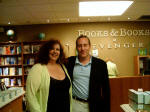
Tuesday, May 24, 2005
A Friday night book signing; what could be better?
Borders, with its usual lack of fanfare and publicity, nevertheless hosted a very well turned out reading by a new author, Andrew Furman. His first novel, Alligators May be Present, looks to have a built in audience in my south Florida neighborhood for sure. A synopsis from the publisher:
While many Jews have picked Florida as the perfect place to retire, Matt Glassman has chosen it as the place to begin his adulthood. Perhaps that’s because the pressures of life have always reminded him about his grandfather who mysteriously disappeared from the family twenty years ago. Now, while he tries to begin a family of his own, he also builds a relationship with the one person who might know the truth about his grandfather’s disappearance: his grandmother. She’s remained stubbornly reticent on the topic all these years, but when a familiar old man shows up at Glassman’s office he thinks he may finally get some answers.
I'm looking forward to reading it.
Want To Know What To Read? Storycode.com Will Do the Math
May 20, 2005
By Rachel Deahl
The notion that taste is personal may have gone the way of eight tracks and Hammer pants. A number of new companies are pioneering a variation of the search engine, known as "recommendation technology," which would use hard data to essentially tell consumers what music, movies and clothing they will like . . . even if they don't know it yet themselves. While this software is already present in the book industry—anyone who's ever been startled by Amazon or B&N's seeming omniscience ("Geez, how'd they know I'd love Knitting to the Oldies?") can attest to this—some companies are now gearing up to bring it to readers in a more ambitious way.
Storycode, founded by Steve Johnston, is one such example. Currently in "soft launch" mode (as of March 1), Johnston claims his new venture—it's intended to function as a book-recommendations database for fiction titles, powered by a "coding" system—has the potential to change the face of the publishing industry. The codes, culled from readers' responses to a series of questions—queries are broken down into five categories and touch on areas like plot and characters—are used to classify, and compare, every book featured on the site. Adding that the site will not publicly launch until a critical mass of codes has been entered—this could mean waiting for books to receive upwards of 20 codes each—the system is intended to offer readers recommendations of books, based on statistical data. In other words, if you just finished The Corrections and loved it, and now want to read another novel just like it, Storycode, Johnston says, will provide a recommendation, complete with a percentage quantifying the similarity between it and a list of matching books.
If the notion of a quantifiable classification system for books, which are, after all, judged and experienced by readers in inherently personal ways, sounds dubious, Johnston counters that all fiction conforms to certain guidelines.
"Every novel does, in some combination, form to a classic story type," says Johnston, who previously spent his professional career in two places: behind the counter of a bookstore; and in front of a computer. After a decade as a bookseller, Johnston became a Web consultant, offering his services to business owners looking for ways to successfully leverage the power of the Internet. "Even with more sophisticated anti-plot novels, the codes will reflect the ambiguity of responses that they receive." He says he sees Storycode as "filling a hole in the retail book trade," and predicts a time when retailers could offer booksellers a more satisfying and viable way to guide their customers to more informed purchases—what he calls "genuine recommendations." The Storycode future he envisions has booksellers logging on to the site from behind their counters, or e-booksellers repurposing his database online. Independent booksellers, meanwhile, are the "potential evangelists" for Storycode.
Leonie Flynn, a former independent bookseller and an editor of The Ultimate Book Guide (A&C Black), says she thinks Storycode is a good idea but doubts booksellers will latch onto it the way Johnston predicts. Saying the site was "more a browsing tool than a fast, immediate selling tool," Smith foresees the site as a place for book lovers over industry professionals. Andrew McClellan, manager of books for Virgin Megastores, says right now Storycode is "no more than an interesting idea." McClellan says that Storycode has potential, but wonders if it can be fulfilled.
"If they receive a lot of input from members of the book reading public, then the site may provide a credible and organic resource of recommendations…as well as becoming a hub for book readers online," he says." From that point, retailers and publishers could make great use of it; however, that's a whole lot of ‘ifs and ‘mays.'"
The idea behind Storycode echoes what other technology companies have been doing for some years for other kinds of products. ChoiceStream, Inc., for example, a Mass.-based company that delivers recommendations across a number of fields, including music, general retail merchandise, television and movies. The company licenses its database to companies such as eMusic, AOL and Yahoo. Its software is programmed to not only know just what consumers like, but more importantly, why they like it.
Darren Gill, ChoiceStream vice president of business development for entertainment, says the company's database is essentially a more advanced version of the recommendations systems on sites like Amazon and Netflix (which offer lists of recommended books and DVDs to consumers based on items viewed, bought or rated). According to Gill, because ChoiceStream has seven million users in its network, with a massive index of products classified, the company has a more advanced system for delivering personalized recommendations.
"Storycode is asking you to do the background work," Gill says. "What we need from a user is to have them tell us about content; people who have done three or four ratings on Yahoo Movies, which licenses our database, get a personalized experience." Gill also says that ChoiceStream is looking to expand the reach of its business to cover other areas—with literature being one of those. "Books has been on our list for a while," he says.
Savage Beast Technologies, Inc., another company in the recommendations business, works exclusively with music and offers recommendations through a system it calls the Music Genome Project. The company, which currently licenses its technology to retailers like Best Buy and Borders, employs a team of specially trained musicians (the profile of a "music analyst" is someone with a four-year music degree and a background in music theory) to characterize songs according to some 400 different attributes. Tim Westergren, one of Savage Beast's founders, says he sees recommendation technologies, and the businesses that provide them, becoming more pervasive in our daily lives. "You can [apply this kind of system] to almost anything from food to dating. I mean, Match.com is trying to do it with people." Westergren says he believes "it's the next wave of the search."
http://www.thebookstandard.com/bookstandard/news/retail/article_display.jsp?vnu_content_id=1000929357
U.S. Book Production Reaches New High of 195,000 Titles in 2004
Tuesday May 24, 7:45 am ET
Fiction Soars
NEW PROVIDENCE, N.J.--(BUSINESS WIRE)--May 24, 2005--Bowker, the leading provider of bibliographic information in North America, today released statistics on U.S. book publishing compiled from its Books In Print® database. Based on preliminary figures, Bowker is projecting that U.S. title output in 2004 increased by 14% to 195,000 new titles and editions, reaching another all-time high.
The catalyst for growth in 2004 was adult fiction, which reversed a three-year plateau and increased a staggering 43.1%, to 25,184 new titles and editions, the highest total ever recorded for that category. Adult fiction now accounts for 14% of all titles published in the U.S., the highest proportion since 1961. New poetry and drama titles increased 40.5%.
The number of new titles released by the largest trade houses increased 5.4%, to 24,159, their largest increase since 2001. University presses increased their title output 12.3% to 14,484, reversing a 4.3% decline in 2003. Since 1995, new titles have increased 72% for all U.S. publishers, 22% for the largest trade houses, and 12% for university presses.
New juvenile titles continued to rise in 2004, increasing 6.6% to 21,516, a new high for that category. Among adult non-fiction categories, religion, travel and home economics enjoyed the largest increases, while education, history, science and biography suffered the steepest declines. The large trade houses published significantly more business, juvenile, law, sociology, and travel titles, and significantly fewer religion, poetry, and literary fiction titles. New adult fiction titles published by the large houses increased a modest 3.5%, a fraction of the increase seen from U.S. publishers as a whole.
Meanwhile, university presses enjoyed increases in almost all categories, with only philosophy and psychology experiencing significant declines.
In 2004, the average suggested retail price for adult hardcovers released by the largest trade houses decreased 10 cents to $27.52; adult fiction hardcovers held steady at $25.08; and adult non-fiction hardcovers decreased 29 cents to $28.49. Adult trade paperbacks increased 11 cents to $15.76; adult fiction trade paperbacks increased 7 cents to $14.78; adult non-fiction trade paperbacks increased 15 cents to $16.16; and adult mass-market paperbacks increased 14 cents to $7.35. The average list price for juvenile hardcovers increased 26 cents to $16.09.
Additional information, including charts to download, can be found at: http://www.bookwire.com/bookwire/decadebookproduction.html, http://www.bookwire.com/bookwire/trade.html or http://www.bookwire.com/bookwire/university.html.
"2004 marked a return to pre-9/11 patterns of publishing," said Andrew Grabois, senior director of publisher relations and content development for New Providence, N.J.-based Bowker. "The historic increase in fiction, and the high double-digit growth of the religion, personal development, domestic arts, and travel categories, point to a seismic shift in the marketplace from the political to the personal. Publishers are betting that the reading public, exhausted by four years of terrorism, war, and polarizing presidential elections, will be more than ready for the kind of escapist and self-help fare that seemed trivial and inappropriate in the wake of a national tragedy."
Other interesting statistics from Bowker include the following:
11,458 new publishers registered with the U.S. ISBN Agency in 2004, an increase of 5.3% over 2003.
4,040 books were translated into English from another language, a decrease of 8.1% from 2003.
Novels published by the large trade houses averaged 359 pages in 2004, a growth of 24 pages since 1995, and 43 pages since 1990.
The book production figures in this preliminary release are based on year-to-date data from U.S. publishers. If changes in industry estimates occur, they will be reflected in a later published report. Books In Print data represents input from 81,000 publishers in the U.S. The data is sent to Bowker in electronic files, and via BowkerLink(TM), Bowker's password protected Web-based tool, which enables publishers to update and add their own data.


 Posts


