Selling a book by its cover: Did flap lead to new jacket?
Steven Zeitchik, a senior editor at Publishers Weekly who writes regularly on pop culture and technology
Published September 11, 2005
When reports surfaced several weeks ago that the cover to Rick Moody's new novel, "The Diviners," had been changed because of bookseller ambivalence, it caused something of a tingle in the book industry.
To some, the jacket on a book is inextricable from the words inside it--and equally non-negotiable. If we're changing the cover because of what other people think, what's next? Altered prose? New endings?
Whether the final product--which has a similar image, but one that appears on a movie screen--proves sufficiently different might never be known. Certainly Moody publisher Little, Brown, is hoping it does. Publisher Michael Pietsch said he believes the new cover still conveys the book's humor while also satisfying more readers, and, while he liked the original, "there was this crescendo of resentment that was simply unignorable."
The incident (which came after printing but before publication) brought to the fore one of the little secrets of book design: Jackets are now one of the most marketing-driven pieces of a title.
Indeed, jackets are routinely scrapped and redone, often many times, sometimes for dubious reasons. It's just that it's done in publishers' offices, out of sight of the rest of us, while here there was a quasi-public backlash as members of the media and booksellers balked while at an industry convention.
An anecdotal study by my own magazine, Publishers Weekly, shows that Kevin Guilfoile's genre-bending thriller, "Cast of Shadows," went through dozens of covers before the publisher decided on the red, neo-Impressionist version. And reports abound of jackets that have been changed after high-ranking employees at the country's bookstore chains intimated a certain cover would mean a lower order. For all their designers' ambitions, covers are like everything else that surrounds our cultural products: the result of assumed commercial appetites.
Certainly there can be unsavory consequences to this. Dicey marketing logic has led to the absurd proliferation of women's legs on book jackets. And critics seem right to fear that changes around the book could slippery up the slope and lead to changes to the words inside it.
But there's a reassuring parallel here too. The fact that designers and publishers now worry a lot more about what people think means their role has changed. They now balance their own ambitions with the perceived wants of an audience. They have become, in other words, just like authors.
http://www.chicagotribune.com/features/booksmags/chi-0509100271sep11,1,5377385.story?coll=chi-leisurebooks-hed
Friday, September 16, 2005


Thursday, September 08, 2005
Tuesday, September 06, 2005
Enough About Me #23: In Which the Author Learns from Conversations with Newspaper Editors that It Can Be Easier to Get into Harvard than to Get One's Book Reviewed
August 29, 2005
By Adam Langer
Back in my bachelor days, it was often easy to tell what my friends really thought of me by the people with whom they tried to set me up. One good friend generously offered to send me on a date with her best friend, while another suggested an evening with a distant acquaintance she described as “kind of attractive and interesting, but not in any conventional way.” In the latter instance, my best friend, who was then a police officer, advised me to avoid the date altogether. “Warning! Warning!” he yelled, pretending that he was responding to a bomb scare. “Cordon off the perimeter! Secure the area!”
In similar fashion, book-review assignment editors can often seem like the yentas of the critical process, sometimes unconsciously revealing how they view an author by whom they assign to review a book, by how much space they allot to the review, by where they position the review and, most importantly, by whether they assign the book at all. For example, the Chicago Tribune, which just published a review of The Washington Story, has assigned long reviews of both of my novels to authors of national stature, one a National Book Award–nominee, the other the winner of a National Jewish Book Award. The Miami Herald’s editor assigned both books to herself, and gave them a fair amount of space. On the other hand, one editor of a mid-market daily paper, who has allegedly made disparaging remarks about me to mutual acquaintances, assigned a tiny capsule review of the first book to a college intern, and has decided not to review the new one. Not that I harbor a grudge or anything.
Often, the critic is perceived as being all-powerful, while little consideration is given to the person who assigns a review to that critic. But, generally, it is that assignment editor who is making the most important decisions—whether to give the book a 1,500-word front-page treatment, bury it inside with a 150-word capsule or, in the great majority of cases (more than 90 percent for just about every publication), given how many books are published and how little space most editors have to work with, ignore it altogether, donate it to the library or sell it to the Strand Bookstore. (Not that I know any critics or editors who’ve done that. Ahem.)
In the past week, I’ve been corresponding with 11 book section editors from daily newspapers to try to get a sense of how the assignment process works. The answers should make any writer thankful that their books get any attention whatsoever. With rare exception, even small newspapers are inundated with hundreds of books every week; if they’re lucky, they can assign perhaps five percent of them to critics. Based on a comparison of percentage rates, it would be more probable for an author to be admitted to Harvard (which traditionally has an acceptance rate of 10% of its applicant pool) than to have his or her book reviewed by The Austin American-Statesman (2.25%), The Baton Rouge Advocate (7%) The Capital Times (4%), The Denver Post (3.75%), The Kansas City Star (.9%), The New York Post (4%), The San Diego Union Tribune (3.33%), The Rocky Mountain News (3%) or The St. Petersburg Times (1.67%).
Some conclusions drawn from discussions with these editors (who were chosen based on the fact that they responded to my e-mails) are liable to strike fear in the hearts of publishers, publicists, editors, and writers everywhere. Among them:
1) In most publications, more than 90% of books get tossed because review sections don’t have sufficient space.
2) Editors rarely bother to read press releases.
3) Editors often assign books without having read more than a book jacket or a chapter here or there.
Here’s a look at some of the aforementioned editors, which should give some idea of what all of them are up against. I’ve edited their remarks for the sake of clarity, pacing, brevity and, in some cases, my own amusement.
to read the rest (and it's fascinating stuff):
http://snipurl.com/ih32
Saturday, September 03, 2005
Knowledge for Sale
Are America's public libraries on the verge of losing their way?—By Chris Dodge, Utne magazine
July / August 2005 Issue
Before joining the Utne staff in 1999, Chris Dodge worked for 19 years in a suburban Minneapolis library system, helping the activist librarian Sandy Berman reinvent the art of cataloging. Long before search engines swept the Web, Berman and his team created a network for searching the system with plain words and phrases, not arcane jargon. Today, that innovative system has been dismantled -- a symbol, Dodge argues, of wider trends that are transforming public libraries across the country. Are we on the verge of losing a cultural treasure? Dodge finds reason for both concern and hope. -- The Editors
Imagine a social space that's designed for individual enlightenment, a "people's university" where all can read and learn. A haven from commerce where everyone can conduct research or enjoy the arts. A place for children to escape their family bonds just long enough to glimpse a broader world. A home away from home for those curious about ideas and passionate about knowledge.
Such is the American public library at its best. And who doesn't love a library, at least in concept? In a land where private ownership is the rule, libraries lend items and offer help for free. Historically, they've provided things to be shared, not consumed and thrown away. Good libraries are deeply conservative in that they guard and archive the culture's diverse wisdom and beauty, its vast oddities and amusements. But they're also radical bastions of mutual aid. In a "knowledge economy" where information carries an ever-steeper price, where the rich get wealthier and the poor have less, libraries are one of the few ways still available for many to educate themselves -- ideally, an American right.
By some measures, these wellsprings of the democratic spirit have never been more popular. According to the American Library Association (ALA), public library visits have risen from 500 million in 1990 to about 1.2 billion a year. Reference librarians now answer more than 7 million questions a week. And as the ALA likes to note, there are more public libraries in the United States -- 16,421, counting all branches -- than there are McDonald's restaurants.
But lurking in that comparison is a hint that all is not well with libraries. In fact, the same forces that have turned the United States into a fast-food nation could soon drive the traditional American library out of existence. In a society where everyone's basic needs for health care, housing, education, clean air and water, meaningful work, creative expression, and open space are not met, the historical model of the public library, open to all, is under siege. Critics say it's a crisis that mirrors a larger one rooted in the failures of capitalism and perhaps democracy itself.
Though tax-supported public libraries first appeared in the United States in the mid-19th century, their spread began decades later, thanks to industrial magnate Andrew Carnegie. After working his way from bobbin boy at a textile mill to owner of the world's largest steel company, Carnegie saw libraries as a way to help self-motivated individuals benefit society by bettering themselves. For 30 years following 1886, his vast wealth funded the building of nearly 1,700 libraries in more than 1,400 American cities and towns. To get a Carnegie grant, a community first had to show the need for a library, provide a site, and agree to support the library with annual taxes totaling 10 percent of the grant.
Libraries still do what they did in Carnegie's day, at least in principle. In the words of ALA president Michael Gorman, their mission is "to select, acquire, give access to, and preserve the records of human civilization and to provide instruction and assistance in the use of those records." In the view of scholar Siva Vaidhyanathan, author of The Anarchist in the Library (Basic Books, 2004), "a library is a temple to the antielitist notion that knowledge should be cheap if not free." How many inventors, artists, farmers, healers, bus drivers, teachers, and writers have been nurtured in public libraries, made important discoveries there, or simply survived, thanks to these welcoming spaces? More important, how many will in the future?
The question arises because libraries have entered an era of change, evidenced most dramatically by widespread cutbacks and closings. In Salinas, California, birthplace of John Steinbeck, a funding shortfall nearly closed the city's three libraries this spring, including the branches named after the writer and the labor activist Cesar Chavez. After a national outcry, a fund-raising campaign kept the libraries open at a reduced level of service. Earlier this year, Philadelphia's library director ordered 20 of 49 branches turned into so-called "express libraries" that would be open only in the afternoons and be staffed by nonlibrarians, a move accompanied by layoffs. Responding to the librarians' union, a judge stopped the partially completed process at least until July 1. Other such crises are springing up from coast to coast.
Read the rest of the article (very long) in its entirety: http://www.utne.com/pub/2005_130/promo/11706-2.html
Tuesday, August 30, 2005
Amazon's Vital Statistics Show How Books Stack Up
By Linton Weeks
Washington Post Staff Writer
Tuesday, August 30, 2005; C01
Hey! Remember books? Sure you do. Your parents read them. So did their parents. Now for all those folks who like to talk about books without actually reading them, some exciting news! Amazon.com, the pack-leading online superstore, has figured out an innovative, and some would say insidious, way to talk about books.
Text Stats.
It's part of the company's ingenious "Search Inside" capability, which allows you to comb through the entire text of a book online.
Sure, "Search Inside" has been around for a couple of years and, by looking at the first few pages of a book that uses the feature, you can get to know a little about it before you buy.
But with the addition in April of Text Stats, "Search Inside" now takes books completely apart. It slices! It dices! It can uncomplicate comedies, trivialize tragedies, diminish legitimate discourse and completely humiliate the humanities!
Through Text Stats you can know such arcane things as the SIPs, or Statistically Improbable Phrases, that appear in a book. The strange pairing "reindeer socks," for instance, shows up four times in Eric Jerome Dickey's "Naughty or Nice." Text Stats will also tell you the number of characters (letters, not protagonists) in a book and the relative "complexity" of the words. It ranks works according to difficulty. Three different computer-driven indexes suggest whether a book is easier -- or harder -- to read than others.
And, thanks to a sensational subsection called Fun Stats, you will know just how many words you are getting per dollar and per ounce with each book. For instance, "War & Peace" by Leo Tolstoy gives you 51,707 words per dollar, while "Obliviously On He Sails: The Bush Administration in Rhyme" by Calvin Trillin delivers only 1,106 words per dollar.
Confronted with the evidence, Trillin says, "I don't mind being compared to Tolstoy literarily, but when it comes to Fun Stats it's a little humiliating."
Trillin also says he was surprised to learn that of the words he used in his book, 10 percent of them were deemed "complex."
"I thought I was hitting around 6 or 7 percent," he says. "That's what I usually aim for."
Virginia author Robert Bausch is also concerned about his statistics. "There is something really kind of disturbing about this," he says while checking the Text Stats of "The Gypsy Man," his novel from 2003. "You can't tell me that 96 percent of books have fewer sentences than mine. If that's true, I'm in [expletive] deep [expletive]."
Kristin Mariani of Amazon.com says the "Search Inside" features were designed to make it "even easier for customers to find, discover and buy books they'll love." She adds that the program has helped increase sales.
How, you may be wondering, will Text Stats enhance your life? Say you must choose between two best-selling novels: "The Kite Runner" by Khaled Hosseini and "The Curious Incident of the Dog in the Night-Time" by Mark Haddon. Both are in paperback; both sell for about $10.
"Kite Runner" is 384 pages long; "Curious Incident" is 240. On Amazon.com, you can read the publisher's synopses and the editorial and reader reviews -- helpful tools for making an intelligent choice.
But now, with Text Stats, you can reduce your decision to utter absurdity. You can learn, for example, which book scores higher on what is known as the Fog Index. Conceived by the late Robert Gunning, an English professor at Oxford University, the index states the number of years of formal education you should have in order to read and comprehend a random passage.
Here's how the index works: It picks a sample -- of 120 words or so -- from the text. It finds the average number of words per sentence, then picks up all the words in the sample that contain three or more syllables. Compound words are ignored; so are verbs that become polysyllabic through tense endings. The first word of each sentence is tossed out, so are proper nouns. Then it takes the polysyllable count, adds it to the average number of words in a sentence, multiplies that number by 0.4 and, voila! The answer is a number that supposedly represents a comprehension grade level.
The Fog Index shows that you should read at a seventh-grade level to digest "Kite Runner" and at ninth-grade level for "Curious Incident." The first novel contains 6 percent complex words, meaning three or more syllables. Five percent of the words in "Curious Incident" are considered complex. There is an average of 1.4 syllables per word in both books.
At 11,702 words per dollar, "Kite Runner" is obviously a better bargain than "Curious Incident," which contains only 6,156 WPD. That is, unless the words in "Curious Incident" are more meaningful, poetic or carefully chosen.
Text Stats still has a few kinks in its system. According to the Fog Index, a simple child's book such as "The Runaway Bunny" requires seventh-grade reading proficiency. And James Joyce's "Ulysses" is said to be easier than 80 percent of other indexed books.
But in its pure form, Text Stats is a triumph of trivialization. By squeezing all the life and loveliness out of poetry and prose, the computer succeeds in numbing with numbers. It's the total disassembling of truth, beauty and the mysterious meaning of words. Except for the Concordance feature, which arranges the 100 most used words in the book into a kind of refrigerator-magnet poetry game. Here's a poem made from the Concordance of Dave Ramsey's "Total Money Makeover: A Proven Plan for Financial Fitness": Emergency. Find first friend. Give kids life. Live myth.
Yes, you heard right: This site is under deconstruction.
Authors! Imagine how Text Stats will help you write books that are, if not better, at least easier to read according to the Fog Index and that offer the reader more words per pound than "Moby-Dick."
Publishers! Who needs editors anymore? If the software can find SIPs, surely it can be programmed to ferret out PCSs (Poorly Constructed Sentences), ORDs (overly romantic drivelings) and DIPs (Dreadfully Implausible Plots).
And readers! You can settle bar bets. Yes, "Ulysses" by James Joyce (9 on the Fog Index) is more complicated than William Faulkner's "The Sound and the Fury" (5.7 on the Fog Index). Yes, Charlotte Bronte provides more words per ounce (13,959 in "Shirley") than her sister Emily (10,444 in "Wuthering Heights"). And, yes, Ernest Hemingway used fewer complex words (5 percent) in his short stories than F. Scott Fitzgerald (9 percent).
That's right! Now you too can sound like a literary insider at Washington cocktail parties. You can throw around statistics and make clever conversation about the hard history books, the long-winded novels, even those thick, heavy, make-you-think philosophy tomes that contain really, really long words. And the beauty of it is, with Amazon's "Search Inside" Text Stats and other features, you won't even have to read them.
Saturday, August 27, 2005
Reading group classics - will these authors really be remembered 100 years from now?
Postwar novels dominate as 15 are chosen from 100 modern-era books
John Ezard
Saturday August 27, 2005
The Guardian
If 500 of this country's most fervent readers have got it right, the past 25 years have been a golden age for classic fiction, the past 15 years have been even better and the past five years have verged on the platinum.
Audrey Niffenegger's The Time Traveler's Wife (2003) is more enduring than Thomas Mann's Death in Venice, Ian McEwan's Atonement (2001) is more penetrating than Virginia Woolf's Mrs Dalloway, Captain Corelli's Mandolin (1994) is of higher merit than Ernest Hemingway's For Whom the Bell Tolls and Sebastian Faulks' Birdsong (1993) is greater than Graham Greene's The Power and the Glory.
This perspective will be news to most critics, academics and publishers, although publishers will be grateful for the boost for their newer titles. But it is the firm view of 48 book reading groups across Britain.
The verdict, discussed in today's Review supplement, is the fruit of seven months spent by the groups debating which titles published during the 20th century or so far this century will be considered classics in 100 years time.
One group member summed up their dilemma in deciding what makes a classic by asking: "Can we enjoy it or does it have to be worthy?"
These groups, in their role as discriminating readers, were asked by the publisher Vintage to come up with a list of their top 15 modern novels. Vintage, part of Random House, did so to celebrate its 15 years of publishing literary paperbacks.
The readers chose only two novels - the first world war classic All Quiet on the Western Front and Aldous Huxley's Brave New World - from the years before the second world war, which are usually considered the golden age of literary modernism.
Then their choice jumped to the 1960s, with Alexander Solzhenitsyn's One Day in the Life of Ivan Denisovitch, Harper Lee's To Kill a Mockingbird and Joseph Heller's Catch-22.
Nine of their favourite titles were published in or after 1980, three come from the 90s and four from the first three years of this century
The four latest books include two acknowledgedly substantial novels, Atonement and Mark Haddon's Whitbread prize winner, The Curious Incident of the Dog in the Night-Time. But no one in the UK books scene has previously ventured to suggest that the 21st century is producing enduring masterpieces at a rate faster than one every year.
Yesterday, however, the choice came as no surprise to Guy Pringle, publisher of Newbooks magazine, which is in touch with readers and readers' groups.
"The groups involved have not taken this lightly," he said. "But my guess is that the groups are keener on more recent fiction than in going back over the classics. The level of reaction has confirmed to me that people might say they like reading the classics, but they don't do so as often as they say.
"Classic titles have always been the hardest to shift when we have special offers for readers' groups. Even an easy and amusing classic like Three Men in a Boat was slow to move. But I know from what I've read in discussion groups that discussion about this choice has been very wide-ranging and thoughtful."
Tom Palmer, the reading partners coordinator for the government Reading Agency, set up the Vintage project with the 48 groups.
"Some groups read classics only, but the majority go for modern fiction. It's stuff like Captain Corelli's Mandolin that a lot of them read - good-quality middlebrow material."
Mr Palmer estimates that Britain has at least 10,000 reading groups. "I know of 400 in the East Midlands alone," he said.
Vintage gave each group free copies of 100 of its titles to choose from. This 100 had no books by Evelyn Waugh, James Joyce, DH Lawrence, William Golding or other writers usually considered classic, but otherwise included a fair spread.
Vintage's public director, Rachel Cugnoni, said of the project: "It's not a list created by academics or literary critics, but by ordinary readers. This is what makes the list authentic.
"To pin down exactly what defines a classic is hard to do and certainly open to debate, but ultimately what all recognised classics must have is the affirmation of large numbers of readers. These are the classics of the future."
Mary Rossall, a member of a reading group from Cumbria, said, "Even group members who were on holiday still took part - emailing their thoughts on their latest reads.
"In every single meeting we've had, we've ended up talking about how to define a classic. Is it literary merit? Is it a story that stays with you long afterwards? Is it a book that gives voice to people or events which would otherwise be silenced or forgotten?
"Can we enjoy it or does it have to be worthy?"
Writers themselves have difficulty defining what a classic amounts to. For Tim Lott, the book must "say something not merely of the time, but for all time".
Ruth Rendell has defined a classic as something that must be completely original: "Nothing like it has ever been done before. A classic may not be easy to read, but demands care and concentration and will seldom have much immediate appeal to those whose past reading has been thin on the ground or confined to the lightest of fiction. Even to them, when they persevere, it may turn out to be a favourite book, the most rewarding they have ever read."
Top 15 best reads
The Handmaid's Tale
Margaret Atwood, first published in 1985
Captain Corelli's Mandolin
Louis de Bernières, 1994
The Name of the Rose
Umberto Eco, 1980
Birdsong
Sebastian Faulks, 1993
The French Lieutenant's Woman
John Fowles, 1969
Memoirs of a Geisha
Arthur Golden, 1997
The Curious Incident of the Dog in the Night-time
Mark Haddon, 2003
Catch-22
Joseph Heller, 1961
Brave New World
Aldous Huxley, 1932
To Kill a Mockingbird
Harper Lee, 1960
Atonement
Ian McEwan, 2001
The Time Traveler's Wife
Audrey Niffenegger, 2003
Star of the Sea
Joseph O'Connor, 2003
All Quiet on the Western Front
Erich Maria Remarque, 1929
One Day in the Life of Ivan Denisovich
Aleksandr Solzhenitsyn,1962
Guardian Unlimited Books | News | Reading group classics - will these authors really be remembered 100 years from now?
Macavity Award Nominations 2005
(for works published in 2004)
The Macavity Awards are nominated and voted on by members of Mystery Readers International. Winners will be announced at Bouchercon on September 2, 2005.
Best Novel
The Killing of the Tinkers, by Ken Bruen (St. Martin's Minotaur)
Cold Case, by Robin Burcell (Avon)
Darkly Dreaming Dexter, by Jeff Lindsay (Doubleday)
High Country Fall, by Margaret Maron (Mysterious Press)
California Girl, by T. Jefferson Parker (HarperCollins)
Playing with Fire, by Peter Robinson (William Morrow)
Best First Novel
Uncommon Grounds, by Sandra Balzo (Five Star)
Summer of the Big Bachi, by Naomi Hirahara (Delta)
Whiskey Sour, by J A Konrath (Hyperion)
Dating Dead Men, by Harley Jane Kozak (Doubleday)
Misdemeanor Man, by Dylan Schaffer (Bloomsbury)
Best Nonfiction
Famous American Crimes & Trials, by Frankie Y Bailey & Steven Chermak, (Praeger Publishers)
Just the Facts: True Tales of Cops & Criminals, by Jim Doherty (Deadly Serious Press)
The New Annotated Sherlock Holmes: The Complete Short Stories, edited by Leslie S. Klinger (W.W.Norton)
Latin American Mystery Writers: An A-to-Z Guide, by Darrell B. Lockhart (Greenwood Press)
Forensics for Dummies, by D.P. Lyle, MD (Wiley Publishing)
Best Short Story
"Viscery" by Sandra Balzo (EQMM, December 2004)
"The Widow of Slane" by Terence Faherty (EQMM, March/April 2004)
"The Lady's Not for Dying" by Alana White (Futures Mystery Anthology Magazine, Winter 2004)
Friday, August 26, 2005
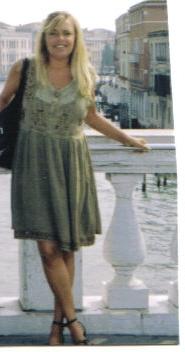
Meet Leana of Treasure Island, Florida - the winner of the July ITW Bookshelf of Books!
Leana won autographed copies of:
The Black Silent, signed by David Dun
Painkiller, signed by Will Staeger
Falling Down, signed by David Cole
Ghost Horse, signed by Patricia Rosemoor
The Halo Effect, signed by MJ Rose
Enjoy your books, Leana!
Thursday, August 25, 2005
The latest recipient of the BookBitch BookSlap:
Roxana Robinson, who obviously hasn't read many books in any of the genres she trashes. Ignorance run amok, and published courtesy of the Chicago Tribune.
A simpler, acrimony-free definition of `women's fiction'
By Roxana Robinson.
Roxana Robinson's most recent books are the short-story collection "A Perfect Stranger" and the novel "Sweetwater."
Published August 21, 2005
It is a truth universally acknowledged that there is such a thing as "women's fiction," but here agreement seems to end. No one can define the term to anyone else's satisfaction, and attempts to do so often degenerate into an exchange of accusations and denials. It's curious, how highly charged this issue is.
So let's try an empirical approach. Let's look at the books that women read in the largest numbers, the books standing in serried ranks at the airport and the supermarket: the best sellers. Certain books declare themselves, with pastel covers and soft-edged, blurry graphics. They're all by women. The jacket copy reveals the protagonist to be a woman and the plot to involve love. These are romances. Surely, if anything is "women's fiction" it is these books.
Like most best-selling novels, romances are escapist fiction, non-realistic fables. They follow formulaic conventions of plot, character and resolution. They deliver a clear moral message and no surprises. The narrative, after ingenious twists, always delivers the reader to the place at which she knew she would arrive. These books are neither beautifully written nor intellectually challenging; they offer little complexity and tell us nothing new or profound. So why do women read them by the millions?
Best sellers function the way populist literature has always functioned. Like myths, fables, fairy tales and sagas, they provide instructive reinforcement for our society. They validate our beliefs. They reiterate the truths we live by, or would like to live by, or which we would like to believe we live by. The truths are these: Virtue will be rewarded, and good will triumph over evil. Judging by the sales, this is a message we want to receive again and again.
Romances concern the quest for love, and their goal is engagement. The narrative device is a metaphorical search for awareness, with the heroine as the initiate who must undergo a series of trials. To succeed, she will need certain attributes: perceptiveness, generosity, empathy and self-knowledge. The human objective of the quest is the beloved--this is the heroine's shadow-partner, her other half. He and she have a date with destiny, which comes as the final engagement.
The heroine may learn that her perfect (but dead) husband was the father of her (supposedly) best friend's (supposedly) sperm-bank baby. She will be deeply shaken, but when she learns to forgive her dead husband, and her friend (who dies, too, so they needn't really make up, plus the heroine gets to keep the baby), as well as herself (for pretending that her marriage was much better than it actually was--frankly, it was a terrible sham), then she can accept the really perfect partner who has turned up just down the beach and who is so loving and true and a far cry from that--at last it can be said--two-timing cad.
The setting of the romance is domestic, the focus narrow. The heroine's worldly task is attraction, so the mechanics of allure are crucial, and its tools--clothes, makeup, hair-dos and manner--will be exquisitely detailed. The philosophical scope is limited. If a social issue arises--hunger among the poor, for example--the heroine will take the side of virtue, and favor feeding. Conventional morality reigns, and though philandering may occur, the final engagement will be based on fidelity. Loyalty is given to an individual, not an abstraction. Emotion is paramount, and love the engine here. Love is the dominant presence: It animates the characters, produces the suspense, provides the central action and the satisfying conclusion.
The underlying premise of the romance is a primal need for emotional connection. The heroine's reward is abiding love, with the implied concomitant rewards and responsibilities: children, home, roots and so on. This functions as a powerfully instructive text, with obvious benefits for society: If women are committed to their husbands, families and households, society will survive, supported by a vast network of committed women, who will provide stability, continuity, communal interconnection and moral consensus. These are the foundational pillars on which any society depends.
Societally, the romance genre plays a big role, and economically, it's a huge market. So it's curious that "women's fiction" is treated so dismissively. The term is a slighting one, faintly derogatory, though people who use it might deny this. This is why the issue is so charged: It seems that the mere declaration of gender confers belittlement. And why is this? Could this be that old, outdated bugaboo, gender discrimination? Aren't we way past that? But it's hard to see this as anything else. It makes no sense to dismiss this genre simply on the grounds of populism, because men have their own populist fiction.
Let's look at thrillers.
Thrillers, too, declare themselves on sight. The covers are ominous grays and blacks, with bold, hard-edged graphics, often in crimson, and often featuring ideologically coded designs, like swastikas. The copy declares that the protagonist is a man and the plot involves death. This, too, is escapist fiction. It's formulaic, obeys conventions, delivers a moral message and ends just as it ought.
The premise here, too, assumes a primal need for engagement, but here this means mortal combat. The narrative device is that of the hunt--a real, not metaphorical, one. The hero is hunter and prey. To succeed, he must be resourceful, elusive and homicidal. (Not ideal husband material.) The vehicle is an international ideological struggle, carried out at a personal level, and the hero is on the side of Right. (He's usually trying modestly to save the Free World.) The human objective is the enemy, the hero's shadow-partner, his other half. They, too, have a date with destiny: They're trying to kill each other.
The focus here is close as well, though the setting is international and the politics global. In the thriller, loyalty is given to an abstraction. The hero's primary task is killing, so his tools--guns, knives, tanks, bombs, warships and fighter planes--are described in exquisite detail. (You may find the lengthy and precise technical discussion of nuclear-submarine deployment in the North Atlantic fascinating. Or you may find it deeply soporific.) The heroes of thrillers are often loners--single, mobile and disengaged--who rely more on their own wits than they do on orders from their superiors. The fundamental struggle here concerns escape, the emotional engine is fear, and the animating presence is death. Fear of death is constant, and the more terrifying the action, the better the story. The hero risks his own death, and deals it out to others, in defense of his country. His escape, and his enemy's destruction, function as personal and political victories. The benefits here are clear: A society needs citizens who will risk their lives for the greater good. In our individualistic culture, the daring loner--James Bond, Walter Mitty--is valued more than the obedient soldier.
So why aren't thrillers called "men's fiction"?
Thrillers are every bit as shallow as romances: They're just as simplistic, just as formulaic and, just as often, poorly written. So why do the two genres receive different degrees of respect? Thrillers have a virile and swashbuckling air, romances, a pallid and sentimental one. Thrillers are cool and romances are not: It seems sex is not as sexy as death.
Yet if love and death are the two great subjects of fiction, if they embody the opposite extremes of our desires, and if they provide the two great pillars supporting the long arc of human experience, why do they receive such different levels of respect? Because the same discrepancy occurs among literary works, as Virginia Woolf observed:
"This is an important book, the critic assumes, because it deals with war. This is an insignificant book because it deals with the feelings of women in a drawing room. A scene in a battlefield is more important than a scene in a shop--everywhere and much more subtly the difference of value persists."
Now we see why the term "women's fiction" is so difficult to define--because it's not confined to formulaic, mass-market works. It seems that this dismissive tone may be applied to any domestic fiction, written by a woman, that takes as its subject the great question of human desire. It doesn't matter how seriously the author takes the question, nor how beautifully she writes, nor how serious the question actually is--the work may still be swept right off the table and onto the floor with the bodice-rippers, using the all-inclusive denomination. Needless to say, the term does not apply to books on this same precise subject that are written by men. No wonder this is all so confusing: sometimes "women's" applies to the subject, and sometimes to the author.
So maybe we should define the term altogether differently.
Maybe it would simplify the issue, and drain the debate of acrimony, to define the work instead by its readers. Because women dominate the audience for literary fiction, the writers of "women's fiction" would be Updike, Cheever, Marquez, Lethem, Franzen and the other distinguished male authors whose work is read by women in droves.
If the term isn't sexist and contemptuous--and no one who uses it admits that it is--then these writers should be grateful for the title, and proud.
Chicago Tribune | A simpler, acrimony-free definition of `women's fiction'
Wednesday, August 24, 2005
For my daughter...
Ariel became a Bat Mitzvah this past week. She did a beautiful job chanting her Haftarah, and made me, her father, her family and friends very proud.
I asked her what the highlight of the day was, and she said when I cried reading the poem I wrote for her. So I'm going to float it out here in cyberspace...
ARIEL, A BAT MITZVAH
written with love by her mother
August 21, 2005
On this occasion I get to kvell
A captive audience I get to tell
How proud Ariel’s made her father and me
How much she’s loved by her friends and family.
I spent the summer of ‘92
Sweating, even while swimming in a pool
But it was worth it, come August 6th
Ariel was born, we got our wish.
She was always a sweet intelligent child
Never really misbehaved or was wild
And I’m very happy to say
Somehow she’s managed to stay that way.
She starting playing t-ball when she was four
Moved up to softball, had fun when she scored
Loves to go camping & hiking through the ‘Glades
Ariel & her dad have seen lots of nature this way
In middle school she joined the band
Picked up a bassoon and thought it sounded grand
She also has fun playing video games
And her computer keeps her busy, chatting on AIM
She practically grew up surrounded by books
Between Borders & the library no wonder she’s hooked
There are worse addictions I’m sure
Than the one she shares with me, reading books by the score.
One day Ariel came to her father and me
And said a Bat Mitzvah is what I want to be
I want to follow the same path my brother took
And study the Torah and the prayer book.
Daniel is a terrific older brother
He does good things, one after another.
Ariel notices and follows his lead
He’s not even aware that he plants these seeds.
Through the years they’ve given us so much pleasure
That it would be impossible to measure
I'm honored to speak for me & Larry today
As we share in this very special day.
The Proverbs state: “Train up a child in the way one should go.”
What we’ve sown, may you grow.
We hope that we’ve filled your head with our voices
Because ahead lies a road strewn with many difficult choices.
Be strong, be healthy, and believe in yourself
Cherish your family and friends, for they are true wealth
A life lived “Jewishly” and filled with love and happiness
This is what we wish for you - only the best.
Thanks for being our sweet Ariel
You’re smart and fun and funny as hell heck
Thank you for giving me the opportunity to say my fill
We love you very much and we always will.
Tuesday, August 23, 2005
A Book to Read Carefully, With a Physical Therapist Near
By EDWARD WYATT
At 1,360 pages (not counting 8 pages of titles and contents at the beginning of the book and 8 blank pages at the end, presumably added for production reasons) the book, quite simply, is massive. It weighs 4 pounds, 9 ounces, equivalent to two and a half copies of "The Da Vinci Code," and it is thicker than Verizon's Manhattan telephone directory (either the white or yellow pages).
"The size implies a certain audacity, especially since we are living in the age of the sound bite," said Philip Turner, the editor in chief of Carroll & Graf Publishers, which will release the book on Sept. 14. "But we figured, why not publish the apotheosis of the big novel?"
"Hunger's Brides" puts other behemoths to shame, including Michel Faber's "Crimson Petal and the White," (848 pages, 3 pounds); Neal Stephenson's "Quicksilver" (944 pages, 3.3 pounds) and the recent reigning champ, Vikram Seth's "Suitable Boy" (1,349 pages, 4.1 pounds).
The plot of "Hunger's Brides" revolves around Sor Juana Inés de la Cruz, the 17th-century Mexican poet and nun whose vow of silence at the age of 40 was signed in her own blood. Her life and work have inspired writings by Octavio Paz, Robert Graves and Diane Ackerman.
But the book is more - much, much more - than an extended piece of historical fiction. It is also the story of Beulah Limosneros, a graduate student who immerses herself in the study of Sor Juana, and Donald Gregory, her professor and a serial adulterer. And in addition to narrative fiction, it is told in the form of poetry, dramatic plays, letters and notes in the margins.
"It is an elaborately beautiful, intricately baroque game that has at its center this mystery about Sor Juana's silence," said Anne Collins, the publisher of Random House Canada, which published the book last fall. Ms. Collins who said she fell in love with Mr. Anderson's writing in 1999 after reading a 50-page sample from the draft of the novel, in which he wrote lyrical passages in four distinct voices.
"Not many first-time novelists have even a clue how to do that," she said. "He totally hooked me."
When Mr. Anderson - a Calgary, Alberta, resident, who worked on the book for 12 years - submitted his 1,000-page manuscript, Ms. Collins had one piece of advice for him: Make it longer.
"What was missing was something that I knew he already knew was missing," Ms. Collins explained - the leap into what, from her childhood or whenever, haunted Sor Juana and eventually forced her into her vow of silence. "I told him, 'You can't not go there.' And that's how it got longer."
Mr. Turner, the American publisher, said that other than making minor changes, he never considered re-editing the book or trying to shorten it. "Because of the sumptuousness of the package - this is a gorgeous piece of typesetting - we weren't inclined to alter it," he said.
"In for a penny, in for a pound," he added - or in this case, four and a half of them.
"Hunger's Brides" has received attention for more than just its girth. After generally good reviews, the book won the top prize for literary fiction at the Alberta Book Awards. Random House Canada sold its entire first press run of 5,000 copies and has gone back to press.
Carroll & Graf has printed 10,000 copies, and the book received starred reviews in Library Journal and Kirkus Reviews and is on the September recommended list of BookSense, a trade group representing independent bookstores.
But there is no escaping its size, which evidently has presented problems for the book's printers as well as its readers. (One copy arrived at this newspaper with the book's pages bound upside down within the cover.) To aid readers, the author himself has contributed some helpful hints. The book's elaborate Web site (www.hungersbrides.com) features a slide show of "safe reading positions."
A Book to Read Carefully, With a Physical Therapist Near - New York Times
Monday, August 22, 2005
This Into That
Need bookshelves? Appreciate the unusual? Believe in recycling?
Here's a novel idea that you will appreciate.
Have a look at www.thisintothat.com
Authors to give eBay bidders a read
by LESLIE WALKER
The Washington Post
Now is your chance to die in a Stephen King novel or be portrayed "in a good light" in the next thriller from John Grisham – while championing the cause of free speech.
That is the idea behind a charity auction on eBay Inc. that starts Sept. 1 and features 16 authors selling character names to the highest bidders.
All proceeds go to the First Amendment Project, a nonprofit legal group dedicated to free speech.
In addition to King and Grisham, writers agreeing to sell a name in their upcoming books include Amy Tan, Peter Straub, Nora Roberts, Lemony Snicket and Dave Eggers.
All have penned summaries of what they plan to offer in an auction preview at www.ebay.com/fap.
Not all are selling characters. Neil Gaiman has offered to include "your name or the name of someone you love" on a gravestone in his upcoming novel.
Snicket, a popular children's writer, is offering "an utterance" by a certain character but concedes the spelling might be "mutilated."
The most priceless preview comes from horrormeister King, who writes that he will want his buyer to provide a physical description and nickname – "can be made up, I don't give a rip," he writes – and that "a buyer who wants to die must in this case be female." The winning bidder will appear in King's book "Cell" next year or in 2007.
In all cases, anyone named must grant their permission, said David Greene, executive director of the First Amendment Project. Each auction will last 10 days. To deter fraudulent bidding, once bidding goes over $1,000, participants will be contacted to verify that they intend to pay, said Eric Gazin, president of AuctionCause, the company managing the event.
The auction was started by novelist Michael Chabon. He began soliciting contributions from writers a few months ago, when he realized the group was running out of money.
Gaiman suggested he consider an auction modeled after a smaller charity event he held last year, in which he sold the name of a cruise ship in his next novel for $3,500.
Chabon, who also plans to sell one of his character's names, said almost every writer asked to participate agreed immediately.
One who did balk told him, "It's a great cause, but I just can't give somebody else that amount of control over my book. I need to be able to name my characters."
Chabon admitted that the couple of times he has auctioned off minor characters in his novels — to raise money for his children's school, for example – he wasn't too happy with the results.
"The winning names were not even remotely names I would have chosen or invented," he said.
But that paled beside what happened to a novelist who held a similar charity auction years ago, Chabon said.
A rival author won and asked that his name be inserted in the novelist's book. That is why he has a line in his preview reserving "the right not to use the name if it is offensive, mischievous, ill-intentioned or inappropriate."
Northwest Herald - Online
Can't Wait for a Book? Paris Can Help
By JENNY BARCHFIELD, Associated Press Writer
Fri Aug 19,10:40 AM ET
Readers craving Homer, Baudelaire or Lewis Carroll in the middle of the night can get a quick fix at one of the French capital's five newly installed book vending machines.
"We have customers who know exactly what they want and come at all hours to get it," said Xavier Chambon, president of Maxi-Livres, a low-cost publisher and book store chain that debuted the vending machines in June. "It's as if our stores were open 24 hours a day."
Stocked with 25 of Maxi-Livres best-selling titles, the machines cover the gamut of literary genres and tastes. Classics like "The Odyssey" by Homer and Carroll's "Alice in Wonderland" share the limited shelf space with such practical must-haves as "100 Delicious Couscous" and "Verb Conjugations."
"Our biggest vending machine sellers are 'The Wok Cookbook' and a French-English dictionary," said Chambon, who added that poet Charles Baudelaire's "Les Fleurs du Mal" — "The Flowers of Evil" — also is "very popular."
Regardless of whether they fall into the category of high culture or low, all books cost a modest $2.45.
Installed in four busy Metro stops and a chic street corner in central Paris, Maxi-Livre's distributors were designed to bypass the characteristic vending-machine-drop, which can be punishing for books.
"We knew that French bibliophiles would be horrified to see their books falling into a trough like candy or soda," Chambon said. "So we installed a mechanical arm that grabs the book and delivers it safely."
Books are but the latest offering in France's ever-expanding vending machine market, which is responding to off-hour demand for everything from toilet paper to carnations.
Can't Wait for a Book? Paris Can Help - Yahoo! News
Sunday, August 21, 2005
The BookBitch gets interviewed!
I was interviewed by David English for Book Talk, an Internet radio program. My interview is scheduled to run the week of Aug 22, 2005 on David's Book Talk. The interview will air Tuesday, Thursday and Saturday at 3:00, 7:00 and 11:00 AM & PM on Leisure Talk Radio Network. Listeners can access the feed at: http://www.leisuretalk.net An audio player, such as Windows MediaPlayer, WinAmp, iTunes, Real player, or several others can be used hear the show. In September, they will put the show up on the Podcast feed so that it will be available for download for on-demand listening or for play on a portable MP3 player such as an iPod.
Check it out and send me feedback!


 Posts
Posts


