Tolkien House to Go on Sale in Britain
Mon May 24, 2:59 PM ET
LONDON - "Lord of the Rings" fans will soon have the chance to buy a home where part of the trilogy was written — as long as they have $2.7 million to spare.
The house in north Oxford, where author J.R.R. Tolkien is believed to have written "The Hobbit" and begun the "Lord of The Rings," is set to go on the market next week.
The house was Tolkien's family home for 17 years during his time as a professor at Oxford University.
The six-bedroom property, where Tolkien lived until 1947, includes a drawing room that once was the author's study. When he moved out, the home was taken over by another academic who died recently.
Tolkien is one of Oxford's best known 20th-century literary figures and was, along with "Narnia" creator C.S. Lewis, a member of the Inklings group, which met in the local Eagle and Child pub.
The house is located in an expensive section of the city, which is home to Oxford University, one of the nation's best schools.
Real estate agents said the house, with its original features and large yard, should be a quick sell, even though it needs work.
Yahoo! News - Tolkien House to Go on Sale in Britain
Wednesday, June 02, 2004


Sunday, May 30, 2004
May 29, 2004, 10:08PM
THE BOOKS OF SUMMER
Bill Clinton memoir promises to be the biggest read on the beach
By FRITZ LANHAM
Houston Chronicle Books Editor
HARRY Potter and the Order of the Phoenix was the big book of summer 2003. Bill Clinton, the phoenix of politics, stands poised to dominate the book world this summer.
Publishing house Knopf has announced a whopping 1.5 million first printing — the largest in the company's history — for Bill Clinton's My Life,the ex-president's long-awaited memoirs. That figure shrivels in comparison to the 8.5 million copies of Harry Potter and the Order of the Phoenix that swamped us last June, but it's still huge for a nonfiction title. By contrast, Hillary Rodham Clinton's memoirs, Living History, had a 1 million first printing.
Knopf isn't saying much about the book and hasn't released galleys. We know it's long — some 900 pages — priced at $35, and will arrive in bookstores June 22. Knopf reportedly paid Clinton between $10 million and $12 million for his efforts.
On June 3 the former president will deliver the keynote address at BookExpo America in Chicago, the annual convention of booksellers and publishers. That will be the first time he talks publicly about the book.
Although it may seem so, My Life won't be the only book published this summer. Here are other titles that should give warm-weather readers a shiver of excitement. This week we survey fiction, next Sunday nonfiction.
Stephen King, James Patterson, Helen Fielding, Jimmy Buffett: All have new books. King's The Dark Tower VI: Song of Susannah (Scribner, $30; set for release in June) is the penultimate volume in his Dark Tower fantasy series.
The equally prolific Patterson, who started out writing blood-drenched thrillers but has gotten warmer and fuzzier in recent years, delivers Sam's Letters to Jennifer (Little, Brown, $24.95; June). It will appeal to "the million-plus readers who laughed and wept through James Patterson's first love story, Suzanne's Diary for Nicholas," promises the publisher.
Mate James Bond with Bridget Jones and, voilà, you get the heroine of Helen Fielding's Olivia Joules and the Overactive Imagination (Viking, $24.95; May). Could the wealthy, elegant Pierre Ferramo be a terrorist, or is Olivia once again a victim of her own O.I.? I'm guessing I know.
While we're on the subject of Chick Lit, newcomer Jardine Libaire's Here Kitty Kitty (Little, Brown, $22.95; May) looks like an edgy contribution to the party-girl-in-the-Big-Apple genre. Sex and the City meets Bright Lights, Big City, says the publisher.
Meanwhile, Sex and the City meets Misery — publishers love their analogies — in Cassandra French's Finishing School for Boys by Eric Garcia (ReganBooks, $24.95; May). You gotta love the concept: Cassie, a young L.A. lawyer tired of dating Neanderthals, locks men up in her basement for instruction on matters ranging from color coordination to sex.
The Psycho Ex Game (Villard, $22.95; June) is another high-concept comedy. A writer, Lisa, meets a rock musician, Grant. The novel consists of he said/she said chapters in which the two vie with each other over "Whose ex was crazier, yours or mine?" Emmy Award-winning writer Merrill Markoe and singer/songwriter Andy Prieboy are authors.
For more laughs, pick up Carl Hiaasen and Jimmy Buffett. Hiaasen's Skinny Dip (Knopf, $24.95; July) features a villainous marine scientist who doesn't know which way the Gulf Stream runs. He tries to murder his wife by pushing her off a cruise ship. She lands on a bale of Jamaican pot, and, well, the tale takes off from there.
In A Salty Piece of Land (Little, Brown, $26.95; May) Buffett brings back Tully Mars from the best-selling Tales From Margaritaville for a "madcap quest" involving a lost lighthouse lens. The flamboyant supporting cast includes an American Indian shaman and a onetime country music star known as Tex Sex.
Olivia Goldsmith's Dumping Billy (Warner, $24; May) is a lighthearted battle of the sexes in which a woman who thinks she's immune to the charms of a handsome cad learns otherwise. Soon to be a movie near you.
Englishman Peter Mayle writes feel-good novels set in Provence, his adopted home. A Good Year (Knopf, $24; June) has a London businessman inheriting a vineyard that doesn't lack for rival claimants even though it produces execrable wine.
Another English author, Jane Green, whose books are huge in her native country, has To Have and to Hold (Broadway, $21.95; May) about a woman who must decide how long to put up with a dashing but chronically unfaithful husband. Cosmopolitan (U.K.) called the book "a deftly humorous and insightful take on modern marriage."
"Style, sexiness and a bit of grit" are promised ingredients of Drive Me Crazy (Dutton, $23.95; July), from best-selling African-American novelist Eric Jerome Dickey.
Summer is traditionally not a strong season for literary fiction. That said, those looking for heartier fare needn't go hungry.
Louise Erdrich brings back characters from a 1988 novel in Four Souls (HarperCollins, $22.95; July). "The story of anger and retribution that begins in Tracks becomes a story of healing and love in Four Souls,"says the publisher.
Patrick McGrath's Port Mungo (Knopf, $24; June) is a "story of art and love, and a family cursed by both." The Master (Scribner, $25; June) by Colm Tóibín centers on a writer rather than a painter, fictionalizing the inner life of Henry James, a man of unresolved sexual identity in search of human connection.
Another famous writer, Russia's Alexander Pushkin, figures tangentially in Alice Randall's Pushkin and the Queen of Spades (Houghton Mifflin, $24; May). Windsor Armstrong, Harvard-educated African-American professor of Russian literature, discovers that her pro-football-playing son, Pushkin X, has become engaged to a lap dancer — a white one at that. This sends her on a journey of discovery into her past. (Footnote: How many people know that Pushkin, Russia's most beloved writer, was the great-grandson of an African slave?)
Readers may remember Randall as the author of The Wind Done Gone, the controversial parody of Margaret Mitchell's Gone With the Wind.
A newcomer, Latvia-born, Canada-based David Bezmozgis, hit the radar last May when Harper's, Zoetrope and the New Yorker all published stories by him. Russian-Jewish immigrants living in Toronto people his debut collection, Natasha (Farrar, Straus & Giroux, $18; June).
Another newcomer getting the big push from his publisher is George Hagen. The Laments (Random House, $24.95; June) is both the title of a book and the name of the dysfunctional family whose search for a place in the world begins in South Africa and carries across three continents.
Hari Kunzru also taps into the immigrant experience in Transmission (Dutton, $24.95; June), about an Indian computer programmer whose fantasies of life in America collide with reality after he accepts a job in California. Kunzru's 2002 novel The Impressionist was much-praised. Granta magazine named the author one of the "20 Best Fiction Writers Under 40."
In Eventide (Knopf, $24.95; May), Kent Haruf returns to the Colorado high plains of his 1999 best seller Plainsong for another foray into the intertwined lives of small-town characters.
Concept-wise, Sabrina Murray's A Carnivore's Inquiry (Grove, $23; July) is about as different from Eventide as can be imagined. Its narrator is a 23-year-old woman whose obsession with cannibalism may be more than academic. Murray won the 2003 Pen/Faulkner Award for The Caprices.
Veterans Thomas Keneally and Julian Barnes have new books. Keneally's The Tyrant's Novel (Doubleday, $25; June) is set in an invented future in which a man is tapped to ghost-write a book by Great Uncle, his country's Saddam-like dictator. Barnes' The Lemon Table (Knopf, $22.95; July) is a collection of stories.
A story collection also is due from David Foster Wallace of Infinite Jest fame. Expect slightly manic self-absorption from the narrators of Oblivion (Little, Brown, $25.95; June).
The Summer Guest (Dial, $24; June) is new from Justin Cronin, whose novel-in-stories Mary and O'Neil won the Pen/Hemingway Award. Cronin now teaches at Rice University. The Summer Guest centers on an aging financier who arrives at the rustic Maine fishing camp he's visited for 30 years with "an astonishing bequest that will forever change the lives of those around him."
Finally, for those seriously committed to literary self-improvement, there's The Guermantes Way (Viking, $29.95; June), the third volume in a new translation of Marcel Proust's seven-volume epic In Search of Lost Time.
Christopher Pendergast headed the team that translated Proust's portrait of Parisian life in the late 19th century; Mark Treharne did the Guermantes volume. The translation "brings us a more rich, comic and lucid Proust than American readers have previously been able to enjoy," claims the American publisher. Heretofore, English-language readers have had to be content with C.K. Scott Moncrieff's version, 80 years old and twice updated.
All seven volumes have been published in the United Kingdom. The first three are out in this country and volume four, Sodom and Gomorrah, will appear this fall. But because of copyright laws, the last three can't be published here until 2019, 2020 and 2022, respectively — by which time I, for one, may well be dead.
Thrillers, mysteries and crime novels are perennial favorites for summertime reading. Expect lots of familiar names this season.
James Lee Burke delivers another featuring Texas lawyer-turned-crime-fighter Billy Bob Holland. In the Moon of Red Ponies (Simon & Schuster, $24.95; June) is the title. Janet Evanovich's high-spirited bounty hunter, Stephanie Plum, returns in Ten Big Ones (St. Martin's, $25.95; June).
Sharon McCone, the sleuth in Marcia Muller's popular series, is back in The Dangerous Hour (Mysterious Press, $25; July), as is Maisie Dobbs, the beguiling English maid turned "psychologist and investigator," in Jacqueline Winspear's second novel Birds of a Feather (Soho, $25; June).
In Hark! (Simon & Schuster, $25; August), another in his 87th Precinct series, Ed McBain revisits one of his best-known villains, Deaf Man. Edna Buchanan launches a new series featuring a special homicide unit that investigates unsolved crimes with Cold Case Squad (Simon & Schuster, $22.95; June).
Easy Rawlins, Walter Mosley's most popular series character, returns in Little Scarlet (Little, Brown, $24.95; July), set during the height of the 1965 riots in the Watts section of Los Angeles. Publishers Weekly calls it "Mosley's best novel to date" — high praise indeed.
The popularity of Spain's Arturo Pérez-Reverte has grown in this country on the basis of such literate thrillers as The Club Dumas and The Flanders Panel. The Queen of the South (Putnam, $25.95; June) centers on a young woman who rises to the top of the international drug trade.
Robert B. Parker's Double Play (Putnam, $24.95; May) isn't a crime novel at all — it's about baseball and the menace that surrounded Jackie Robinson when he broke the game's color barrier in 1947. The main character is Robinson's (fictional) bodyguard.
Lisa Scottoline's Killer Smile (HarperCollins, $25.95; June) has a young female lawyer discovering that a case involving a suicide in a World War II internment camp may not be ancient history after all.
Among the debuts, Michael Simon's Dirty Sally (Viking, $23.95; July)merits note. It features Austin police detective Dan Reles, a New Yorker who fled south as a teenager when his father got crosswise with the mob. Reles "searches for justice in the mansions and ghettos of corrupt, post-oil-boom Texas," says the publisher. James Ellroy gives the book a big plug. (Simon used to live in Austin.)
Expect two-fisted thrillers from Jeffery Deaver and Dale Brown. Deaver's Garden of Beasts (Simon & Schuster, $24.95; July) is set in the 1930s and deals with an American mobster who can escape a life sentence only by participating in a government plot to assassinate one of Hitler's henchmen. Brown's Plan of Attack (Morrow, $25.95; May) is set in a future that sees Russia and the United States again on the brink of all-out war.
And remember, if you get desperate, you can always reread Harry Potter.
HoustonChronicle.com - THE BOOKS OF SUMMER
Thursday, May 27, 2004
Book seeks to solve 500-year-old puzzle ----------------
Big News Network.com Thursday 27th May, 2004
Two childhood friends have written a bestseller based on the fictional tale of solving the mystery of a 1499 Renaissance classic.
The Rule of Four, a novel in which Ian Caldwell and Dustin Thomason invented a solution to what The Hypnerotomachia Poliphili is about and who wrote it, will debut at No. 6 on the New York Times bestseller list Sunday and will jump to No. 3 June 6, the New York Times reported Wednesday.
The basis for the novel, released May 11, is a book published in Venice by an unknown author that has confused scholars for centuries because of its bizarre allusions, including a main character who has sex with buildings.
When Caldwell attended Princeton, he wrote a paper on hieroglyphics in The Hypnerotomachia and recalled the book contained an acrostic when put together allegedly identified the author.
I thought: 'This is a great way to start a book. What kind of secret could we invent, and what piece of Renaissance history could we connect it to to make a good yarn?' Thomason said about their book's origins.
Book seeks to solve 500-year-old puzzle
Wednesday, May 26, 2004
'Fictitious' author publishes the first book without verbs
By Kim Willsher in Paris
(Filed: 09/05/2004)
First, there was the novel written without using the letter "e". Now a French author has produced what he claims is the first book with no verbs.
Perhaps inevitably, critics have commented unfavourably on the lack of action in Michel Thaler's work, The Train from Nowhere, which runs to 233 pages. Instead of action, lengthy passages are filled with florid adjectives in a series of vitriolic portraits of dislikeable passengers on a train.
In a typical piece of prose, Mr Thaler writes: ". . . Those women there, probably mothers, bearers of ideas far too voluminous for their brains of modest capacity."
A less-than-glowing review in the respected magazine Le Nouvel Observateur described his book as "disagreeable" and said its scathing descriptions of women travellers displayed "a rare misogyny".
Yet he is equally disparaging of male passengers. He describes one as a "large dwarf or small giant - a young buck with a gelled mop with ideas, at first glance, shorter than his hair, and not longer than the bristles on a toothbrush, perhaps shorter".
The author, a doctor of literature who admits that "Thaler" is a pseudonym, and who has not previously written books under the name, said it was liberating to write without verbs, which he describes as "invaders, dictators, and usurpers of our literature".
"My book is a revolution in the history of literature. It is the first book of its kind. It's daring, modern and is to literature what the great Dada and Surrealist movements were to art," said Mr Thaler, an eccentric who refuses to reveal his real name or age, beyond admitting to being in his sixties.
"The verb is like a weed in a field of flowers," he said. "You have to get rid of it to allow the flowers to grow and flourish.
"I am like a car driver who has smashed the windscreen so he cannot see into the future, smashed the rear-view mirror so he cannot see the past, and is travelling in the present."
Mr Thaler says that he hopes Le Train de Nulle Part, which costs €20 (£14) will be translated into English.
In France, with its long and distinguished literary heritage, the reading public is struggling to fathom whether the work is any more than an exercise in semantics and strangled grammar.
It remains to be seen whether Mr Thaler's book grows to be as admired as La Disparition (The Disappearance), which Georges Perec wrote in 1969 without using the letter "e". Mr Perec, who tried to expand literature by borrowing formal patterns from other disciplines such as mathematics and chess, followed it up with Les Revenantes (The Ghosts), in which the only vowel he used was "e".
Chrystel Manfredi-Matringe of Adcan, which published Le Train de Nulle Part, said: "Monsieur Thaler takes an immense pleasure in language and words, but he also likes being provocative. Some critics have said, unfairly, that he is a misogynist but it's not true. He is a very charming, courteous man who loves women.
"His book attacks both sexes. Each person in it, male or female, displays a type of modern behaviour which he finds shocking and abhors."
Telegraph | News | 'Fictitious' author publishes the first book without verbs
Monday, May 24, 2004
Raelynn Hillhouse
CHIP McGRATH IS WRONG: Spy Thrillers Thrive & Surprise
web http://www.InternationalThrillers.com
"With some 160,000 books published annually, it’s no surprise that even The New York Times occasionally misses a trend here or there, including the truth about today’s new thrillers and new authors."
--Gayle Lynds
Last week the The Wall Street Journal published a piece about a new trend in publishing: women writing spy thrillers. My dear friend and fellow author, Gayle Lynds and I were both cited as part of that trend. From our many conversations, I knew that Gayle had her finger on the pulse of these developments, so I pulled her away from her current book project to write about them as my first guest blogger.
CHIP McGRATH IS WRONG:
SPY THRILLERS SURPRISE & THRIVE
by guest blogger Gayle Lynds
Copyright © 2004 by Gayle Lynds
www.gaylelynds.com
Noted book reviewer and critic Tom Nolan quietly broke a story last week, on May 18th, in The Wall Street Journal, in which he described an important publishing trend that’s escaped the notice of most other literary pundits: Female authors have infiltrated spy thrillers, and the form is thriving. Take it from me, both pieces of information are subversive.
Once the globe’s top reading choice, with tens of millions of copies selling annually, this male-dominated, reliable genre collapsed with the end of the Cold War. As New York Times critic Walter Goodman announced funereally in November 1989, the same month the Berlin Wall crumbled: "The future looks dismal for the trench coat set."
He was prophetic. Sales of bestselling thriller authors plummeted, while new authors seldom found publishing homes. This, of course, was when my first one came out. (More about that shortly.) By 1998, two thriller icons, Frederick Forsyth and John le Carré, had declared it was time to accept reality: The black business of espionage no longer interested readers. Both men fled to fresh literary turf.
The gloomy forecasts have continued unabated for some fifteen years, right up to as recently as February, when Charles McGrath worried in the pages of the august New York Times: "What’s odd is that most of our thriller writers — the people who in the past have taught us most of what we know about intelligence gathering and intelligence failure — don’t seem to be interested in the post-9/11 landscape.... [T]hey’re writing instead about corporate espionage and theological cover-ups in the Middle Ages. To understand what’s going on in the world, ... we readers now have to turn to nonfiction...."
Ouch. Still, with some 160,000 books published annually, it’s no surprise that even The New York Times occasionally misses a trend here or there, including the truth about today’s new thrillers and new authors.
There’s a lesson to be learned from a closely aligned genre, the mystery: Let’s take a quick trip down mystery’s memory lane to 1977, when Marcia Muller’s first book, Edwin of the Iron Shoes, was published to resounding silence. It was a tiny printing by a soon-to-be defunct publisher, who was willing to take a risk on a woman who was writing seriously about a smart, strong, realistic female private investigator (P.I.), Sharon McCone. No one noticed, including Ms. Muller, that the novel was not only ground-breaking, it dealt a roundhouse blow to the old boys’ school of P.I. fiction. (Note: The thirtieth in the Sharon McCone series, The Dangerous Hour, will be published in July by Mysterious Press.)
Five years passed. Ms. Muller could find no new publisher, but then neither could any other woman. At the same time, the genre, which had already been foundering, fell into malaise, the victim of too much of the same for nearly a half century. Finally, in 1982, within months of one another, the fresh voices of Sara Paretsky (Indemnity Only) and Sue Grafton (A Is for Alibi) burst onto the scene, soon followed by Ms. Muller’s return plus a flood of other female authors. Because a majority of the newcomers were fine writers creating interesting, relevant books, they reinvigorated the P.I. form. New men joined the field. Readers and booksellers and publishers were happy. Cash registers sang.
In his February article in the Times about thrillers, Mr. McGrath goes on to note wistfully, "[Nonfiction books aren’t] as much fun as novels, though, and they also lack the sulfurous whiff of cynicism and conspiracy that makes good thrillers so satisfying." He’s not alone in that longing for the glory days of spy novels. Renowned reviewer Dick Adler of The Chicago Tribune wrote two months later, "Where are the new Robert Ludlums and Tom Clancys coming from?"
In January Magazine, book critic David Montgomery — thoroughly steeped in the thriller — observed astutely within days of Mr. Adler’s comments, "The thriller genre has been pronounced dead so many times that it would seemingly take a miracle even to get it on life-support at this point."
While Mr. McGrath, his gaze firmly on the past, offers nowhere to go, both Mr. Adler and the youthful Mr. Montgomery do. Since this is Raelynn Hillhouse’s blog, and I am concerned about her publishing future as well as that of other excellent authors at last allowed entry to the field, and since I am weary of these endless death notices for a reinvigorated literary form because they discourage readers and insult us by ignoring us, I am now going to serve myself up as evidence. Consider me the sacrificial literary goat.
As Mr. Nolan documents in his Wall Street Journal piece, I finished my first spy thriller, my debut, Masquerade, in 1994. My agent sent it to the president of one of the top New York houses. She told my agent, "I love this book. I want to buy it. But no woman could’ve written it, so I’m not going to make an offer." Blatant sexism, it appears, although maybe not so. It was a low period in the thriller market, but perhaps not low enough to make the gamble seem smart, at least to her.
Steve Rubin of Doubleday, who is rightly considered a visionary publisher, saw it differently. Doubleday published Masquerade in hardcover in 1996, and Berkley sold so many copies in paperback in 1997 that it hit The New York Times extended list. Some 20 countries also published Masquerade, while People magazine named it "Page-turner of the Week." After that, Pocket Books brought out my next two spy thrillers, Mosaic and Mesmerized, again highly political and again dealing with the post–Cold War world.
Fast-forward to today. I’m now at St. Martin’s Press with Keith Kahla, such a terrific editor he could make Maxwell Perkins snap to, and my first novel with St. Martin’s has just been released. It’s called The Coil, and it’s the sequel to Masquerade.
Although Masquerade sold well, there was a stigma to it, a whiff of "she doesn’t belong". In fact, the low point for me was when a male reviewer stopped me in the bar at a writers’ conference and asked why I wanted to cut off the private parts of male authors and readers, because that’s what I was doing by writing in the field. Less insulting but still troublesome was the reviewer who "complimented" me in print for "aping" my betters.
So this is how the business has changed: In April, BookPage not only named The Coil one of its notable new titles, it also called Masquerade a "tour-de-force." Critic Paul Goat Allen wrote in his review, "With the release of Masquerade in 1996, Gayle Lynds joined the deified ranks of spy thriller authors like Robert Ludlum and John le Carré." O, to have even dared to think that back then; I sure would’ve slept better.
As for Mr. McGrath’s latest death knell in the Times for the spy thriller, the capitalist truth is that the form is thriving. According to PW Newsline, the "espionage/thriller" category jumped a whopping 34 percent in sales in 2003. From his critical perspective, Mr. Montgomery agrees: "[Y]ou can't believe everything you read these days, for not only is the thriller not dead, but it is alive and well and safe in the hands of outstanding authors such as Gayle Lynds."
And after asking rhetorically where the new Ludlums and Clancys are coming from, Mr. Adler answers: "Here's one excellent candidate: the tough-minded and talented Gayle Lynds, who co-wrote several books with Ludlum and introduced us to Liz Sansborough – a psychology professor at the University of California at Santa Barbara and an ex-CIA agent – in the gripping Masquerade."
As Mr. McGrath noted, 9/11 happened. While his view is that it made little difference, I think it made all of the difference. After those horrifying attacks, Americans abruptly shook off their post–Cold War exhaustion and resumed their interest in the world at large, searching for information and, ultimately, understanding of what had happened, why it had happened, and what to do about it. We are a nation of readers, so of course we turned to books, but not only nonfiction. One of our favored resources is through the lens of good political fiction, which is what the best spy novels are all about (and which helps account for the surge of sales in 2003.)
Which is also what I write about, passionately, stubbornly, cloaked in what I hope is rousing adventure, as do many other new authors — Jenny Siler (debut: Easy Money, 1999) and Francine Mathews (debut: The Cutout, 2001), to name just two. As does Raelynn Hillhouse, whose marvelous first novel, Rift Zone, is set in the last desperate days of the Cold War and will be available in August.
It’s time for the book world to look realistically at espionage thrillers again. They’re not only alive, readers are excited about them. And as Mr. Nolan observes in the Wall Street Journal, a sea change is happening just as it did in mysteries 20 years ago: Female heroes and villains and authors are infusing new life and much-needed sensibilities into a form that had been not only at risk of becoming disconnected but of becoming a caricature of itself.
The best political fiction is so relevant that it’s predictive, a quality we can claim. Mr. McGrath’s complaint that "most of our thriller writers don’t seem to be interested in the post-9/11 landscape" doesn’t refer to us, nor does it to Frederick Forsyth and John le Carré, who have joined us: They’re back in print with very contemporary tales. But then, there’s so much to write about, proving again what J. Edgar Hoover said many years ago, "There’s something about a secret that’s addicting." When you read our books, you’ll know why.
______________________
Gayle Lynds is the New York Times bestselling author of seven spy thrillers.
Publishers Marketplace: Raelynn Hillhouse
Saturday, May 22, 2004
Oh Lad, Poor Lad
By LAURA MILLER
A new genre of commercial fiction, lad lit, was recently pronounced stillborn by Publishers Weekly, a mere month after its arrival had been announced by The New York Times and The Associated Press. Nothing stings quite so bitterly as cold numbers, so when the magazine printed that Nielsen BookScan had detected sales of only 1,716 copies of Kyle Smith's ''Love Monkey,'' an ostensible leader of the well-publicized ''trend,'' it had to hurt. An events planner at a Chicago bookstore chain was quoted saying that lad lit might attract women readers interested in ''spying on the other side, getting a look into the locker room,'' but she had to admit that the 10 stores in the chain she works for hadn't sold a single copy of either ''Love Monkey'' or another exemplar of the genre, Scott Mebus's ''Booty Nomad.''
Like Jayson Blair's tell-all, sell-little memoir, ''Burning Down My Master's House,'' the fizzling of lad lit demonstrates that press coverage doesn't always translate into cash receipts. It also proves that novels that don't appeal to women are a tough sell. Market research firms consistently report that men make up as little as 20 percent of the readership for adult trade fiction, and with the exception of a few franchise authors like Tom Clancy, writers who appeal mostly to men have a tough time of it. By contrast, a half-dozen ladies, each armed with three names and the capacity to churn out two books a year, manage to sell millions of novels while barely registering on the media's radar. The likes of Mary Higgins Clark and Anne Rivers Siddons are the Godzillas of the fiction trade, towering over the scurrying masses who think of Jonathan Franzen as the big time. Even Bridget Jones shrinks to the dimensions of a minor phenom in comparison.
Nevertheless, chick lit is a legitimate and booming genre, perhaps the only new one to spring up in the past 25 years. Most bookstores now devote a shelf, or two or three, to its candy-colored, cartoon-bedizened offerings. What makes these books so appealing and the lad lit novels so not? The chick lit formula has been tweaked to accommodate heroines who are, among other things, black, Latina, middle-aged and married, often to great success. How come the sex change attempted by lad lit turns out to be a tweak too far?
Helen Fielding's innovation was to fuse a fond, satirical take on the contemporary cult of feminine self-improvement to an old-fashioned romance plot. ''Bridget Jones's Diary'' is famously based on Jane Austen's ''Pride and Prejudice,'' but while Fielding's Mr. Darcy isn't too big a departure from Austen's hero, Bridget Jones is no Elizabeth Bennett. Instead, she's the creation of modern women's magazines. She wouldn't be funny -- and to work, chick lit has to be funny -- if she weren't perpetually falling short of the absurdly inhuman standard of perfection to which she aspires. You wouldn't want her to succeed. She'd be insufferable if she did.
The narrators of lad lit carry no such cross. It's not that pop culture has no paragons of masculinity -- the fictional genres aimed at men are staffed with strong, masterful, good-looking, altruistic heroes. It's just that the average guy rarely feels pressured to equal them. He may resent the need to behave with adult decorum around women, but when he transgresses, the results are more likely to be boorish than endearing. So, for example, the narrator of ''Booty Nomad'' can't remember the names of the women he's slept with and gives them nicknames like ''Bendy Girl'' and ''Totem Pole.'' The narrator of ''Love Monkey'' says things like, ''This girl is harder to get into than Rao's.''
The titles of the books alone tip you off to the precarious line they try to walk. (Has anyone but Nick Hornby ever managed it?) ''Monkey'' says rude, animalistic behavior, guys! But we've softened it with ''Love,'' girls! From the unholy mating of ''Sleepless in Seattle'' and ''Jackass'' only misshapen progeny can spring. As for ''Booty Nomad,'' what woman wants to sympathize with the kind of man who thinks of her bed as a pit stop? ''Love Monkey'' and ''Booty Nomad'' have enough similarities to suggest the germ of a subgenre: each is about a 30-ish man pining for an unavailable woman while trying to get into the pants of several others; each features a scene in which a spectacularly crass buddy (put in to make the hero look decent by comparison) drags the narrator to a strip joint.
Lad lit authors may be truthful about young men's preoccupations, but the recipe for great escapist reading does not include ample servings of stuff people would rather not know. The promoters of lad lit confuse the way women exhaustively analyze a boyfriend's smallest words and gestures with genuine curiosity about men's inner lives. What could be mistaken for a process of detection is actually an act of construction on the part of women who already have a pretty good sense of what's going on in the locker room and prefer to imagine something more appetizing. However realistic the chick lit heroine may be, her love object, the brass ring that makes all her misadventures worth suffering, is usually a figure of fantasy, an initially intimidating alpha male who secretly cherishes her wacky antics and inner goodness. He isn't that different, really, from the kind of hero featured in the thrillers, westerns and spy novels read by men. A little less brooding and violent, perhaps, but an honorable and decisive fellow anyone can admire. That's one thing men's genres share with women's: they're all in love with the same guy.
Lad lit is intent on spoiling the fantasy, and this could result in something even worse than the despair of being caught on a cross-country flight with a tiresome book. If female readers allowed themselves to believe that most straight men spend their time holding conversations with their penises, watching the Cartoon Network, fiddling with their rotisserie baseball teams and contemplating the fine art of passing gas on subway trains, romance -- and perhaps even human reproduction itself -- would grind to a halt. So for the good of the species, they're staying away from lad lit, in droves.
The New York Times > Books > Sunday Book Review > The Last Word: Oh Lad, Poor Lad
Friday, May 21, 2004
Lee County Reading Festival 2003
This was the fourth year for this relative newcomer, but it was hard to tell that they hadn't been doing this forever. I met with Lesa Holstine, committee chair for Authors, and she was kind enough to introduce me to her committee members, along with an author or two and some local media in attendance. I got a brief tour and was impressed with the layout. The authors spoke inside of the Harbourside Convention Center (lovely air conditioning) while across the street in Centennial Park, on the water in downtown Ft. Meyers, were tents with additional Florida authors, mostly local; food; Barnes & Noble; and Authors Alley, where authors went after their presentations to sign books. Other than a slight printing problem with the schedule, the day went off without a hitch - or at least that's how it appeared from my perspective. There was a last minute cancellation by Nancy Pickard due to a family medical emergency, but newcomer Mary Anna Evans stepped up on a day's notice and filled in the hole nicely.
The drive across the state went much more quickly than I anticipated, and I arrived with an hour to spare before the first presentation. My first stop was at the Barnes & Noble tent because I couldn't find my copy of Long Lost by David Morrell (an ongoing problem at my house) so I figured I'd just buy one for him to sign. Unfortunately, B&N didn't have a copy either, and seemed rather confused about the whole thing. They did have several of his paperbacks, and his new nonfiction book, Lessons from a Lifetime of Writing: A Novelist Looks at his Craft - which, after spending some time with him, I'm thinking is undoubtedly brilliant. But the bookseller helpfully offered that she thought he might be bringing the books with him, so I left. I wandered into the building where all was bustling with preparation for the days events. As I wandered down the hallway, I passed a very small conference room where a man was sitting reading the paper. I did a double take; he looked just like David Morrell, so I popped my head in and asked, and sure enough, it was him. I explained about the B&N snafu and inquired as to whether or not he'd brought the books, which he had not. But he was very nice and offered me a signed promotional postcard for his next book, The Protector, which I was delighted to accept. I got to spend the rest of my hour with David, and with Kelly and Kristy Montee. Who are they, I hear you asking? They are P. J. Parrish, who is not a man, but rather two very lovely sisters who write together, long distance no less. They were all there for the first panel of the day, "Page Turners."
David is actually Dr. David Morrell, with a PhD in American Literature, which he taught for sixteen years in the undergraduate program at the University of Iowa. The man is nothing if not hugely, diversely, talented. He is equally at home speaking of Henry James and William Faulkner as he is of Steve McQueen (he is a fan) and Sylvester Stallone. Did I mention that he also refers to himself as "Rambo's daddy?" David's debut novel was First Blood, which the Rambo movie was based upon. And in case you were wondering, he was happy with Stallone as Rambo, and pleased with the movie, although it does differ from the book.
David spoke rather passionately about what it takes to be a writer; the drive, the determination, the obsession. He feels that the "how to" can be learned, but that good story telling is just something one is born with. He spoke about the sameness of so many books today and suggested this exercise: take one hundred books of any genre, remove the covers and cover up the title & author, then read the first page. He predicts 95 out of 100 will be similar enough that differentiating between authors would be impossible. A most provocative thought, as was his feeling that the first line of a novel is enough to tell whether or not to continue reading it - and he gave examples. He also brought with him the startling statistic that there are only 2500 fiction writers in this country that are actually earning a living at it.
David had a very difficult childhood, his father died in WWII, leaving his mother destitute. Her solution was to abandon him to an orphanage at age 4. He is of the school that believes the best fiction writers are a product of a screwed up childhood, which I have heard from other writers as well. His best advice for would-be writers? Read. All in all, a very emotional and enlightening talk by David Morrell.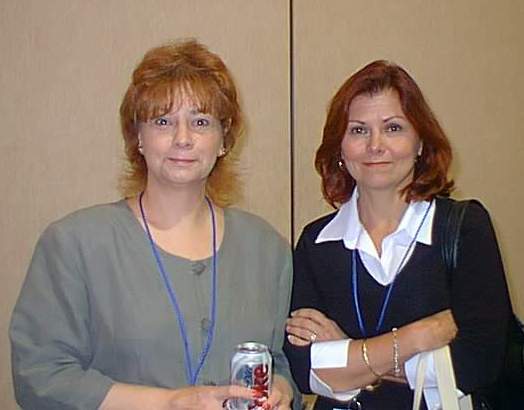 P. J. Parrish, AKA Kelly (pictured, left) and Kristy (right) shared the microphone and talked about how they actually do their writing. Kristy lives in South Florida, Kelly in Mississippi, so they do a lot of telephoning and emailing back and forth. They work on the concept of the book together, but the actual writing is divided. Kelly's strength is in writing action scenes, while Kristy's is in description. They assign each other chapters, rewrite each other, and if one gets stuck, they simply pass it on to the other and say fix this! They get together for about a month every year and get quite a bit done in that time. They are currently working on a new novel in their Louis Kinkaid series, a follow up to Thicker Than Water (which is near the top of my to-be-read pile!) called Island of Bones. It's set on the west coast of Florida, where there are many small, unpopulated islands, some of which are Indian mounds that are thousands of years old, and some of which, well, who knows what's out there. They were planning on spending the afternoon on Cabbage Key, doing some more research.
Kristy was a journalist for many years with the Sun-Sentinel, and wrote several books on her own before this series with her sister. She wrote what she calls "fat romances" - romance novels but not the little skinny ones in the series. Kelly says she wrote for years, but in secret - she never showed anyone anything. She married and had a few kids and would scribble away, hiding her writing from everyone. When they decided to write together, their publisher determined that for marketing purposes, it would be better if they wrote under one name, as it is most unusual for a mystery to have two names on it. They had recently been to Europe, so Paris sprung to mind, which somehow evolved to Parrish, which seemed race-less, and the initials were decided on to keep the name genderless.
In a rather amusing moment, while David was talking about Rambo, Kelly quickly pulled out one of the Parrish books (sorry, I forget which one it was!) which are set in the 1980s and read a bit about their character pausing outside a video store that had a huge Rambo poster in the window. Her timing was inspired.
The next panel was called Crime Scene: Florida and included Randy Wayne White, Mary Anna Evans and Jonathon King. Jonathon's The Blue Edge of Midnight made my favorites list for 2002, and he actually lives not too far from me, but I have missed every event he's done in my neighborhood for one reason or another, so it was really a thrill for me to finally catch up to him. He spoke about his years as a crime reporter, first in Philadelphia, then his move nineteen years ago to the "quiet" town of Ft. Lauderdale where he landed right in the middle of the cocaine cowboys drug wars. He spoke reverentially of Randy Wayne White, and how inspirational he was. April 14th brings A Visible Darkness, the next book in the Max Freeman series which explores eighty years of Florida history in addition to the suspense. Jonathon pointed out that "in good fiction there's good friction," and he's already eloquently demonstrated it.
Mary Anna Evans was the last minute fill in, and this was her first author event. She was poised and totally professional in speaking about her upcoming mystery, Artifacts. Set on the west coast of Florida, the main character is an archaeologist who digs where she has no business digging, and finds something she has no business finding. She told us how she dragged her family on vacation so she could do research for her book, chartering a fishing boat with no intention of fishing. The charter captain was accommodating and informative and her research/vacation paid off.
That story led to Randy Wayne White telling an uproarious story about his days as a charter fishing boat captain. He took out an "elderly" couple - in their late 50's, which twenty-five years earlier seemed elderly to White, but once they had gone out a ways, the couple informed him they had no desire to fish. They were celebrating their 25th wedding anniversary, and wished to be left on a deserted island for a couple of hours. White complied, but when he returned to get them, they were out in the water, up to their necks. Apparently the tide had come in and washed away their clothes. They became much more intimate clients than White had bargained for.
Mary Anna was seated between White and King, who both have shaved heads. White was delighted to point out to the newbie, Mary Anna, that there are two dangers with writing. The first, he said, is that if you write something, there is a very good chance that someone is going to read it. And the second danger, he continued, is that you lose your hair. My camera faltered here, because the look on her face, under all that beautiful dark curly hair, was priceless.
Randy Wayne White has a new book coming out in May called Everglades, his newest entry into the Doc Ford series. He's been busy with a couple of other things too; he's writing a cookbook and is seeking recipes, so visit www.docford.com and leave a recipe for Randy. He also wrote a documentary called Gift of the Game, which won "Best of the Fest" at the 2002 Woods Hole Film Festival, not that Randy mentioned that; instead he was all excited about seeing Hemingway's home in Cuba. Ernest Hemingway founded a youth baseball team called the GiGi Stars for his son Gregory, and Wayne went to Cuba to find the men who played for Hemingway as boys, and to start a new league with local kids. He brought with him former Red Sox pitcher Bill “Spaceman" Lee, Detroit Tigers pitcher John Warden, and pals Gary “Twig” Terwilliger and Mat Asen. The documentary should air on PBS (?) sometime in May.
Unfortunately, due to a scheduling conflict and printing mishap, I didn't get to The Daily Farce panel of Tim Dorsey and Ad Hudler. I've seen Dorsey a few times, and he is one of my favorite speakers. His newest book, The Stingray Shuffle, is part of the continuing saga of serial killer Serge A. Storms and should come with a warning: don't drink anything while reading this book because it will undoubtedly end up coming out of your nose. I was fortunate to run into him in the hall, he was hanging around in case any fans showed up (like me) because of the scheduling problems.  I really wanted to meet Ad Hudler who wrote the ultimate homage to dads everywhere, Househusband, but I wasn't sure if I wanted to shake his hand or punch him in the nose. Turns out he's a real sweetheart of a guy, and he introduced me to his wife and daughter. The first thing I said to his wife was - is he really perfect? And she gave me a resounding answer - NO. I liked him a whole lot better after that. His next book is called Southern Living, and is about three women of the South and will be released in August as a Ballantine trade paperback - perfect for reading groups. If anyone can write a southern novel about women, it's Ad Hudler, and I'm looking forward to it. We chatted until they dragged him away to sign books, but not before his wife took this picture.
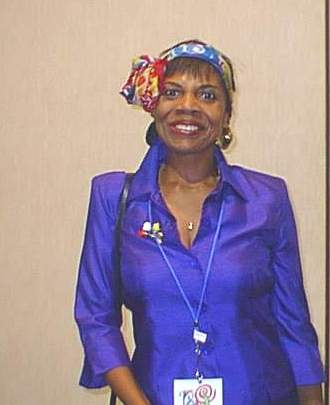
The next panel was called The World of Education and featured Kitty Oliver, Salome Thomas-El, and Rubye Graham-Emerson, but I needed to stretch my legs a bit so I just caught the end of it. I met Kitty Oliver (pictured, left) last year at the Broward County Literary Fest, and she is an inspirational and entertaining speaker. I enjoyed her so much that I took a class with her last semester. She wrote the fascinating memoir, Multicolored Memories of a Black Southern Girl. I did get to hear Salome Thomas-El speak about his life, and his first book, I Choose to Stay: A Black Teacher Refuses to Desert the Inner-City. He is an amazing man, very gifted and very dedicated to his kids. He read a short excerpt from his book about how he turned down a promotion to Vice Principal so he could stay with his kids. A lot of folks thought him a fool, but one of his little girls gave him a hug and said thank you, which made it all worthwhile for him. Arnold Schwarzenegger is a big supporter - he donated a nice chunk of change for an after school program, and comes to school to play chess with the kids. Eventually Thomas-El, or "Mr. El" as his kids call him, did take a promotion and is now Principal of an inner city school.
The last author of the day (for me - there was more but I had a long drive home) was the incomparable Diana Gabaldon. She was greeted by a standing ovation, and seemed delighted by it. She talks like she writes - long, but fascinating - and she went nonstop for almost an hour. She's led a very interesting 51 years, but doesn't look it, which she attributes to sunscreen and good genes. 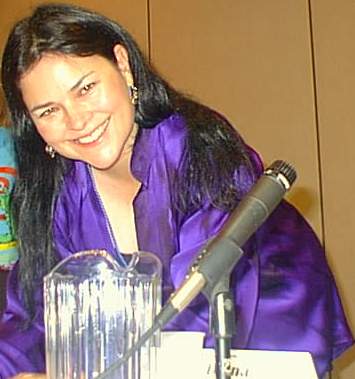 Diana grew up in Flagstaff, Arizona and has her B.S. in Zoology, her Masters in Marine Biology, and her PhD in Ecology. She spent several years as a professor and told a funny story about teaching an Anatomy & Physiology class at 8:00 a.m. to the football team, who were mostly asleep. She got their attention by announcing she would be teaching the history of contraception, and recited this little ditty: In days of old/knights so bold/when condoms weren't invented/they wrapped their cocks/in old socks/and babies were prevented. Who knew she was a poet?
She spent many years teaching and doing freelance writing - Fortran programming, software reviews, technical manuals - before turning her hand to fiction. She loves to read mysteries, but had second thoughts about writing one as they involve "plotting" and she wasn't sure she was up for that. She decided on historical fiction because she says, "it's easier to look things up than make things up" and then had to decide on a time period. She was watching an old episode of Dr. Who, which is a British time travel cult phenomenon, when the good Doctor landed his Tardis (time travel machine) in 18th century Scotland. Doctor Who often meets people on his journeys who end up traveling with him, and this time he left with a young Scotsman wearing a kilt. Diana was quite enamored of the kilt, and decided that was the way to go...and so Outlander was born. Except when she started writing it, the female character kept making these smart-ass, definitely-not-18th-century remarks and she wasn't able to stop her, so she added the time travel element. These books contain elements of several genres, and are very long; consequently she almost lost her publishing contract before the first book was printed. Her publisher had a moment of panic when trying to figure out how they would sell the book. Every book store and library shelves them in different places - sci-fi, fantasy, general fiction, historical fiction, or romance. In fact, I didn't read these books for years because Borders shelved them in Romance, and I don't read romance novels. But after hearing so many customers and booksellers rave about them, I finally succumbed and spent a happy week or two plowing through the several thousand pages that comprise the series.
Diana belonged to the Literary Forum on Compuserve, back in the pre-World Wide Web days and would post chunks of her book now and then. She became friendly with several published authors, who encouraged her to get her book published. She got the name of an agent that a few of them used, and one offered to send a letter of introduction. When she finally met the agent, he had her manuscript in his office, and she figured he was going to say thanks, but no thanks. But instead, he told her that he represents Frederic Forsyth and Ayn Rand, and that "they are really great storytellers." Then he put his hand on her manuscript and said, "you are another." Everyone teared up at that story, including Diana.
Diana's writing style is different from any other writer I've ever met. She gets an idea, a "kernel" she calls it, and writes a few sentences. Then she starts rewriting it, and adding to it, and rewriting, and so forth until she gets a "chunk" of about 50-60 pages. Eventually she ends up with several unrelated chunks of book, which she then pieces together like a puzzle. Sometimes she needs to build bridges between the pieces, sometimes they just fit together perfectly, and sometimes they are so far apart they end up in different books. The next book in the Outlander series is now titled A Breath of Snow and Ashes but it won't be out for at least a year or two - she's still writing it. And she promised there will be at least one more book after that. Someone asked about the ghost in the very first book, and she said that the ghost is Jamie, but she wouldn't say any more other than it will be explained in the last chapter of the last book.
For fans who can't wait for the next book, she had these words of wisdom - "you can look at me, or you can have the next book faster; not both." Touring definitely cuts into her writing time. But there is a book coming out in November or December, a companion to the series, not a continuation of it, called Lord John and the Private Matter, and it's historical crime fiction. Lord John Gray is one of the lesser characters in the Outlander series, and a few years ago Diana was asked to contribute a short story to an English collection of historical crime fiction. She didn't have time to delve into another time period, and she was rather fond of Lord John so she decided to use him. The story was called "Hellfire," but unfortunately is now out of print. Her agents suggested she write a couple more short stories about him and put them together as a collection. She loved the idea and started writing. She met with her agents and they asked how the short story was coming along - she told them she was at 85,000 words and was almost done. They pointed out that 85,000 words is the length of most novels, and the "collection of short stories" was evolved into this new book.
Diana was gracious and bright and funny, and it was truly a pleasure to see her. Hats off to the Lee County Library for a fabulous day, and many thanks to Lesa Holstine for inviting me to share in it.
Wednesday, May 19, 2004
THE LAST WORD; Divorce That Book
By Laura Miller
A READER recently wrote in to say she was ''amused -- vindicated in fact'' -- to discover in this column some disparaging comments about a certain historical novel she'd read. ''I knew,'' she continued, ''like a bad marriage, that I had made a mistake halfway through the first chapter. I was bored, irritated and actively offended,'' but ''brought up in New England on various strictures of the clean-your-plate school, I did skim it from start to finish with no change of heart.''
Yankee resolve is justly celebrated, but this is over the top. Why subject yourself to an irksome book when so many sublime ones are available? Nevertheless, every reader recognizes the threshold my correspondent has yet to cross: the moment when you decide that you don't have to finish every book you start.
For some, it's like a loss of virginity; you never forget the book that defeated your naïve faith in the contract between an author and his or her reader, the promise that your time and effort, even your irritation, will be fairly repaid. (In my case, it was ''A Portrait of the Artist as a Young Man''; I had had about enough of Master Dedalus, thank you very much.) For anyone who reads books professionally, that faith dissipated long, long ago, and even the perversely principled stick-to-itiveness that makes a person gut out a book that reminds her of a badly chosen spouse has become a distant memory. Even critics who start out as hungry readers, devouring fat volumes in single, 10-hour sittings, learn to nibble, sampling a chapter at a time from each of the dozens of new books that arrive in the mail every week. It's a warped, unnatural way to read, dictated by uncommon circumstances. ''I now finish no book I start,'' says David Gates, a novelist and critic, ''unless I'm reviewing it. Or if it's wonderful fiction, but I haven't seen a wonderful novel for a long time.''
But surely authors, who aren't responsible for filtering through piles of new releases and who know what it's like to pour years of work into a book that people will pass over with a glance at the cover and the jacket copy, are more generous? Not really. ''I'm very unforgiving,'' says Michael Chabon, the author of ''The Amazing Adventures of Kavalier & Clay.'' If the book doesn't grab him in a page or two, he's out of there. ''I guess I'm less responsible to books than I should be, but my time for reading is so limited and the competition is so fierce. It's a Darwinian process.'' Being perfectly willing to bail out when the going gets dull is, for many writers, less a matter of lost idealism than an apprehension of mortality. ''As time goes on, I'm more apt to abandon them,'' Diane Johnson, author of ''Le Divorce,'' writes via e-mail. ''I quite often lose books, leave them on buses or whatever,'' which she interprets as her unconscious relieving her of a duty when her conscious mind is playing the martinet.
Even younger writers feel the press of time. Myla Goldberg (''Bee Season'') tells herself that reading a mediocre book ''would mean that I would eventually be on my deathbed having been deprived of the opportunity to read some other book, perhaps one that would have been really fun, or exciting, or even life-changing.'' Chabon gives a book two pages, Goldberg allows it 15 to 50, and a book editor I know says that ''publishing turns you into a person who decides within five pages whether you'll like something or not and who puts it down (whether it's work or personal reading) without one ounce of guilt if the answer is no.'' She added, ''I know someone who swears by nothing more than the first sentence.'' What puts these readers off? The most complained-of quality is ''lyricism,'' the piling on of metaphors, similes and extravagant imagery. Also hated are long passages of description (particularly of weather and geology) and hokey framing devices like ''I remember well the summer I turned 14. . . .'' For the writer, the pitfalls are many, and one imperative rules: ''Your beginning better be just killer,'' Chabon says.
Some might see this as evidence of a culturewide case of literary attention-deficit disorder, but it's hard to justify time wasted in the reading of unloved books. The burden is on the author to prove that what you're holding is something exceptional, and if not in the first few pages, then where? It's also unwise to idealize the passionately committed reading habits of youth; becoming a writer yourself can make you realize how low you once set the bar. ''I had an insatiable appetite for complete narratives,'' says Jonathan Lethem (''The Fortress of Solitude''), remembering the years when he finished every book he started. ''I needed to know what happened. I'd fillet a novel of its story. Now I read more slowly, less to get to the end than for the pleasure of the sentences and paragraphs. Before, it was pure consumer frenzy.''
Others described their need to read to the end of even the worst book in similarly pathological terms: ''an obsession,'' ''a sick sense of loyalty,'' ''masochistic.'' Ayelet Waldman, a novelist (''Daughter's Keeper'') who is married to Michael Chabon, claims to have ruined a family vacation in Hawaii because she refused, with a tenacity her husband found maddening, to jettison a book she loathed. ''The rage that it engendered kept me going,'' she says. ''I have to feel personally betrayed by a book to quit, but sometimes, exactly like some relationships I've had, the betrayal becomes so catastrophic that I keep going back to it.'' Most will persevere with a trying book only if it comes highly recommended. ''It's like dating,'' says Tom Bissell, the author of ''Chasing the Sea.'' ''You need to know if this is serious or just a fling.''
The editor Robert Gottlieb, a prodigious reader, maintains that he never deserts a book, although closer questioning reveals that it takes him quite a bit of ''reading in'' a volume to decide that he's started it. Gottlieb, who says he'll sometimes read an old, forgotten book just because ''I feel sorry for it,'' also believes that he'll get back to the many partly read books in his life eventually, which makes them half-finished, rather than un. The distinction is fine, but useful; by the time fate obliterates the difference, you won't care.
Published: 05 - 09 - 2004 , Late Edition - Final , Section 7 , Column 1 , Page 27
NYTimes.com Review THE LAST WORD; Divorce That Book
Tuesday, May 18, 2004
BOOK FAIRS 2001-2002
Miami Book Fair 2002
The Miami Book Fair is a bibliophile's mecca, so I had a wonderful time. I couldn't help but notice that the street fair was smaller than last year, which was smaller than the year before, which was smaller than the year before that. Borders hasn't had a booth for two years now. No Books-a-Million either. Waldenbooks had a small booth, and Barnes & Noble was still there, but in considerably smaller quarters than previous years. Lots of indies though, including Books & Books, the originator of the fair, and Murder on Miami Beach - which is becoming Murder on the Beach and moving north to Delray Beach, which is in my neck of the woods, making me a very happy BookBitch.
As usual, there were multiple authors speaking at the same time which forced me to make some tough decisions. Then I ran into a scheduling problem when an event didn't start on time. I waited in line for almost half an hour to see Les Standiford, but by the time they opened the doors and it would have gotten started, it would have been time for me to leave to get to the next panel. That was a heartbreaker, but more on that later.
While wandering around the street fair early Saturday morning, I ran into Robert Mykle, author of Killer 'Cane: The Deadly Hurricane of 1928, which devastated the Florida Everglades. If you liked Perfect Storm or Isaac's Storm, check it out. Then I headed for the first panel of the day. Robert Bausch read from The Gypsy Man, a literary thriller set in Virginia in the late 1950's. John Dufresne was next, and he read from Deep in the Shade of Paradise, which is resting comfortably on my dining room table - at least until Thanksgiving, then all bets are off. This is the pseudo-sequel to Louisiana Power & Light, and I think Publisher's Weekly summed it up best: "Imagining John Irving, William Faulkner, Flannery O'Connor or Max Shulman (or all of the above at once) on peyote juice only begins to evoke the dimension and energy of the seriocomic fantasies of Dufresne at his freewheeling, frenetic best." Dufresne is an experience not to be missed.
The highlight of the day for me was the last speaker on that panel - Tim O'Brien. He is, in my humble opinion, an American treasure, and one of our greatest living writers. The National Book Award winning Going After Cacciato is my personal favorite, not to slight The Things they Carried and In the Lake by the Woods, all Vietnam War books in one way or another. I am totally in awe of this man's brilliance and talent, and it turns out he is also gracious and funny. It was beautiful to see teenagers asking him questions about his books that they had studied, and to see the patience and care that he expressed in answering them. He was slated to read from his latest novel, July, July, which is about several characters and their personal stories that emerge at a college reunion, except he was told to prepare for a twenty minute reading. Upon arrival at the fair, he was told to keep it to ten minutes, which he felt was inadequate to do justice to his book, so instead he just told us about the book. He also told a very funny story about the inspiration of one of the characters in July, July.
It seems he received a twenty page, handwritten letter from a woman who wrote him the most bizarre story. She said that she had met a man and he told her that he was a writer using the pseudonym Tim O'Brien. He kept up the charade for a very long time, coming up with more excuses and more lies to cover up than he ever bargained for. Eventually they got engaged and were to be married. Every now and then she would question him, because she never saw him write for one thing, but he always had an answer for her. One day she borrowed one of Tim O'Brien's books from the library, and confronted him with the picture. He told her that they were writing partners, and eventually he told her that the partner was gay and they'd had a fight about that, so he signed over all his rights to the name Tim O'Brien to his partner. She kept on believing, until shortly before they were to be married when he broke down and admitted the entire thing had been a lie. She immediately ended the relationship. Eventually she wrote Mr. O'Brien this story, addressing it to "the real Tim O'Brien." Enclosed with her letter was a letter of apology from her former fiancé, which inspired a character in the new novel who likewise gets caught up in a lie.
An interesting question was raised about the impending war in the Middle East. While stating that he didn't wish to get into politics, Mr. O'Brien also suggested that our fearless leaders put their bodies where there mouths are. All in all, Tim O'Brien was an entertaining and enlightening speaker.
The next panel I went to began with a laugh; Cassandra King read from her new novel, The Sunday Wife. This is a book about a preacher's wife in a small Southern town. She read a hilarious scene about a meeting of church ladies trying to get some "pornographic" novels banned from the high school - books by some famous pornographers like Mark Twain, Joseph Heller and Pat Conroy (who also happens to be the author's husband.)
Following Ms. King was Mark Dunn, author of Ella Minnow Pea: A Progressively Lipogrammatic Epistolary Fable, and one of the most creative and original novels I've ever read. He explained the progression of the book, and how difficult it was to write, and how it was even more difficult to find a publisher for it. This is a book written entirely in letters. It's set in a small town whose most famous resident invented the pangram, "The quick brown fox jumped over the lazy dog." There is a statue erected in his honor, along with the pangram. One day the "Z" falls off, and the town leaders decide that it is some sort of sign, and forbid the residents from using the letter "Z" in writing or in speech. Then another letter falls off. And another. And eventually there are only a handful of letters left that are legal to use, forcing the townspeople who remain to become quite creative in speaking and writing. It was very interesting hearing the letters read aloud. The first letter read was from the night before the "Z" was banned, and he ended with the last letter of the book that was written with the scant half dozen letters that were left, making it most difficult to read aloud, but also pointing out the stark simplicity of his story. I ran into him a little later in the day and we chatted. He was delighted to hear how much I enjoyed his book, and was very personable. His newest book is called Welcome to Higby, and was just selected as a New and Notable book by USA Today, and they have posted an excerpt.
The last author to speak on that panel was Robert Olen Butler. I've never read any of his works, but he has won numerous awards and was an eloquent and amusing speaker. He teaches creative writing at Florida State University, and I truly envy his students. He read from his latest novel, Fair Warning. This book started out as a short story commissioned by Francis Ford Coppola. Apparently Mr. Coppola met Sharon Stone when she was working as an auctioneer for a fundraising event, and was quite taken with her. He commissioned Mr. Butler to write a story about a woman auctioneer, which he did and it was published in Mr. Coppola's literary magazine, Zoetrope. The idea lingered, however, and came to fruition as a full length novel with this book. Every year at the Fair I generally find an author whose work I've never read, but intrigues me, and this year was no exception. I enjoyed the reading Mr. Butler gave, and look forward to exploring all his writing.
After a brief stop at the food court, which was also an abbreviation from previous years, I headed over to see Les Standiford. His newest book is not a mystery, but rather a fascinating look at a small piece of Florida history called Last Train to Paradise: Henry Flagler and the Spectacular Rise and Fall of the Railroad That Crossed an Ocean. It's a quick read, and one that is most enjoyable. Speaking with Mr. Standiford was Tony Horwitz, author of Blue Latitudes: Boldly Going Where Captain Cook Has Gone Before, which I am dying to read, and Philip Gourevitch, author of A Cold Case, which is a true crime book that I would have liked to have heard about. Unfortunately, due to David Rockefeller running long and the auditorium not being available on time, I had to leave for the next panel. I was also very sorry to miss the only mystery panels of the day with Ridley Pearson (Art of Deception) and Gregg Andrew Hurwitz, who I haven't read, although Do No Harm is in my to-be-read pile, and another one with Karin Slaughter (Kisscut, which I didn't love although I did love her first book, Blindsighted) and Carolina Garcia-Aguilera. There were several mystery authors scheduled to speak on Sunday, but I had tickets to see The Lion King, so I was limited to Saturday only. I really need to figure out how to be in several places at once, and I'll have it all covered.
The last panel of the day was entitled New Fiction, and ended with Robert Clark, author of Love Among the Ruins. He read a wonderful excerpt of this literary novel about young love set in the late 1960's in Minnesota.
The reason I was so determined to see this panel was Leif Enger, author of Peace Like a River, which my reading group will be discussing next week. Leif (whose name rhymes with "safe" - I asked) was a very witty and charming speaker. He has spent eighteen years as a reporter for National Public Television in Minnesota, and told a great story about an Associated Press reporter there. It seemed that this reporter always got the best stories, including one from a memorable 4th of July that Leif just loved. It was a very busy news day, with a horrendous storm destroying a huge chunk of a national park, and various other tragedies. But the story that Leif liked best was about a boy who held on to a firecracker for a second too long - and had his finger blown off. This sort of thing happens pretty much every 4th of July, but the kicker to this story was that the finger was never found. Leif was totally intrigued with that, comparing it to the phantom hitchhiker type stories that have become the stuff of urban legends, and used that story on all his newscasts that day. Except shortly after that story hit the newswire, the AP reporter responsible for it came forward and admitted that he made it up. And shortly after that, he admitted he'd been making up stories for twelve years. It seemed like this was the impetus for Leif to turn his hand to fiction.
Peace Like a River is a gentle, flowing book about a family with all sorts of problems. The protagonist is a young boy named Reuben, who struggles with asthma. Reuben believes his father can perform miracles, and there are touches of magic realism throughout the novel. Reuben has an older brother named Davey, who gets into some serious trouble, and a younger sister named Swede, who I just fell in love with. Swede is a nine year old girl who loves reading the westerns of Zane Grey, and writes beautifully metered cowboy poetry. Leif told us that it took several years to write, and that he wrote it for his family; he has a son with asthma. I am grateful that he got to share it with the rest of the world. I asked him if he had anything he'd like to say to my reading group, and he said to tell them that "every word of it is true."
Ann Packer, author of the NY Times bestselling novel The Dive from Clausen's Pier, was also on this panel. If you've read the book, all I can say is that Ann was exactly like I pictured Carrie, her main character. This is a very interesting book, and is perfect for reading group discussions, and she read quite a long bit of it. Carrie is engaged to Michael, but soon realizes that she's not quite as much in love with him as she had originally thought. Memorial Day weekend finds them on their annual picnic, and Michael dives into the lake. But the water is exceptionally low this year, and he breaks his neck. Carrie stays by his side while he remains comatose, but she knows that if he survives, he will be a quadriplegic. One night she takes off, abandoning him and her responsibilities. It's so easy to judge, but the beauty of this book is that it dramatizes varying viewpoints.
Before heading home, I stopped by the Florida Mystery Writers of America booth. Christine Kling, author of Surface Tension (the book I'm giving away this month) was scheduled to sign books late Saturday afternoon. But when I got there, Joanne Sinchuk (of the aforementioned Murder on the Beach) told me that the fair wouldn't allow her to do the signing because she was scheduled to speak on a panel on Sunday, so she wasn't allowed to do anything else. (And bravo to Ballantine, who managed to get copies of the book to the Fair even though the official publication date wasn't until 11/26.) I was disappointed because I wanted to meet her and tell her how much I enjoyed her book. Now here's the kicker: "Pages" magazine also had a booth at the street fair, and they were giving away the current issue with Scott Turow on the cover. They had a big sign stating that he would be there at 2:30 to do a signing. But Scott Turow was scheduled to speak on a panel on Sunday, just like Christine Kling. Now I don't know if he actually did the signing or not, because at 2:30 I was waiting in line for Les Standiford, but it seems to me if he was able to do it, then she should have been able to do it too. Why would they allow a best-selling author to do what he wants and not let a first time published author who really could use the extra PR not do it (yeah, yeah, never mind.) That's the sort of thing that drives me nuts. I hope somebody can tell me that they made Turow cancel too, and I will feel much better about that.
Broward County Literary Fest 2002
It was my privilege and pleasure to be able to attend this event. Kudos to BYBLOS, the fundraising arm of the Broward County Library System who arranged this Day of Literary Lectures. It was held at the beautiful new library at Nova Southeastern University. This library is unique in that it is believed to be the first such joint venture in the United States between a private institution and a public library system.
The day was divided into thirds, allowing me to see a variety of authors, but sadly forcing me to miss some as well. The morning panel was called "American Dream". The first speaker was John Byrne, co-author along with Jack Welch of JACK: STRAIGHT FROM THE GUT, the best-selling autobiography of the man who runs General Electric. John is a writer for Business Week, and he took a year's sabbatical to write this book. The Wall Street Journal story about the reporter from Harvard Business Review resigning because of her involvement with Jack had just broke and that was the first question put to the author. He danced around it, saying that they had a "relationship of sorts" but negating to specify anything further. If you're not a subscriber to the WSJ, read the TIME.com story about it.
Next up was Homer Hickam, author of THE ROCKET BOYS (renamed October Sky after the film) and his newest book, WE ARE NOT AFRAID. It's an inspirational tome he wrote after 9/11, putting his Coalwood, West Virginia spin on the fears generated since that horrific event.
Up next was the very young and very interesting Ana Menendez, author of the short story collection, "IN CUBA I WAS A GERMAN SHEPHERD" which is the punch line to a joke in the title story. Sorry, you'll have to read the book to get the whole joke!
That panel wound up with Lynn Sherr, the famed ABC correspondent from 20/20, with her new book, AMERICA THE BEAUTIFUL. This books tells the history of the song that some people, Ms. Sherr included, believe should be the National Anthem. Ms. Sherr, the apparent queen of understatement, made an impassioned speech about the TV news industry in response to a question about the whole Ted Koppel/David Letterman debacle, indicating that there are some people in management at ABC that are "not very nice."
The next panel I attended was called "Crime Stoppers". This was a tough decision, I had to forego seeing writers like Art Buchwald, Susan Griffin, Frank Deford, Delia Ephron and Jennifer Egan. But the main impetus for my even shlepping down there was to meet George Pelecanos. He spoke eloquently about the problems his city, Washington D.C., faces - the inner city problems, not the ones on Capitol Hill. I was a bit troubled by RIGHT AS RAIN, it had an almost a preachy feel to it at times in dealing with racism and he pulls no punches with the life of the people living in the urban blighted-Marion Berry neighborhoods. But after hearing him speak, I think that is his goal, he wants people to feel uncomfortable as it really gets the point across. He was a very thought-provoking speaker. He told us that his newest book, HELL TO PAY, is based on an actual incident that happened there and the book is dedicated to the little boy that lost his life. This book has been generating amazing reviews (not only from the BookBitch) and lots of publicity. Check out the terrific articles about him in USA Today and the NY Times. And on a more personal note, his pictures do not do him justice, he's a hottie!
Elaine Viets actually opened this panel, and she was very funny. If she ever decides to give up writing humorous suspense, she would do well in stand-up comedy. Her books are set in St. Louis, including her last one called DOC IN THE BOX. In this book she gets to kill off every doctor that ever left her waiting while they finished a round of golf, that didn't return her phone calls, that patronized her when she deemed to ask a question, and, well, you get the idea. She lives in South Florida and says that her next book will be set here as there are only a limited number of unusual story ideas found in St. Louis, while South Florida is an never-ending source! I am looking forward to it.
Phillip Margolin, author of legal thrillers like THE ASSOCIATE and GONE, BUT NOT FORGOTTEN, was very entertaining. I saw him just a few weeks ago at the Martin County Library but he did not repeat himself at all here. He is a very interesting man who still seems amazed by his success. He says that he can't help but think that writing is just a hobby, albeit "the hobby that swallowed" his law practice. He retired from the law to write full time.
Laura Lippman, winner of the Edgar, Shamus, Anthony and Agatha awards, was the other "Crime Stopper" on the panel. Her popular mysteries are set in her hometown of Baltimore. She was an intelligent, engrossing speaker and I look forward to reading all of her "Tess Monaghan" books, starting with BALTIMORE BLUES through the last one, IN A STRANGE CITY. The next book in the series, THE LAST PLACE, comes out in September.
The last panel of the day was called "Below the Mason-Dixon Line". I figured this would be a giant step towards overcoming my prejudice (read: ignorance) against Southern literature. This was a most impressive panel with an eclectic combination of different Southern accents! Robert Inman, author of the wonderfully reviewed CAPTAIN SATURDAY, grew up in Elba, Alabama. He spent most of his working life as a TV journalist in Charlotte, NC, until he retired in 1996 to write full time.
Robert Morgan, winner of the Oprah lottery with GAP GREEK has a new book out, a sequel set twenty years later entitled THIS ROCK. Morgan is a native of the mountains of North Carolina and according to his publisher is "widely regarded as the poet laureate of Appalachia". He currently teaches English at Cornell University.
Next up was the amazing Kitty Oliver, author of Multicolored Memories of a Black Southern Girl, a native of Jacksonville, Florida. This book is her memoir, and in it she talks about being one of five African-American freshman that integrated the University of Florida (student population: 18,000) as well as being the first African-American journalist at the Miami Herald. She is a good jazz singer, which she demonstrated, and claims to make a mean jambalaya! I was awed by this all around inspiring, talented woman who is currently teaching a class in nonfiction/autobiographical creative writing at Florida Atlantic University.
The last speaker of the day was also the most pivotal for me: Rick Bragg, born and raised in the hills of Alabama and the Pulitzer-prize winning journalist for the NY Times, author of ALL OVER BUT THE SHOUTIN' (which is required reading in high schools all over the United States, including my neighborhood) and his newest book, AVA'S MAN. I have literally sold hundreds of copies of ALL OVER BUT THE SHOUTIN' but I've never read it. He spoke about his family, (both books are memoirs), and about growing up in the South. Then he quoted the beginning of ALL OVER BUT THE SHOUTIN' and simply blew me away.
At the end of his talk, he asked for questions from the audience. The last one to speak was a woman who stood up and said that she was from NY and never really cared for Southern literature. She told him that a good friend of hers was from Alabama, and over the years had sent her various books but none of them ever really changed her attitude. Until his book.
"Rick Bragg writes like a man on fire. And All Over but the Shoutin' is a work of art. While reading this book, I fell in love with Rick Bragg's mother, Margaret Bragg, a hundred times. I felt like I was reading one of the prophets in the Old Testament when reading parts of this book. I thought of Melville, I thought of Faulkner. Because I love the English language, I knew I was reading one of the best books I've ever read. By explaining his life to the world, Rick Bragg explained part of my life to me. You feel things in every line this man writes. His sentences bleed on you. I wept when the book ended. I never met Rick Bragg in my life, but I called him up and told him he'd written a masterpiece, and I sent flowers to his mother." --Pat Conroy
After the lecture, I met Rick Bragg and told him that I could be that lady from NY...so he signed my book for me and I am in the process of reading it, a few beautiful, emotional pages at a time. It bears careful reading. The language is mellifluous and the story is spellbinding. I feel most fortunate to have found this book, and this author, and I humbly beg the readers of this site to do likewise.
BookMania 2002
BookMania is an annual Martin County, Florida tradition and they do a superb job. I wasn't able to spend the entire weekend but I enjoyed a talk by Eileen Goudge and her fourth husband, Sandy Kenyon. The way they met goes into the "truth is stranger than fiction" file. He interviewed her by phone for his radio show, and afterwards she invited him to call again. He did, they dated by phone for a while before actually meeting, and when they finally did it was love at first sight. They recently celebrated their fifth anniversary.
The crime panel discussion was the reason I attended though. The legal thriller maven Phillip Margolin, the veddy British Peter Robinson and the supposedly-reclusive genius Dennis Lehane spent an hour and a half discussing their work and their genre. The panel was led by Scott Eyman, books editor of the Palm Beach Post. One of the fascinating facts revealed by Peter Robinson was that he does not use an outline to write his books, just starts writing and often doesn't know "who done it" until he is three quarters of the way through! He also revealed that he wrote one book that was set in Los Angeles, but it was only published in Canada and is most difficult to find.
On the other hand, Phillip Margolin revealed that he does very extensive outlines, 29 pages long for THE ASSOCIATE and 68 pages long for WILD JUSTICE, which is my personal favorite (and his!)
Dennis Lehane admitted that he had a commercial light at the end of his tunnel while writing SACRED, and it is his least favorite of all his books, while he is most proud of GONE, BABY, GONE and MYSTIC RIVER. Clint Eastwood bought the film rights to MYSTIC RIVER and production is supposed to start at the end of this year. Finally, if you've ever wondered what writers actually read, Dennis highly recommended a mystery called THE BLUE PLACE by Nicola Griffith and THE LAST GOOD KISS by James Crumley. All in all, it was a lovely afternoon.
Miami Book Fair 2001
I'm still basking in the glow of the 18th annual Miami Book Fair. I was thrilled to be able to spend the day there Sunday, November 18, 2001 and I got to hear some great authors speak. This fair is international in scope; in fact several booths were devoted to consulates of various countries. It lasts a little over a week, with a series of lectures all week culminating in a three day street fair that also encompasses several lectures. The most difficult part is in choosing who to see, as there are usually three or more lectures going on at the same time.
I couldn't help but notice that there were far fewer booths at the street fair than there have been in the past. Borders was absent, which saddened me. Most of the big publishers had booths, some smaller presses as well, and B&N, Walden and a handful of independents like Books & Books and Murder on Miami Beach. Deals abound; I was able to pick up Leif Enger's book, PEACE LIKE A RIVER, for less than half price. There is something to be said for hitting the fair on the last day! The rep assured me that it was the best book he'd read all year, and I've heard that from a lot of other people who don't have quite as much vested in that statement.
After spending the first couple of hours checking out the booths, it was time for the first lecture of the day. I had to pass up Nicholas Basbanes (PATIENCE & FORTITUDE), Michael Pollan (BOTANY OF DESIRE) and a poetry reading, among others, to see a panel discussion entitled "Dark and Dangerous" featuring Tim Dorsey, T. Jefferson Parker and James Grippando. Tim was the opening speaker and was hilarious, admitting that at times he felt like he was "morphing into Carrot Top". He gets my vote for the guy I'd most like to go drinking with, but I digress. He read from his upcoming book TRIGGERFISH TWIST (May 2002), a prequel to FLORIDA ROADKILL which I adored. I think Dorsey's books can best be summarized as humor with dead bodies.
I've never read T. Jefferson Parker, but he was very interesting. His books are set in southern California, which is his home. He spoke about where he got his ideas from and told a great story about his latest, SILENT JOE. He said he saw a man on the boardwalk, holding a baby. The man's face was horribly disfigured, but that infant, his daughter, was looking at him with such unconditional love that it started his wheels spinning. From Booklist: "...Parker offers another compelling take on one of his favorite themes: damaged souls forced to confront their own inner demons."
James Grippando gave an enlightening and moving talk about one of the results of the ongoing civil war in Columbia; the staggering number of kidnappings. A KING'S RANSOM was inspired by his prodigious research into this nightmare. A few years ago I read FOUND MONEY, which was excellent and this new one sounds even better.
The next hour found another tough decision. I skipped Stephen Ambrose (THE WILD BLUE), and David Rackoff (FRAUD) to go to a lecture entitled "Powerful Voices" featuring James Hall, Peter Moore Smith, and a man I hold in the highest esteem possible, Andrew Vachss.
James Hall opened the lecture with bird calls and monkey sounds. There is more to this man that meets the eye! He then proceeded to read us a most interesting piece he had written for the NY Times, A Fireball Too Far. He also read a bit from his upcoming thriller, BLACKWATER SOUND (January 2002), and it sounded terrific. I am looking forward to reading it.
Next up was Peter Moore Smith. I'd not heard of him or his book, Raveling, which is his first novel. He didn't speak much but spent way too much time reading from his book, to the point of being rude I'm sorry to say.
Andrew Vachss. I will try not to gush but consider yourself warned. It's not just his writing, which is so compelling and gritty and worthy enough of praise. He is a lawyer with a unique clientele; he only represents children, who generally don't have much in the way of disposable income. The books pave the way for Andrew Vachss to perform his life's work; to try and help children.
When I first read him I checked out his website. His bio is completely overwhelming. I had so many questions for him, but I was too intimidated to even write him. When I found out he was going to be at the fair, I knew I would go hear his lecture, but I didn't even bother to bring his books to be signed. I am far from shy, but I didn't think I would have enough nerve to actually talk to him.
I haven't read his newest thriller, PAIN MANAGEMENT, but I will. I am reading him in order and doing it slowly, with lots of fluff in between. He said he was unable to read his book because the legal disclaimers from the publisher were so numerous, due to the content, that if he read them all he wouldn't have time to read the book anyway. So instead, he spoke a bit about the abused children in this country and how he got involved in trying to help them. In that brief speech he was so passionate and so eloquent that I found myself crying at times, yet he also made me laugh. He was simply mesmerizing.
Apparently there are people who attend these things simply for the autographs, for when we came out of the lecture there was already a huge line of people waiting. I left to have lunch. But sometimes fate has a way of stepping in. As I stepped off the escalator on my way to attend the next lecture, there he was, just having finished up, and I practically walked right into him. I figured it was meant to be so I babbled something about being totally in awe of his work or some such thing. He was gracious and charming and oh-so-sexy and I am still floating...
I grabbed a quick lunch (the food is surprisingly good and varied) and headed over to the last lecture of the day for me. The 3:00 hour was the worst kind of torture, choosing between Dave Barry (DAVE BARRY HITS BELOW THE BELTWAY) with Jeffrey Toobin (TOO CLOSE TO CALL), Edna Buchanan (YOU ONLY DIE TWICE) with Laura Lippman (IN A STRANGE CITY) or the panel I headed for called "Stellar Fiction", with Chip Kidd, Mark Salzman and Rosario Ferre.
I walked in during Ms. Ferre's reading of her book, FLIGHT OF THE SWAN. I chose this particular lecture because of Chip Kidd. Regarded as the world's foremost book jacket designer, this was his first attempt to create the inside of a book. Some of his more famous covers include Jurassic Park, Geek Love, American Rhapsody, and the super-hero coffee table book Batman Collected, among many, many others. His terrific novel THE CHEESE MONKEYS was very different and the most creatively designed novel I've ever seen. He read one of my favorite parts, and read it well, dramatically, bringing all his quirky characters to life.
Last up was Mark Salzman. I had heard of him, but hadn't read any of his books. He was my find of the day; brilliant, achingly funny and totally fascinating. He is exceedingly accomplished and experienced.
I ran out immediately and bought his newest book, LYING AWAKE. It's about a Carmelite nun who has a form of temporal-lobe epilepsy that causes her to have visions of God. His meticulous research and his way with words had me hooked. And in a delicious bit of irony, it appears that Chip Kidd designed the cover!
I came home and got my hands on his first book, a Pulitzer prize nominated nonfiction memoir of his years in China called IRON AND SILK, which I'm following up with LOST IN PLACE: Growing Up Absurd in Suburbia, another memoir.
All in all, a truly memorable day.
Monday, May 17, 2004
Who reads the book of love?
Book group for singles has everything but the guys
By Ron Fletcher, [Boston] Globe Correspondent | May 16, 2004
Single readers with no interest in being left on a shelf gathered on a recent weeknight at Village Books to make a solitary pleasure social.
"A customer had heard about a book club we were sponsoring that was made up entirely of men," said Annie Bauman, the co-owner of the store. "She said she wanted in.
"It turned out that that club was a closed one -- and made up of married men. So, we started talking about a club for singles. The response was overwhelming. Here we are."
Thirty- and forty-somethings browsed among the book-lined walls, enjoying red wine, cheese, and the softly playing music of the English duo Everything But the Girl. The tune was tinged with irony, though, when the 7 p.m. start time ticked by and the shop filled with everyone but the guys.
But Bauman had anticipated what she called "a slanted ratio" and had come up with a proposal: a $5 store gift certificate for any woman who brought along a male friend.
"It's common practice to offer an incentive when seeking some sort of gender balance," said Bauman. "One customer told me if she had a guy to bring then she wouldn't be here."
Of the 30 book lovers who pre-registered for the event, about half made this May 5 opening night: 12 women and 3 guys, each arriving of his own volition.
Bauman assured the slanted ratio that there would be better gender balance at the next meeting.
"This night isn't so much about meeting someone else," said Bauman, a wife and mother-to-be, "but a way of expanding a network of single people, of people at a similar stage in their lives."
The single women took the news in stride. Asked to put a price on the value of male company, Janis Khorsi of Roslindale laughed.
"You might have to offer $25 to get a guy into a bookstore these days," said the Oregon native and WGBH employee.
Sporting nametags bearing the title of the last book they read, singles scanned the shelves, lauding one author and pooh-poohing another. A woman who had recently read "Le Divorce" chatted with a guy claiming to have read "Sophie's Choice."
Elsewhere women turned to women to joke about that rare species: the single male reader.
"I'm not surprised that it's mostly women," a recent reader of "I Don't Know How She Does It" told "Life of Pi." "My ex-husband didn't read. He did not read. I couldn't share anything with him. He was into TV. I could never again be with someone who doesn't want to read."
I wanted to tell her that men do read, but that many prefer to do so the same way George Thorogood took his drink and Henry David Thoreau took his walks: alone.
I wanted to tell her how after the opening game of my hockey season last fall, Chris Hobson, a teammate not above an on-ice donnybrook, pulled me aside at T's Pub and spoke in hushed tones.
"Hey, Ronnie Boy," began Hobby. "What do you think about starting a book club this year? We could invite the Crawdaddy. You know, just the three of us. You name the book."
I agreed sotto voce and told him I'd have a title for him by our next game. We clinked beer glasses.
The book club, alas, remained a "pints dream," despite the fact that each of us voiced good intentions and purchased Ian McEwan's "Atonement," a title I went on to read with another all-male book club: the roomful of high school juniors I teach.
"Fear of commitment" provides a convenient but facile explanation for why three guys couldn't orchestrate the reading and discussion of something that takes time, a novel.
Yet I don't imagine that the club would've happened had we chosen a short story -- or a haiku. Seems that informality and spontaneity trump A Plan when it comes to guys and books. Between hands in poker or while suiting up for a hockey tilt, guys have been known to mention an author's work, yet they seem to need the freedom to digress, to punctuate the serious with the trivial, talk of metaphors with talk of models.
But I digress. Back at the Village Books's cheese and crackers, one intrepid man's stock seemed to be plummeting as he extolled the virtues of a book on serial killers to an incredulous stranger.
Bauman unwittingly came to the rescue of that pair when she asked the group to listen to a talk on building the perfect book club. The advice eerily paralleled a successful relationship, with its lauding of chemistry, commitment, and communication.
"Be passionate, speak honestly," advised Bauman, "but come to the table capable of defending your emotions one way or another. That leads to discussion and that makes this thing work."
After the talk, Khorsi took the books-romance analogy a step further, describing her last date as "definitely non-fiction," someone she said she would title, "I, Narcissus."
"My last date had four pints in two hours," added Ms. Le Divorce, who declined to give her name. "It was like a date with Charles Bukowski -- without the poetry."
Ed Langley, one of the trinity of men -- and not a fan of serial killer prose -- was unaware of the going rate of his Y chromosome.
"Five dollars?" he said, with a laugh. "That's very undervalued."
By the exit, Khorsi bundled up for the cool evening. Despite the night's lack of knights, she remained optimistic about the next meeting. "You never know who will be there," she said. "Could be Mr. Right -- holding a book."
Boston.com / News / Local / Mass. / Who reads the book of love?


 Posts
Posts


