The 50 Top-Selling Books of 2005
1. Harry Potter and the Half-Blood Prince, Rowling, J.K. (Arthur A. Levine Books, 0439784549, 7/1/2005, $29.99)
2. A Million Little Pieces, Frey, James, (Anchor Books, 0307276902, 9/1/2005, $14.95)
3. The Kite Runner, Hosseini, Khaled, (Riverhead, 1594480001, 4/1/2004, $14.00)
4. 1776, McCullough, David, (Simon & Schuster, 0743226712, 5/1/2005, $32.00)
5. The Da Vinci Code, Brown, Dan, (Doubleday, 0385504209, 3/1/2003, $24.95)
6. The World Is Flat, Friedman, Thomas L. (Farrar Straus Giroux, 0374292884, 4/1/2005, $27.50)
7. The Purpose-Driven Life, Warren, Rick, (Zondervan, 0310205719, 10/1/2002, $19.99)
8. Angels & Demons, Brown, Dan, (Pocket Star, 0671027360, 7/1/2001, $7.99)
9. You: The Owner's Manual, Oz, Mehmet, (HarperCollins, 0060765313, 5/1/2005, $24.95)
10. Eldest, Paolini, Christopher, (Knopf Books for Young Readers, 037582670X, 8/1/2005, $21.00)
11. The Broker, Grisham, John, (Doubleday, 0385510454, 1/1/2005, $27.95)
12. Your Best Life Now, Osteen, Joel, (Warner Faith, 0446532754, 10/1/2004, $19.99)
13. Blink, Gladwell, Malcolm, (Little, Brown, 0316172324, 1/1/2005, $25.95)
14. Natural Cures "They" Don't Want You to Know About, Trudeau, Kevin, (Alliance Publishing, 0975599518, 6/1/2005, $29.95)
15. Freakonomics, Levitt, Steven D. (William Morrow, 006073132X, 5/1/2005, $25.95)
16. The Secret Life of Bees, Kidd, Sue Monk, (Penguin, 0142001740, 1/1/2003, $14.00)
17. The Curious Incident of the Dog in the Night-Time, Haddon, Mark, (Vintage, 1400032717, 5/1/2004, $12.95)
18. Sisterhood of the Traveling Pants, Brashares, Ann, (Delacorte Press Books for Young Readers, 0385730586, 3/1/2003, $8.95)
19. The Broker, Grisham, John, (Dell, 0440241588, 11/1/2005, $7.99)
20. French Women Don't Get Fat, Guiliano, Mireille, (Knopf, 1400042127, 12/1/2004, $22.00)
21. Wicked, Maguire, Gregory, (ReganBooks, 0060987103, 12/1/2000, $15.00)
22. True Believer, Sparks, Nicholas, (Warner Books, 0446532436, 4/1/2005, $24.95)
23. The Mermaid Chair, Kidd, Sue Monk, (Viking, 0670033944, 4/1/2005, $24.95)
24. Black Rose, Roberts, Nora, (Jove, 0515138657, 6/1/2005, $7.99)
25. The Penultimate Peril, Snicket, Lemony, (HarperCollins, 0064410153, 10/1/2005, $11.99)
26. The Chronicles of Narnia, Lewis, C.S. (HarperCollins, 0066238501, 10/1/2001, $19.99)
27. Mary, Mary, Patterson, James, (Little, Brown, 031615976X, 11/1/2005, $27.95)
28. The Historian, Kostova, Elizabeth, (Little, Brown, 0316011770, 6/1/2005, $25.95)
29. Girls In Pants, Brashares, Ann, (Delacorte Press Books for Young Readers, 0385729359, 1/1/2005, $16.95)
30. The Second Summer of the Sisterhood of Traveling Pants, Brashares, Ann, (Delacorte Press, 0385731051, 12/1/2004, $8.95)
31. My Sister's Keeper, Picoult, Jodi, (Washington Square Press, 0743454537, 2/1/2005, $14.00)
32. Red Lily, Roberts, Nora, (Jove, 0515139408, 12/1/2005, $7.99)
33. The Last Juror, Grisham, John, (Dell, 044024157X, 12/1/2004, $7.99)
34. Harry Potter and the Order of the Phoenix, Rowling, J.K. (Scholastic, 0439358078, 8/1/2004, $9.99)
35. The Five People You Meet In Heaven, Albom, Mitch, (Hyperion, 0786868716, 9/1/2003, $19.95)
36. At First Sight, Sparks, Nicholas, (Warner Books, 0446532428, 10/1/2005, $24.95)
37. Eragon, Paolini, Christopher, (Knopf Books for Young Readers, 0375826696, 4/1/2005, $9.95)
38. Deception Point, Brown, Dan, (Pocket Books, 0671027387, 12/1/2002, $7.99)
39. He's Just Not That Into You, T, Behrendt, Greg and Tuccillo, Liz (Simon Spotlight Entertainment, 068987474X, 9/1/2004, $21.95)
40. Rachael Ray's 365, Ray, Rachael, (Clarkson Potter, 1400082544, 10/1/2005, $19.95)
41. Honeymoon, Patterson, James, (Little, Brown, 0316710628, 2/1/2005, $27.95)
42. The Tipping Point, Gladwell, Malcolm, (Back Bay Books, 0316346624, 1/1/2002, $14.95)
43. 4th of July, Patterson, James, (Little, Brown, 0316710601, 5/1/2005, $27.95)
44. Why Do Men Have Nipples?, Leyner, Mark, (Three Rivers Press, 1400082315, 7/1/2005, $13.95)
45. Teacher Man, McCourt, Frank, (Scribner, 0743243773, 11/1/2005, $26.00)
46. Team of Rivals, Goodwin, Doris, Kearns, (Simon & Schuster, 0684824906, 10/1/2005, $35.00)
47. Our Endangered Values, Carter, Jimmy, (Simon & Schuster, 0743284577, 10/1/2005, $25.00)
48. Trace, Cornwell, Patricia D. (Berkley, 0425204200, 6/1/2005, $7.99)
49. Bad Cat, Edgar, Jim, (Workman, 0761136193, 10/1/2004, $9.95)
50. Predator, Cornwell, Patricia, (Putnam, 0399152830, 11/1/2005, $26.95)
The Biggest of 2005: The 200 Bestselling Books of the Year: "The 50 Top-Selling Books of 2005"
Friday, January 06, 2006


Thursday, January 05, 2006
Publishers toss Booker winners into the reject pile
Jonathan Calvert and Will Iredale
THEY can’t judge a book without its cover. Publishers and agents have rejected two Booker prize-winning novels submitted as works by aspiring authors.
One of the books considered unworthy by the publishing industry was by V S Naipaul, one of Britain’s greatest living writers, who won the Nobel prize for literature.
The exercise by The Sunday Times draws attention to concerns that the industry has become incapable of spotting genuine literary talent.
Typed manuscripts of the opening chapters of Naipaul’s In a Free State and a second novel, Holiday, by Stanley Middleton, were sent to 20 publishers and agents.
None appears to have recognised them as Booker prizewinners from the 1970s that were lauded as British novel writing at its best. Of the 21 replies, all but one were rejections.
Only Barbara Levy, a London literary agent, expressed an interest, and that was for Middleton’s novel.
She was unimpressed by Naipaul’s book. She wrote: “We . . . thought it was quite original. In the end though I’m afraid we just weren’t quite enthusiastic enough to be able to offer to take things further.”
The rejections for Middleton’s book came from major publishing houses such as Bloomsbury and Time Warner as well as well-known agents such as Christopher Little, who discovered J K Rowling.
The major literary agencies PFD, Blake Friedmann and Lucas Alexander Whitley all turned down V S Naipaul’s book, which has received only a handful of replies.
Critics say the publishing industry has become obsessed with celebrity authors and “bright marketable young things” at the expense of serious writers.
Most large publishers no longer accept unsolicited manuscripts from first-time authors, leaving the literary agencies to discover new talent.
Many of the agencies find it hard to cope with the volume of submissions. One said last week that she receives up to 50 manuscripts a day, but takes on a maximum of only six new writers a year.
Last week, leading literary figures expressed surprise that Naipaul, in particular, had not been talent spotted. Doris Lessing, the author who was once rejected by her own publishers when she submitted a novel under a pseudonym, said: “I’m astounded as Naipaul is an absolutely wonderful writer.”
Andrew Motion, the poet laureate, who teaches creative writing, said: “It is surprising that the people who read it (Naipaul’s book) didn’t recognise it. He is certainly up there as one of our greatest living writers.”
While arguing that the best books would still always find a publisher, he added: “We need to keep the publishers on their toes as good books are as rare as hens’ teeth.”
Middleton, 86, whose books have a devoted following, wasn’t surprised. “People don’t seem to know what a good novel is nowadays,” he said. Naipaul, 73, said the “world had moved on” since he wrote the novel. He added: “To see that something is well written and appetisingly written takes a lot of talent and there is not a great deal of that around.”
“With all the other forms of entertainment today there are very few people around who would understand what a good paragraph is.”
Publishers toss Booker winners into the reject pile - Sunday Times - Times Online
Wednesday, January 04, 2006
Ali Smith's 'Accidental' Wins Whitbread Award
Associated Press
Wednesday, January 4, 2006
LONDON, Jan. 3 -- Scottish writer Ali Smith's "The Accidental" has been named novel of the year by Britain's prestigious Whitbread Book Awards.
Smith -- best known as a short-story writer -- won the best novel category Tuesday for her first full-length novel, the tale of an enigmatic young woman who disturbs a family's uneventful holiday in an English town.
Finalists included Nick Hornby's "A Long Way Down" and Salman Rushdie's "Shalimar the Clown."
The panel of judges described the book as "a glorious work of fiction that inspired both laughter and sadness and that none of us could stop reading."
Smith, 43, said it was "as great a surprise to have reached its final list as it was to be listed at all, especially on such a tough and wide-ranging shortlist and in a year when there's been such strong fiction."
"I still can't quite believe it. I've been very lucky," said Smith, who has twice been shortlisted for the Booker Prize.
The Whitbread prizes are awarded in five categories -- novel, first novel, poetry, biography and children's book. Each category winner receives $8,700. One of the five will receive the $43,000 Whitbread Book of the Year Award on Jan. 24.
The first-novel award went to Tash Aw for "The Harmony Silk Factory," set in his native Malaysia in the 1930s and '40s. Christopher Logue won the poetry category for "Cold Calls," a modern reworking of Homer's "Iliad." Hilary Spurling took the biography prize for "Matisse the Master," while Kate Thompson's "The New Policeman" won the children's book award.
The British retail and leisure group Whitbread Group PLC announced last year that it would no longer sponsor the prizes, which were founded in 1971 and are open to residents of Britain and the Republic of Ireland. A search is underway for a new backer.
Ali Smith's 'Accidental' Wins Whitbread Award
Monday, January 02, 2006
2nd Annual Palm Beach Poetry Festival
January 20-22, 2006
Old School Square, 51 North Swinton Avenue, Delray Beach, FL 33444
Couple of comments: This year the Poetry Festival was fortunate to get Susan Mitchell to do a reading. I took a class with her at FAU a few years ago and she is brilliant and so very interesting, I'm sure her reading will be fabulous. And returning this year is Sharon Olds - I was thrilled to get to see her last year and she is funny and passionate and a pleasure to listen to. There are many other incredibly talented poets as well, I highly recommend attending as many of the readings as possible.
Schedule of Events:
Friday January 20, 2006 Crest Theatre (Book Signings: Ocean Breeze Room)
1:15-2:30 PM Laure-Anne Bosselaar and Kurt Brown Read; followed by book signings
Introduced by Myra Shapiro
Laure-Anne Bosselaar grew up in Belgium, where her first language was Flemish. She is the author of a book of poems in French, Artemis (1973), and two collections of poems in English from BOA Editions: The Hour Between Dog and Wolf (1997) and Small Gods of Grief (2001), which won the Isabela Gardner Award. She is also editor of three anthologies, Outsiders: Poems about Rebels, Exiles and Renegades (Milkweed Editions, 1999); Urban Nature: Poems about Nature in the City (Milkweed Editions, 2000), and Never Before: Poems about First Experiences (Four Way Books, 2005). With her husband, Kurt Brown, she co-edited the anthology Night Out: Poems about Hotels, Motels, Restaurants and Bars (1997), also from Milkweed Editions. She teaches poetry workshops at Sarah Lawrence College.
Kurt Brown is the author of five chapbooks: The Lance & Rita Poems, which won the Sound Post Press competition in Columbia, Missouri (1994); Recension of the Biblical Watchdog, which won the Anamnesis Poetry Chapbook Competition (1997); A Voice in the Garden: Poems of Sandor Tádjèck published by Beyond Baroque Literary Arts Center (1998); Mammal News, Pudding House Press (2000); and Fables from the Ark, which won the Woodland Press Poetry Chapbook Competition (2002). Two full-length collections of poems, Return of the Prodigals, (1999) and More Things in Heaven and Earth (2002) were published by Four Way Books. He teaches a graduate poetry workshop at Sarah Lawrence and is the founding director of the Aspen Writers’ Conference and Writers’ Conferences & Centers (a national association of directors.) His poems have appeared in many literary journals and he has edited numerous poetry anthologies.
8:00-10:00 PM Marilyn Nelson and Thomas Lux Read followed by book signings.
Introduced by Denise Duhamel
Marilyn Nelson Named Poet Laureate of Connecticut in 2001, her books include Fortune's Bones: The Manumission Requiem (2004), a Coretta Scott King Honor Book, and Carver: A Life in Poems (2001), a Coretta Scott King Honor Book, a National Book Award finalist, and a Newbery Honor Book; A Wreath for Emmett Till (2005); The Cachoiera Tales and Other Poems (2005); The Fields of Praise: New and Selected Poems (1997) a Poet’s Prize winner, a Lenore Marshall Poetry Prize finalist, a National Book Award finalist, and a PEN Winship Award winner; Magnificat: Poems (1994); The Homeplace (1990), an Annisfield-Wolf Award winner and a National Book Award finalist; Mama's Promises (1985), and For the Body (1978). Since September 2004 she is Emeritus Professor at the University of Connecticut and director of Soul Mountain Retreat, a writers' colony. Other honors include two Pushcart prizes, two creative writing fellowships from the National Endowment for the Arts, a Fulbright Teaching Fellowship, the 1990 Connecticut Arts Award, and a Guggenheim Fellowship.
Thomas Lux holds The Bourne Chair in Poetry and directs the McEver Visiting Writers Program at Georgia Tech. in Atlanta. His books of poetry include The Cradle Place (Houghton Mifflin, 2004); The Street of Clocks, (2001); New and Selected Poems, 1975-1995, (1997), a finalist for the 1998 Lenore Marshall Poetry Prize; The Blind Swimmer: Selected Early Poems, 1970-1975, (1996); Split Horizon, (1994), winner of the Kingsley-Tufts Poetry Award. His distinguished teaching career includes twenty-seven years on the writing faculty and Director of the MFA Program in Poetry at Sarah Lawrence. Lux has taught poetry writing at Emerson, Warren Wilson, and many other universities. He has been a finalist for the Los Angeles Times Book Award in Poetry and has received three National Endowment for the Arts grants and a Guggenheim Fellowship.
Saturday January 21, 2006 Crest Theatre (Book Signings: Ocean Breeze Room)
1:30-2:30 PM Laure-Anne Bosselaar Craft Discussion: The End…. right? Right!
There are countless ways to end poems, and yet the great majority of endings do one of two things: greatly contract the focus of the poem, or expand it wider than any first time reader could anticipate. By taking a close look at some poems we’ll discover how the use of imagery, line-breaks, focus, leaps, surprises and other “tricks” lead to their satisfactory conclusions. This will be an inter-active workshop: participation in the discussion is most welcome.
2:45-3:45 PM Kurt Brown Craft Discussion: Restraint in Poetry
The word ‘restraint’ may suggest many things: humility, decorum, tact, breeding and good taste, as well as moral, political, or ethical discretion, but I mean to infer none of those social graces—except, perhaps, tangentially. Instead, I will deal only with matters of craft and aesthetic restraint in poetry—those formal, thematic, conceptual, and emotional checks on passion and self-indulgence that can overburden the reader and sink a poem.”
4:00-5:30 PM Readings by Campbell McGrath and Susan Mitchell
Introduced by Nick Carbo
Campbell McGrath is the author of six full-length collections: Capitalism, American Noise, Spring Comes to Chicago, Road Atlas, Florida Poems and Pax Atomica. He has received numerous awards, including a MacArthur Genius award, the Kingsley Tufts Prize, the Cohen Prize, a Guggenheim Fellowship, and a Witter-Bynner Fellowship from the Library of Congress. McGrath lives in Miami Beach with his wife and two sons and teaches in the M.F.A. program at Florida International University.
Susan Mitchell is a poet, essayist, and translator who has won many awards, including fellowships from the NEA, the Guggenheim Foundation, and the Lannan Foundation. She is the author of three books of poems, including Erotikon and Rapture, which won the Kingsley Tufts Poetry Award. Her poems have been published in The New Yorker, The Atlantic Monthly, The American Poetry Review, The Paris Review, the New Republic, Poetry London, and The Yale Review, as well as in five volumes of the Best American Poetry annual anthologies and the Best of the Best American Poetry. She lives in Boca Raton, and teaches in the MFA Writing Program at Florida Atlantic University.
7:30-9:30 PM Readings by Jane Hirshfield and Tony Hoagland
Introduced by Barbara Hamby
Jane Hirshfield is the author of six collections, including After (HarperCollins, Jan 2006), Given Sugar, Given Salt (finalist, 2001 National Book Critics Circle Award, winner of the Bay Area Book Reviewers Award), The Lives of the Heart, and The October Palace, as well as a book of essays, Nine Gates: Entering the Mind of Poetry. She also edited and co-translated The Ink Dark Moon: Love Poems by Komachi & Shikibu, Women of the Ancient Court of Japan, Women in Praise of the Sacred: 43 Centuries of Spiritual Poetry by Women, and Mirabai: Ecstatic Poems. Other honors include The Poetry Center Book Award; fellowships from the Guggenheim and Rockefeller Foundations, the National Endowment for the Arts, and the Academy of American Poets. In 2004, she was awarded the 70th Academy Fellowship for distinguished poetic achievement by The Academy of American Poets. She has been a visiting professor at UC Berkeley and elsewhere and a member of the Bennington College MFA faculty.
Tony Hoagland has published three collections of poetry: Sweet Ruin (a winner of the Brittingham Prize), from the University of Wisconsin Press, Donkey Gospel (a winner of the James Laughlin second book award), and What Narcissism Means To Me, (2003). He is the 2005 recipient of the Mark Twain Award for his contributions to humor in American Poetry, and has received grants from the Guggenheim Foundation, the National Endowment on the Arts, and the Academy of Arts and Letters. His poems and essays about poetry have appeared widely. He currently teaches in the graduate writing program of the University of Houston and in the Warren Wilson MFA program.
9:30-11:30 PM Poetry Café in the Vintage Gymnasium
Join us for coffee, cordials, desserts and a raucous fun-filled slam competition between festival poets and local Delray Beach Poets. Bring a poem to read at the open microphone. $5 admission at the door.
Sunday January 22, 2006 Crest Theatre (Book Signings: Ocean Breeze Room)
1:15-5:00 PM High School Contest Awards Ceremony followed by Open Microphone
Awards Ceremony: The Palm Beach Poetry Festival has sponsored a county-wide poetry contest open to high school students enrolled in public and private high schools throughout Palm Beach County. Dr. Jeff Morgan, Chair of the Department of English at Lynn University, judged the contest. A winner and four runners up have been chosen. Join us for the presentation of their awards, prizes and for their readings that will kick off the open microphone session.
Open Microphone: Workshop participants and others who hold tickets to attend this event are invited to read a poem, not to exceed thirty lines. Due to the popularity of this event, we must strictly enforce the limitation on the length of the poem. Ticket holders who wish to read must place their names in the box provided near the door. Workshop participants names will be entered by staff for each workshop. We will draw names randomly and will proceed so long as time permits.
7:00-9:00 PM Readings by Sharon Olds and Galway Kinnell
Introduced by David Kirby
Sharon Olds former Poet Laureate of New York State, was born in San Francisco in 1942. She studied at Stanford University and received a master's degree from Columbia University. Her numerous honors include a National Endowment for the Arts grant; a Guggenheim Foundation Fellowship; the San Francisco Poetry Center Award for her first collection, Satan Says, (1980); and the Lamont Poetry Selection and the National Book Critics Circle Award for The Dead & the Living, (1983). Her other books of poetry, all published by Alfred A. Knopf are Strike Sparks (2004); The Unswept Room, (2002); Blood, Tin, Straw, (1999); The Gold Cell, (1997); The Wellspring, (1995): and The Father (1992). Her poetry has appeared in The New Yorker, The Paris Review, Ploughshares and many other literary journals. She teaches poetry workshops in the Graduate Creative Writing Program at New York University and was one of the founders of the NYU workshop program at Goldwater Hospital on Roosevelt Island in New York.
Ms. Olds was inducted into the American Academy of Arts & Sciences in 2004.
Galway Kinnell was born in Providence, Rhode Island, in 1927. He studied at Princeton University and the University of Rochester. His volumes of poetry include A New Selected Poems (Houghton Mifflin, 2000), a finalist for the National Book Award; Imperfect Thirst (1996); When One Has Lived a Long Time Alone (1990); Selected Poems (1980), for which he received both the Pulitzer Prize and the National Book Award; Mortal Acts, Mortal Words (1980); The Book of Nightmares (1971); Body Rags (1968); Flower Herding on Mount Monadnock (1964); and What a Kingdom It Was (1960). He has also published translations of works by Yves Bonnefoy, Yvan Goll, François Villon, and Rainer Maria Rilke. He retired this year as the Erich Maria Remarque Professor of Creative Writing at New York University and is currently a Chancellor of the Academy of American Poets.
The Barnes & Noble Palm Beach Poetry Festival Bookstore is located in the Ocean Breeze Room
and is open for business during the following hours:
Friday, January 21: 1:00-10:00 pm
Saturday, January 22: 1:30-9:30 pm
Sunday, January 23: 1:00-9:00 pm
Festival Pass Tickets admit one to readings, craft discussions, high school awards & open microphone and you SAVE up to $140 compared to individual event prices!
Reserved Seating (orchestra center) $85
General Admission (orchestra side & balcony) $75
General Admission Discount $60
Discount applies to seniors (65+), full-time college & high school students with ID, and groups (10 or more)
Individual Event Prices per Event
Reserved Seating (orchestra center)
Readings: $25 afternoon / $35 evening
Craft Discussions: $25
High School Contest Awards & Open Mic $20
General Admission (orchestra side & balcony)
Readings: $20 afternoon / $30 evening
Craft Discussions: $20
High School Contest Awards & Open Mic $15
General Admission Discount*
Readings: $15 afternoon / $25 evening
Craft Discussions: $15
High School Contest Awards & Open Mic: $10
* For seniors (65+); full time college/high school students with ID; groups of 10 or more
Saturday, December 31, 2005
'Magical' writing outshines the mundane
A non-fiction title about Chairman Mao was strangely compelling. But did anyone really read all the way through the novel that won the National Book Award? USA TODAY's book reviewers look at what they loved — or loved to hate — this year.
USA TODAY's book of the year
The Year of Magical Thinking by Joan Didion. The ultimate test of any book is whether it will endure. Didion's The Year of Magical Thinking (Knopf, $23.95) will be read as long as people look for ways to deal with the loss of a loved one. Written after the death of Didion's husband, fellow writer John Gregory Dunne, and the critical illness of their only child, the book is a poignant, candid and heartbreaking account of grief, loss and love. In a year of notable non-fiction and several outstanding novels, it stands out above all other books.
And the rest of the top 10...
2. The March by E.L. Doctorow
3. The Historian by Elizabeth Kostova
4. The World Is Flat: A Brief History of the Twenty-First Century by Thomas L. Friedman
5. The City of Falling Angels by John Berendt
6. The Assassins' Gate: America in Iraq by George Packer
7. Team of Rivals: The Political Genius of Abraham Lincoln by Doris Kearns Goodwin
8. Harry Potter and the Half-Blood Prince by J.K. Rowling
9. French Women Don't Get Fat: The Secret of Eating for Pleasure by Mireille Guiliano
10. The River of Doubt: Theodore Roosevelt'sDarkest Journey by Candice Millard
Best book by a celebrity
My Life So Far by Jane Fonda. Well-crafted, thorough, suitably regretful about that trip to Vietnam and her lack of parenting skills as a young mother. Tantalizing without being tawdry.
Worst book by a celebrity
Goldie: A Lotus Grows in the Mud by Goldie Hawn. Tame, tiresome and self-congratulatory, a tell-nothing that makes little mention of her divorce from Bill Hudson, glosses over her relationship with Kurt Russell and repeatedly salutes her own achievements.
Best book for kids not yet ready for Harry Potter
Leonardo, the Terrible Monster by Mo Willems. A picture book with simple drawings about a lonely boy who scares easily and a monster who can't scare anyone.
Best example of fair and balanced reporting
Sorry, Fox News, but the award goes to John Harris' The Survivor: Bill Clinton in the White House, the best book yet on the president and the person, his successes and failures, impressive talents and equally notable flaws.
Best proof that comic books aren't just for kids anymore
Marvel 1602 by Neil Gaiman, illustrated by Andy Kubert. An exotically beautiful graphic novel, out in paperback, set in the England of Queen Elizabeth I and starring variations of the X-Men, Spider-Man and the Fantastic Four.
Best unmasking of a historical monster
Mao: The Unknown Story by Jung Chang and Jon Halliday. The authors write that the Chairman was responsible for killing more than 70 million of his fellow citizens. And that was in peacetime.
Best second act
A decade after Wicked, which imagined a misunderstood, not-so-wicked Witch of the West, Gregory Maguire revisited Oz in his equally imaginative Son of a Witch.
Most disappointing second act
Two years after her debut best seller, The Devil Wears Prada, Lauren Weisberger's Everyone Worth Knowing was really not worth knowing at all.
Most overstated title
A tie between Bill Press' How the Republicans Stole Christmas and Bernard Goldberg's 100 People Who Are Screwing Up America (and Al Franken Is #37)
Biggest disappointment
Bob Woodward's The Secret Man, which revealed few secrets about the man who was Deep Throat, Woodward's key source during the Watergate scandal.
Most dubious best seller
Kevin Trudeau's Natural Cures "They" Don't Want You to Know About, best-selling health advice for readers afflicted with conspiracy theories.
Most overrated novel
William Vollmann's Europe Central. Upon receiving the National Book Award for fiction, Vollmann said of his 800-page opus of intertwined stories about World War II: "I'm very happy it's over, and I don't have to think about it anymore." So are we (and we didn't get past page 200).
Book most in need of an editor
Until I Find You, the seemingly endless 820-page novel by John Irving. Even the subplots had subplots.
Best whodunit
Michael Connelly's The Lincoln Lawyer. Best known for his L.A. cop dramas, Connelly has written his first legal thriller, and it's one heck of a ride.
Best reminder that history could have turned out differently
David McCullough's 1776, page-turning history about how close Americans came to losing the American Revolution.
Best barroom reading
J.R. Moehringer's The Tender Bar, a bittersweet memoir about coming of age in a barroom full of surrogate fathers.
Most scurrilous book
Ed Klein's The Truth About Hillary, an unflattering portrait of Sen. Clinton that relied so heavily on anonymous sources that even political conservatives, no fans of Hillary, questioned its value.
Best title not printable in a family newspaper
On Bull ————by Harry G. Frankfurt, a Princeton philosophy professor, who, in his 67-page best seller, argues that bull ———— is more dangerous than lying.
Biggest (literally) best seller
The Complete Calvin and Hobbes by Bill Watterson. It weighs in at 23 pounds and has every cartoon (all 3,160) in the series.
Goodbye and hello
Light from Heaven, ninth and last in Jan Karon's popular Mitford series, came out in November. Not to worry, Mitford maniacs: The Father Tim novels launch in fall 2007.
USATODAY.com - 'Magical' writing outshines the mundane
Sunday, December 18, 2005
Put your title to the test
Want to know if you’ve got a killer title for your novel? Now, for the first time in literary history, you can put your title to the scientific test – and find out whether it has what it takes for bestseller success.
The Lulu TitleScorer has been developed exclusively for Lulu by statisticians who studied the titles of 50 years’ worth of top bestsellers and identified which title attributes separated the bestsellers from the rest.
They commissioned a research team to analyse the title of every novel to have topped the hardback fiction section of the New York Times Bestseller List during the half-century from 1955 to 2004 and then compare them with the titles of a control group of less successful novels by the same authors.
The team, lead by British statistician, Dr Atai Winkler, then used the data gathered from a total of some 700 titles to create this “Lulu TitleScorer”: a program able to predict the chances that any given title would produce a New York Times No. 1 bestseller.
Lulu Book Title Analyzer
Saturday, December 17, 2005
I ADMIT IT - I'M A RACHAEL RAY FAN!
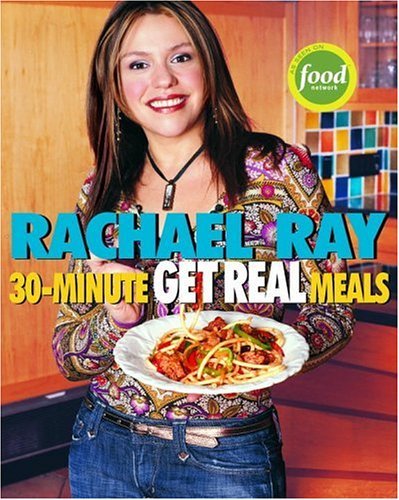
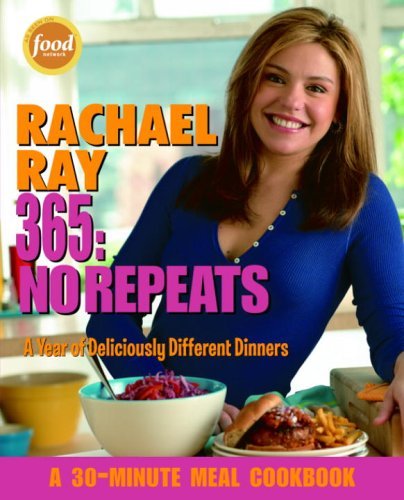
I don't watch much TV but it's always on, and usually on the Food Network. I really enjoy Rachael Ray's Thirty Minute Meals, and she has a line of cookbooks to go along with the show. I got to play with two of them: Rachael Ray's 30-Minute Get Real Meals: Eat Healthy Without Going to Extremes and her latest, Rachael Ray 365: No Repeats--A Year of Deliciously Different Dinners (A 30-Minute Meal Cookbook).
Lots of great recipes - but I must admit, while I really believe Rachael can get these done in thirty minutes, I usually can't. I don't chop as fast as she does, and her ingredients are always right in the front of the pantry or refrigerator - I can spent ten minutes looking for the fresh Italian parsley that somehow got buried in the produce crisper drawer. But even if it takes me a little longer, I don't mind because they really are easy, and always delicious.
And I'm not the only one in my house who's a fan - my husband is enamored of Ms. 
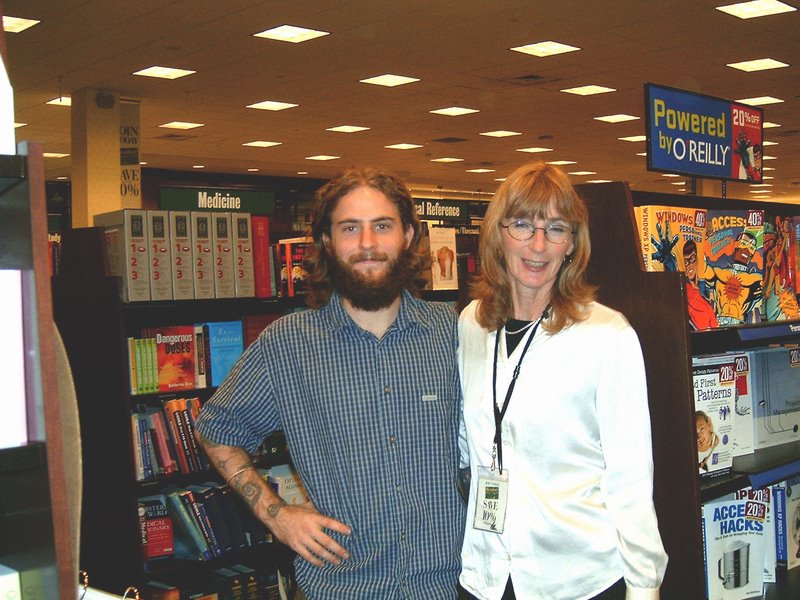
The signing was scheduled for 6:00 pm. Rachael had another signing earlier in the day across town, and the day before, and so forth, so I'm sure she must have been exhausted. I called the store around 1:15 and spoke to a bookseller I knew from my Borders days. She told me to get my butt up there, that there were already about 50 people lined up. The publicist dictated no more than 225 people were to have books signed, not an unreasonable number.
B&N decided to start giving out wristbands to the first 225 people in line at 3:00. Not 6:00 as advertised. Although to be fair, apparently in their ad in the local newspaper there was some fine print about the 3:00 time, but most people did not know about it, including some that had been in the store early in the morning purchasing several copies of Rachael's cookbooks to be signed later in the day. They were not informed about the 3:00 wristband thing and they were angry. They were also not informed that she would only sign 3 books per person, and only the three books that had been released by her new publisher - her older cookbooks from her previous publisher could not be signed.
I tried to pull some strings and have my friend secure me a wristband, but nothing doing - I was told that no staff members could reserve places for friends, and that even staff were not guaranteed they would get their books signed. So I headed up there, figured I'd get my wristband, head back home, pick up my daughter from school, get my husband, and go back to get the books signed. But after waiting in line for an hour and a half for my wristband, I saw all the people that had been waiting ahead of me were now lined up outside the store. The wristbands were not numbered so another line was necessary. Well, actually they were numbered but they weren't using the numbers. And imprinted on the wristband was an ominous warning that having one didn't guarantee anything.
There were some lovely employees working that day
I got in the new line, called a friend to pick up my daughter, called my husband so he could leave work early, and they met up with me a couple of hours later. I met some lovely people in line, two teachers from NY, a canine cop (well, the human half of the partnership) and some old Borders friends who had jumped ship to B&N. After waiting for half an hour outside, B&N employees realized that there were people waiting in the line who didn't have wristbands and they threw them out. Then they let the rest of us into the store to wait.
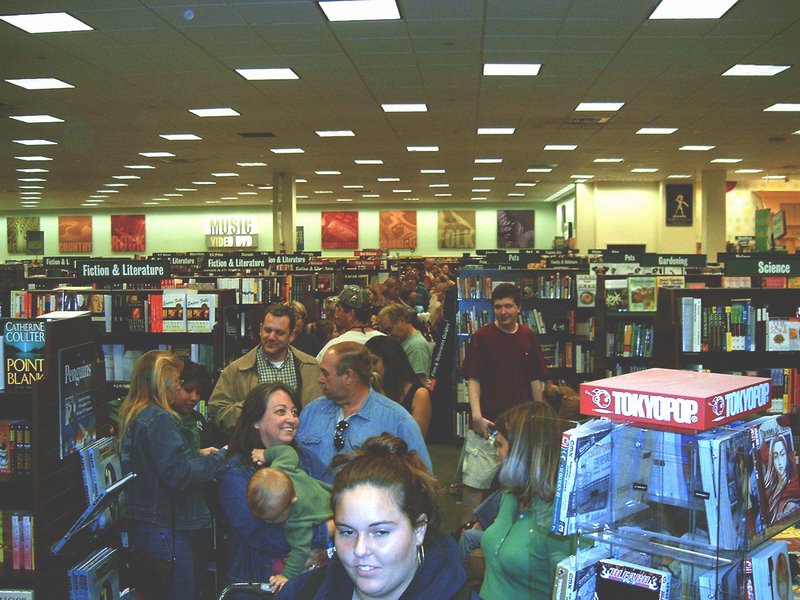
A few friends tried to get in around 4, but were turned away at the door. They let in anyone who said they just wanted to shop, and my friend JP managed a glimpse of Rachael for his trouble. Bev said she couldn't get near the mysteries because of the line - it snaked up and down most of the rows of books, making shopping an impossibility except for the strongest willed reader.
When Rachael finally appeared, the crowd let out a roar, there were people screaming "I love you Rachael!" and general madness ensued. Protected only by a handful of booksellers, it had to be a little scary for her to run the gauntlet across the store to where they had a table set up for her signing. Most people behaved, but there were a few incidents, including some booksellers who were threatened with physical violence. One confided that perhaps a real security force might have been more appropriate than just some very non-threatening booksellers.
After waiting for five hours, we finally approached the front part of the line, nirvana, where an overtaxed, overwhelmed B&N employee informed me that I was only allowed to bring one person with me. My husband immediately banished our 13 year old daughter , who acted very nonchalant about the whole thing, but I was annoyed. I told the woman that I had spoken to Lauren (the B&N community relations person running this nightmare) and that she had said it was okay. Defeated, she let the three of us through. By the way, I lied - I spoke to Lauren but not about that. The things mothers will do for their children. Yech.
As we got closer to the promised land, we were informed that only staff members were allowed to take photos - they would use our camera and take one picture. No posed shots. No one allowed behind the table with Rachael - they had to lean in across the table while Rachael signed their book. She would only personalize her newest cookbook, and just sign the other approved titles.
Ahead of us in line was a woman with her young daughter. Paige was probably about 9 years old. She clutched an obviously well used but unapproved-for-signing Rachael Ray's 30-Minute Meals for Kids: Cooking Rocks! cookbook and chattered excitedly about Rachael. When it was finally her turn, Rachael invited her behind the table, explained who Isaboo is (her new puppy) and to her credit, not only looked through the cookbook with the little girl, she signed it, personalized it "Paige Rocks!" and made that little girl feel very special, and very happy. It was lovely to see after such a hectic afternoon.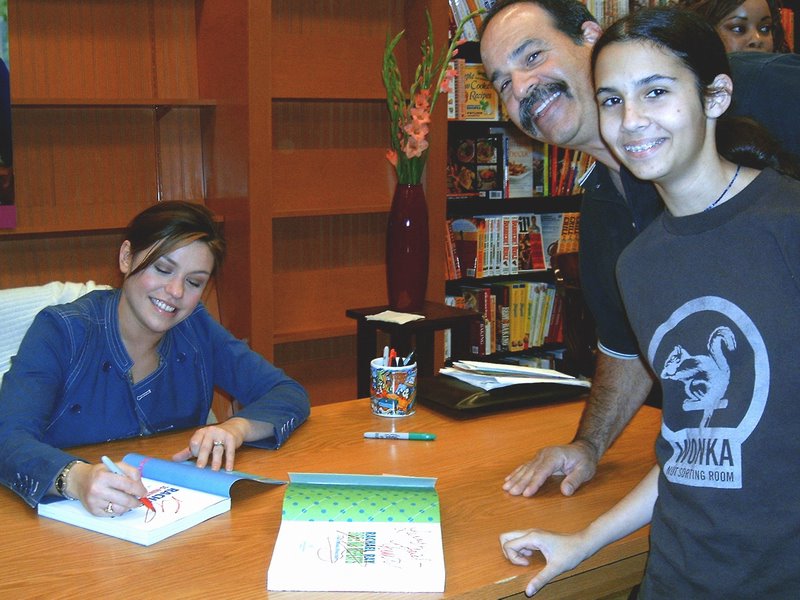
Was it worth it? For the smile on my husband's face, yes. And the cookbooks are ...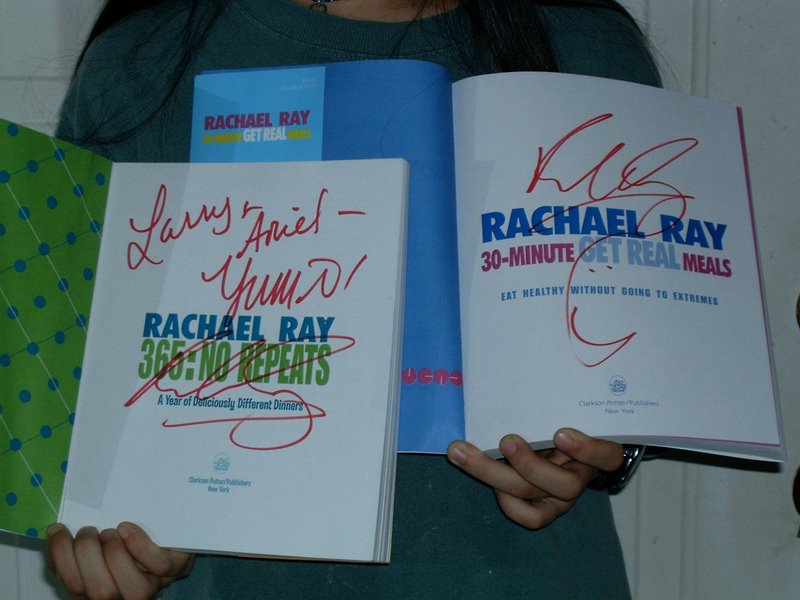
Friday, December 09, 2005
Fiction Writer Reaches Readers by E-Mail
Eugene, Oregon
November 23, 2005
Bruce Holland Rogers, a multiple award-winning writer, has been taking his work directly to his readers for nearly four years. Three times a month, he sends new short-short stories by e-mail to over 600 paying subscribers in some 60 countries.
"Writers complain that conglomerate ownership of media makes it harder for anyone but the bestsellers to find an audience," Rogers says. "In fact, there has never been a better time for writers to build their audiences, starting small and gradually expanding."
The key to this literary distribution model is the Internet. Sending stories by e-mail costs very little, and sending a story to South Africa costs no more than sending it across town. Also essential, according to Rogers, is micro-payments. "An electronic payment service lets me process small subscription fees from other countries without bank fees for currency conversions." The service that Rogers uses is PayPal.
The subscription stories are very short, ranging from 200 words to two-thousand. Rogers believes that literary brevity suits the busy lives of his readers. "Anything longer, you wouldn't want to read as an e-mail," he says. Indeed, some readers find that they don't want to be reading for pleasure at the computer at all. "I enjoyed the stories," wrote one non-renewing subscriber, "but my inbox is choked." Another noted, "When I'm reading e-mail, I'm just not ready for fiction; it's a bit jarring."
Receiving entertaining e-mail at work can have other drawbacks. "With this one, you not only show your writing skills, you demonstrate that you are a comic genius," wrote one Seattle subscriber. "Good thing I moved into an office from a [cubicle]. If I laughed any louder, it would have hurt."
At five U.S. dollars a year, the subscriptions aren't going to allow Rogers to retire any time soon. "Short fiction doesn't pay very well in any case, so the money is something of a side issue," he admits. "The great thing about running this service is that I have direct contact with my readers. I still publish in traditional magazines and anthologies, but most of my fan mail comes from e-mail subscribers."
The service has doubled in each year of operation, so the money may not be a side issue forever. Most new subscribers join because of word-of-mouth recommendations from existing subscribers, or because they have been given gift subscriptions.
Over 600 subscribers now pay $5 a year for the stories. Sample stories by Bruce Holland Rogers can be found at http://www.shortshortshort.com. For more about Bruce Holland Rogers, see his web page at http://www.sff.net/people/bruce/.
Wednesday, December 07, 2005
Publishers Assess the Fall Season's Winners and Losers
By EDWARD WYATT
When Rodale Books signed Martha Stewart to a $2 million contract in the summer, it was betting that the queen of domesticity was back and as popular as ever, unstained by the stock-trading scandal that sent her to prison for five months.
It appears to have been a bad bet.
"The Martha Rules: 10 Essentials for Achieving Success as You Start, Build, or Manage a Business" has sold roughly 37,000 copies since its publication in early October, according to Nielsen BookScan. That's a major disappointment for a celebrity author like Ms. Stewart, and it leaves Rodale, which planned an initial printing of 500,000, with a financial loss on the book, at least so far.
Ms. Stewart's book is not the only one that has fallen short of publishers' expectations in 2005. Indeed, a look back at the fall publishing season, when publishers typically release their biggest books hoping to cash in on the holidays, reveals that the publishing industry is still struggling.
There are, of course, surprise best sellers: Joan Didion's "Year of Magical Thinking," published by Alfred A. Knopf, has sold more than 200,000 copies, according to the publisher, making it her best-selling book ever in hardcover. And "The Silver Spoon," a 1,200-page cookbook from Phaidon Press, a company better known for lavish books about art and architecture, is such a hit that some stores and online sellers are sold out of it until after Christmas.
Still, the Association of American Publishers reported last month that sales of adult hardcover books, sluggish for several years, have fallen by 2 percent so far this year. Similarly, the American Booksellers Association, a trade group representing bookstores, said that overall bookstore sales in the first nine months of 2005 declined 2 percent from a year ago.
Some much-anticipated novels have fallen short this fall. Salman Rushdie's "Shalimar the Clown" sold just 26,000 copies, according to BookScan, and "Wickett's Remedy," Myla Goldberg's follow-up to her heralded 2000 novel, "Bee Season," sold only 9,000.
BookScan records sales at bookstores, online booksellers and some mass merchandisers, which together typically account for 70 to 80 percent of a new hardcover's sales, meaning that actual sales of a new book are usually about one-third higher than the BookScan number. For books like "The Silver Spoon," which has sold thousands of copies through nontraditional outlets like cooking Web sites and specialty stores, sales could be double the BookScan number.
"If there's any theme to the year," said David Rosenthal, the publisher of Simon & Schuster's flagship imprint, "it's that people only want to read the truth." So while nonfiction sales are generally good, he said, fiction sales are best defined, in Mr. Rosenthal's usual plain-spoken manner, by an expletive.
This continues a trend that began at least four years ago, when, after 9/11, a large segment of readers seemed to give up on fiction, flocking instead to nonfiction works, first about 9/11 itself, then about Islam, the Middle East, Iraq and United States politics.
Two books that are selling well ahead of expectations this fall fit that mold: "Our Endangered Values," by Jimmy Carter, an assessment of the country's current political and religious debates, published by Simon & Schuster; and "A Man Without a Country," by Kurt Vonnegut, a series of essays leavened with the author's trademark humanist view, published by Seven Stories Press.
"Both of these men have a moral profile" that is helping their books, said Jim Harris, an owner of Prairie Lights Books in Iowa City. He added that the authors' "authoritative voices" have attracted buyers who do not place themselves at one political extreme or the other.
Mr. Carter's book has sold nearly all of the 310,000 copies in its initial printing, said Mr. Rosenthal of Simon & Schuster, and the company has since pushed the number in circulation to 675,000. Mr. Carter has had best-selling books before, most notably his 2001 memoir, "An Hour Before Daylight," which sold 300,000 hardcover copies.
Mr. Vonnegut, too, is no stranger to the best-seller lists, but he has more often arrived there with works of fiction. His latest book, his first best seller since the 1997 novel "Timequake," has sold nearly 100,000 copies, according to the publisher, and spent six weeks on the New York Times best-seller list. It is also the first entry on the Times list for Seven Stories Press, an independent publisher that in 2000 published a previous book of essays by Mr. Vonnegut, "God Bless You, Dr. Kevorkian."
Gerry Donaghy, an inventory supervisor at Powell's Books in Portland, Ore., said Mr. Vonnegut's book had attracted buyers because, at a time when political dialogue is increasingly polarized, "he is not as strident as Michael Moore or Al Franken." Besides, Mr. Donaghy added, while many new hardcover books are priced as high as $35, Mr. Vonnegut's has a relatively low list price of $23.95, and "many people are buying multiple copies to give as gifts."
Publishing, it is said, is one of the few businesses where a company makes bigger headlines for how much money it spends than for how much money it takes in. Little, Brown & Company got a fair amount of press when it paid $2 million for "The Historian," the first novel by Elizabeth Kostova, which retells the Dracula legend. In this case, the wager seems to have paid off. Booksellers lined up to have Ms. Kostova sign their advance copies at Book Expo America, the industry's annual summer convention, and BookScan has recorded sales of more than 485,000 copies.
Another big surprise is a Civil War saga that weaves intimate portraits of historical figures with real-life events. It is not, however, E. L. Doctorow's much-anticipated novel, "The March," published by Random House. It is "The Widow of the South," the first novel by Robert Hicks, published by Warner Books. According to BookScan, each book has sold just over 100,000 copies.
Jamie Raab, the publisher of Warner Books, which like Little, Brown is part of the Time Warner Book Group, credits much of the success of both "Widow of the South" and "The Historian" to a series of dinners that the publishers arranged with booksellers around the country just as early copies of the books were being shipped to stores. Such early meetings between authors and bookstore representatives have become as important to a book's marketing as the traditional author tour and book signing after a book is released, Ms. Raab said.
Many booksellers might have welcomed a similar chance to meet Ms. Stewart, but consumers exhibited relatively little interest in her book on how to build a business.
"We only sold three copies, and we had it prominently displayed," said Greg Smith, a bookseller at Page One Bookstore in Albuquerque. "It's not that the book is not being promoted, but I don't think it's the kind of thing people associate with her."
"The Martha Rules" spent just one week on The Times's five-place advice, how-to and miscellaneous best-seller list before dropping off. But Liz Perl, the publisher of Rodale Books, said the company had an "innovative and comprehensive plan to market and promote the book through the holiday season and into next year."
Readers have not lost all of their appetite for Ms. Stewart, however. Mr. Smith said Ms. Stewart's latest cookbook, "Martha Stewart's Baking Handbook," published by Clarkson Potter, a unit of Random House Inc., was selling briskly.
Tuesday, December 06, 2005
Food critic Coren wins British bad sex award
Friday December 2, 2005
Guardian Unlimited
It was the shower hose that clinched it. A passage from his debut novel, Winkler, describing a male character's genitalia as "leaping around like a shower dropped in an empty bath" won the 13th annual Literary Review award for Bad Sex in Fiction for food-critic-turned-novelist Giles Coren last night.
Coren beat off heavyweight competition for the prize with an unpunctuated 138-word description of coitus, followed by the two-word sentence, "like Zorro". Salman Rushdie, Gabriel Garcia Marquez, Paul Theroux and John Updike were among the 11 contenders for this year's prize, with Rushdie, Theroux and Updike all boasting previous nominations.
The prize was launched in 1993 by the late editor of the Literary Review, Auberon Waugh, in an attempt to "draw attention to the crude, tasteless, often perfunctory use of redundant passages of sexual description in the modern novel". Winners of the award receive a statuette and a bottle of champagne - but only if they show up. While most do, last year's champion Tom Wolfe boycotted the ceremony, claiming that judges had failed to recognise the irony in a passage from his novel I Am Charlotte Simmons beginning "slither slither slither slither went the tongue".
Coren, however, seemed delighted with his win, and accepted his prize with aplomb from the Turner Prize-winning artist, Grayson Perry. Of the other shortlisted passages, he said "I wish I'd written them all."
Sunday, December 04, 2005
WASHINGTON POST - Editors' Choices
The Ten Best Books of the Year
Sunday, December 4, 2005
Fiction
The History of Love, by Nicole Krauss
March, by Geraldine Brooks
The March, by E.L. Doctorow
On Beauty, by Zadie Smith
Shalimar the Clown, by Salman Rushdie
Nonfiction
The Assassins' Gate, by George Packer
Bury the Chains, by Adam Hochschild
Melville, by Andrew Delbanco
Night Draws Near, by Anthony Shadid
Shake Hands With the Devil, by Romo Dallaire
Saturday, December 03, 2005
New York Times: The 10 Best Books of 2005
Fiction
KAFKA ON THE SHORE
By Haruki Murakami.
Alfred A. Knopf, $25.95.
This graceful and dreamily cerebral novel, translated from the Japanese by Philip Gabriel, tells two stories - that of a boy fleeing an Oedipal prophecy, and that of a witless old man who can talk to cats - and is the work of a powerfully confident writer.
ON BEAUTY
By Zadie Smith.
Penguin Press, $25.95.
In her vibrant new book, a cultural-politics novel set in a place like Harvard, the author of ''White Teeth'' brings everything to the table: a crisp intellect, a lovely wit and enormous sympathy for the men, women and children who populate her story.
PREP
By Curtis Sittenfeld.
Random House, $21.95. Paper, $13.95.
This calm and memorably incisive first novel, about a scholarship girl who heads east to attend an elite prep school, casts an unshakable spell and has plenty to say about class, sex and character.
SATURDAY
By Ian McEwan.
Nan A. Talese/Doubleday, $26.
As bracing and as carefully constructed as anything McEwan has written, this astringent novel traces a day in the life of an English neurosurgeon who comes face to face with senseless violence.
VERONICA
By Mary Gaitskill.
Pantheon Books, $23.
This mesmerizingly dark novel from the author of ''Bad Behavior'' and ''Two Girls, Fat and Thin'' is narrated by a former Paris model who is now sick and poor; her ruminations on beauty and cruelty have clarity and an uncanny bite.
Nonfiction
THE ASSASSINS' GATE
America in Iraq
By George Packer.
Farrar, Straus & Giroux, $26.
A comprehensive look at the largest foreign policy gamble in a generation, by a New Yorker reporter who traces the full arc of the war, from the pre-invasion debate through the action on the ground.
DE KOONING
An American Master
By Mark Stevens and Annalyn Swan.
Alfred A. Knopf, $35.
A sweeping biography, impressively researched and absorbingly written, of the charismatic immigrant who stood at the vortex of mid-20th-century American art.
THE LOST PAINTING
By Jonathan Harr.
Random House, $24.95.
This gripping narrative, populated by a beguiling cast of scholars, historians, art restorers and aging nobles, records the search for Caravaggio's ''Taking of Christ,'' painted in 1602 and rediscovered in 1990.
POSTWAR
A History of Europe Since 1945
By Tony Judt.
The Penguin Press, $39.95.
Judt's massive, learned, brilliantly detailed account of Europe's recovery from the wreckage of World War II presents a whole continent in panorama even as it sets off detonations of insight on almost every page.
THE YEAR OF MAGICAL THINKING
By Joan Didion.
Alfred A. Knopf, $23.95.
A prose master's harrowing yet exhilarating memoir of a year riven by sudden death (her husband's) and mortal illness (their only child's).
Tuesday, November 29, 2005
Chick lit for Christians
For young Christian women, these often steamy books that combine spunk with spirituality have become hot sellers.
BY JESSICA HEASLEY
Columbia News Service
It's called chick lit -- tales of bed-hopping alcoholics and foul-mouthed fashionistas made popular by such best-selling novels as "Bridget Jones's Diary."
At lunch one day, Anne Dayton and May Vanderbilt, two single career women in their mid-20s, joked that there should be chick lit for Christians like them, whose faith might be strong but whose single-girl imperfections loom just as large.
"Everyone thought it was a hilarious idea," Dayton said. "Chick lit is about sex and dating and shopping, and Christians don't do those things." (Well, one of those things.)
Six months later, the two church-going women (a Presbyterian and an Episcopalian), both living and working in New York, started to write "Emily Ever After." It's the story of a small-town single girl struggling to balance her religious values with her big-city life.
It's also the biblical story of Esther, but with designer handbags and cocktails. And it was one of the first Christian chick lit books to ignite a hot market of similar big sellers.
For young practicing Christian women, these tales are a welcome dose of 21st-century attitude. But with their PG-rated flirtations, and heroines who combine spunk with spirituality, the books aren't just selling in Christian bookstores. They're titillating the heathens who shop at Target, too.
"I think a lot of non-Christians assume Christian chick lit is just full of preachy messages," said Rebecca Fong, 43, a stay-at-home mom and secular reader from Loomis, Calif.
"I'm finding that most of it is just straightforward storytelling and writing that doesn't contain any shocking lifestyles or deviant politics."
Not surprisingly, young Christian women are the books' biggest fans. Alicia Manley Lawver, 29, a stay-at-home mom in Tacoma, Wash., and a Lutheran, was a huge fan of mainstream chick lit. Then she discovered her first Christian version, a novel with a provocative cover image of a pair of women's legs shod in hot pink slippers. Now she's hooked.
"I can live vicariously through these characters," Lawver said. "And it's stuff I can actually share with my mother."
What makes it Christian?
More than anything else, it's the heroines' cardinal rule: "Everything in a secular book is in a Christian book, just in a different order," said Judy Baer, author of "The Whitney Chronicles," a popular example of the form.
"In secular books characters meet, have sex, then try and be friends. In Christian books, they meet, become friends, get married, then have sex."
Christian romance novels have been around since the 1970s, most of them historical "prairie" epics of rural or small-town life. Books like "Emily Ever After," on the other hand, are thick with modern-day chick lit dramas -- dating perils, shoe yearnings, big-city independence -- all recounted in a witty voice that makes the reader feel as if she's chatting with her best friend.
More than 3 million Christian fiction books were sold in 2004, a 9 percent jump from 2003, according to the Evangelical Christian Booksellers Association.
Sales of Christian romance novels, including Christian chick lit, have doubled since 1995. In part that's because these books are sidling up next to mainstream secular chick lit in Barnes & Noble and other mass-market stores.
The popularity of the books in Wichita stores varies, according to managers.
"The whole religious fiction section is just sort of exploding right now," said Brad Purkey, manager of the Barnes & Noble on North Rock Road. "We just keep expanding and expanding and expanding."
In that expansion, Purkey said he's noticed more of the Christian chick lit books coming into the store -- so the demand is there. And over the past three or four months, he said, he's noticed a few people coming in asking for the books.
Sarah Bagby, managing partner of Watermark Books & Cafe, 4701 E. Douglas, said the bookstore doesn't carry the books, but workers are ordering them maybe twice a week at customers' requests.
"That's not something we were doing two years ago," she said.
Richard Wilson, manager of Family Christian Stores at 21st and Maize Road, said he hasn't noticed a great demand for the books, though the store carries some of them, including "Emily Ever After."
"We just don't have a big following for that," he said.
Not everything goes
Just because the books have been liberated from religious bookstores, however, does not mean that anything goes.
Bridget Jones counts "units" of alcohol consumption, profanity and sexual conquests like an unholy trinity. Christian heroines generally don't drink or curse. They may, however, be born again or have had premarital sex. Many also admit to feelings of desire.
"Colorful pasts are OK," said Joan Marlow Golan, senior editor for Harlequin's Christian fiction line. But a heroine of faith "struggles with living up to her Christian values."
Some evangelical Christian booksellers and publishers have been slow to embrace the genre. The author of the 2005 novel "Dreaming in Black and White" is Laura Jensen Walker, a nondenominational Christian.
When she first tried to get her book published, she heard criticism of Phoebe, her protagonist. Phoebe obsesses about her weight, dabbles in online dating and pokes fun at Christian singles groups in a slightly wicked tone that is more like "The Devil Wears Prada" than "Song of Solomon." One of Walker's prospective publishers said Phoebe wasn't a proper role model for young religious girls.
And Walker agreed. "Come on. There's not a deep message here," she said. "It's fiction. It's chick lit. It's supposed to be fun."
Walker believes many people have a stereotype of observant Christians that's one-dimensional.
"Christians are not all judgmental. We're real, we struggle, just like anyone else. And we're funny."
"Emily Ever After" authors Dayton and Vanderbilt received some angry reviews, too, for their heroine's "unChristian-like" behavior when, in the book, Emily drank too much and vomited.
In "What a Girl Wants," Kristin Billerbeck's 1999 novel, her heroine shopped for thong underwear with a married friend. That sparked a heated letter-writing campaign from outraged readers.
Changing attitudes
Attitudes have changed to at least some degree since then, said Ami McConnell, acquisitions and development editor for Westbow, Billerbeck's publisher. "Now there are a lot less 'We can'ts' and a lot more 'We cans,' " she said.
Dayton and Vanderbilt are getting ready to promote their second book, "Consider Lily." It's a modern retelling of Samson and Delilah set in San Francisco. With the book, the authors are edging closer to the mainstream, particularly in a bikini scene that may raise a few eyebrows.
"Lily has the proverbial angel on one shoulder and devil on the other," Vanderbilt said. "She has to decide whether to wear the bikini or not. And it's hard, because God gave her a hot body."
--------------------------------------------------------------------------------
Contributing: Joe Rodriguez of The Eagle.
Friday, November 25, 2005
MIAMI BOOK FAIR 2005
This past Sunday I had the pleasure of attending the Miami Book Fair. This was the first year they charged admission and I must admit I didn't enjoy paying $5 to get in. I watched much of it on TV on Saturday and with the lousy weather - it rained off and on all day - and with most of south Florida still reeling from the effects of Hurricane Wilma, the crowds were very light. Sunday was hot and humid and seemed a bit busier, at least according to Joanne Sinchuk, owner of the fabulous Murder on the Beach bookstore. Joanne has a tent every year at the street fair and schedules author signings every hour during the event. I met Nancy J. Cohen, author of the Florida fun Bad Hair Day mystery series, and Lynn Sholes & Joe Moore, authors of The Grail Conspiracy.
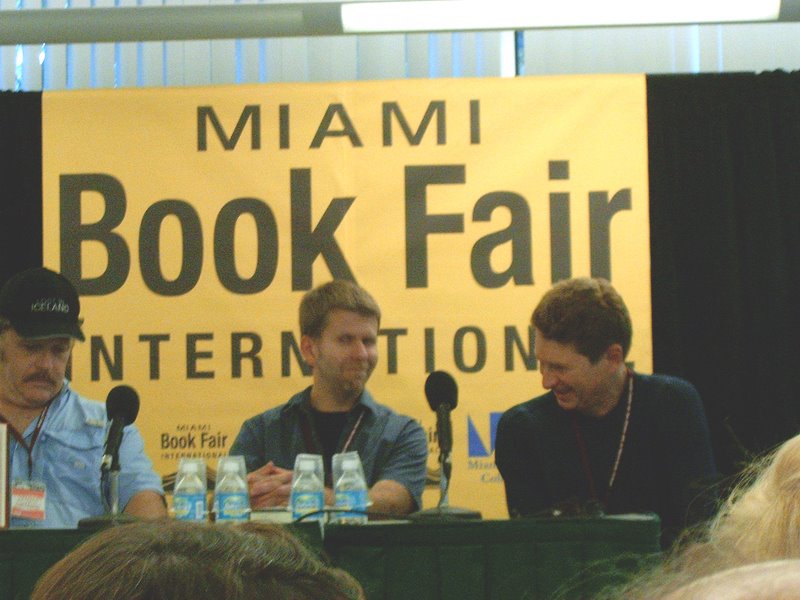
As always, the book fair radiates most of its energy on the nonfiction authors, which may have something to do with the fact that those events are televised live on Book TV (CSpan 2) and the serious fiction authors; for the most part, the mystery authors are relegated to smaller, less conspicuous venues. I'm posting some pictures that I took despite their quality, or lack thereof. Photography is obviously not one of my talents.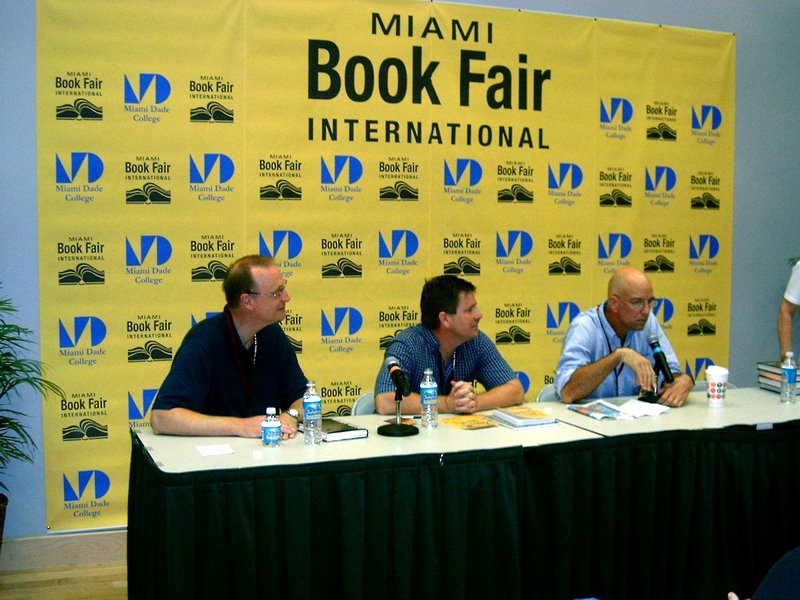
Jonathon King talked about how he was finally able to quit his day job - crime writing for the Sun Sentinel - to focus on fictional crime writing. His next book, EYE OF VENGEANCE is a stand alone, a departure from his wonderful Max Freeman series, and it sounded really interesting. Unfortunately, we have quite a wait - it doesn't come out until next May.
I'd never seen Reed Arvin before but I really enjoyed his book, THE LAST GOODBYE, so I was happy to finally get to meet him. He's a very interesting guy. He grew up on a working cattle ranch in Kansas, the son of two lawyers and his mother went on to become the first blind female judge in the country. He talked about having a blind mother and how it really forced him to articulate everything because she couldn't see his face. His newest book, BLOOD OF ANGELS, has received excellent reviews and I'm looking forward to reading it.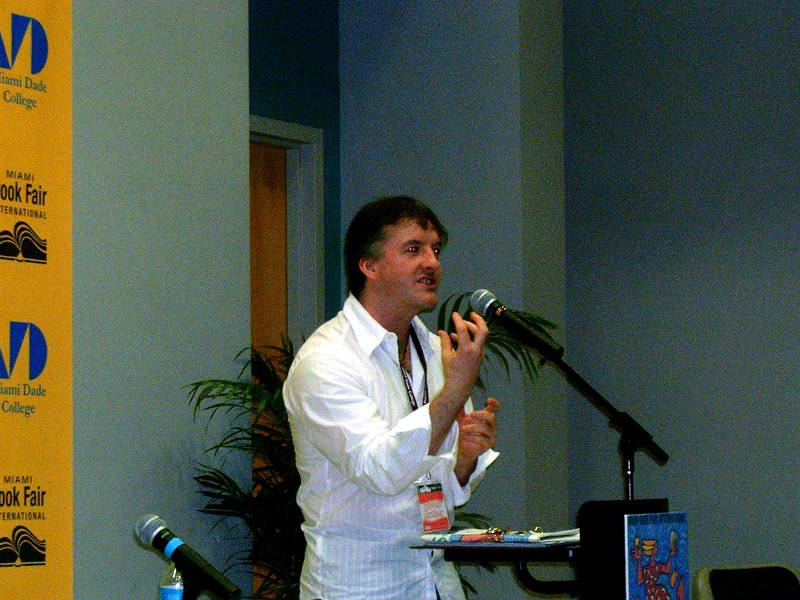
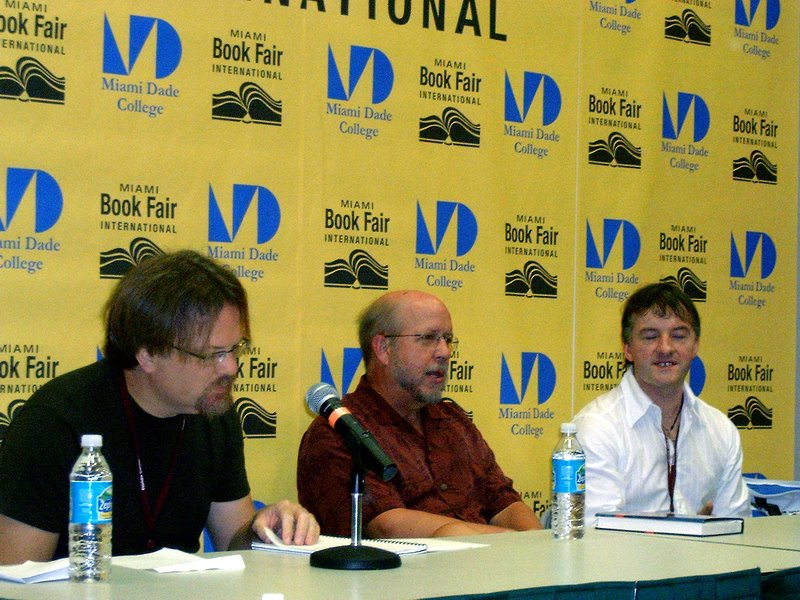
After some wandering through the street fair, which every year seems to be getting more and more Hispanic, and offer fewer and fewer books for sale, it was time for the afternoon panels. First up was another "Mystery Reading", this time with Paul Levine, Dylan Schaffer and Jeff Lindsey.
Paul Levine was introduced by his former law partner from Miami, and some old friends came to see him too - Edna Buchanan, Ridley Pearson and Christine Kling. He hasn't written a novel in several years (see my interview with him on this blog somewhere) but his newest, SOLOMON VS. LORD, is just terrific.
Dylan Schaffer spoke next, and I must admit he was not at all what I expected. His first book, MISDEMEANOR MAN, introduced his main character, a public defender with no ambition - he's totally happy dealing with the flashers and not with the murderers because it frees up more time for his true passion: playing with his Barry Manilow cover band. It was a really fun read providing you don't mind having Manilow songs stuck in your head for the duration! The sequel just came out, I WRITE THE WRONGS, and I'm really looking forward to reading it. My point being that I guess I expected Dylan to be somewhat like his character - bad assumption on my part. In reality, he is a serious lawyer who handles appellate work for cases dealing with the likes of John Gotti (he claims to be the only person in America who listened to all 400+ hours of the tapes that convicted Gotti) and said he will probably be handling the upcoming Scott Peterson case.
Jeff Lindsey, the only non-lawyer on the panel, spoke about his loveable serial killer in his newest adventure, DEARLY DEVOTED DEXTER. Showtime is trying to turn it into a series and is filming the pilot in Miami. It starts Michael C. Hall (Six Feet Under) as Dexter - but still, I can't imagine watching it. I don't mind reading serial killer books but I won't watch that sort of thing.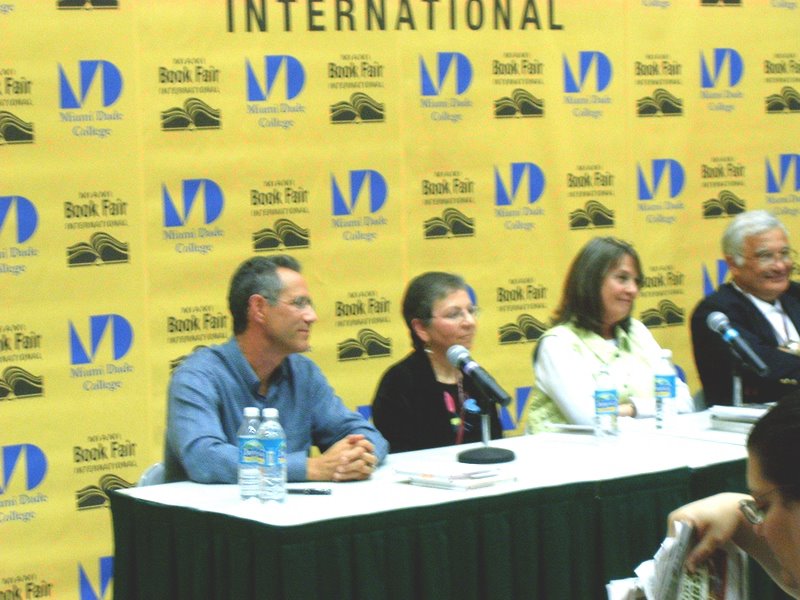
I headed across the fair to the main auditorium where Dave Barry & Ridley Pearson were speaking. I got there a few minutes after they started and was surprised to actually find seats available, albeit wayyyyy in the back of the room. I took a picture but I was so far away it is just a blurry shot of two guys with guitars so I'm not even bothering to post it. They were really funny, and talked about living in Florida, how they became friends, the beginnings of the Rock Bottom Remainders and the books they are writing together - children's books, PETER AND THE STAR CATCHERS and the sequel, PETER AND THE SHADOW THIEVES, which will be coming out in July. Then they strapped on their guitars and played a new song Dave said he wrote recently, entitled "Hurricane Blues". They were great and it was a wonderful presentation.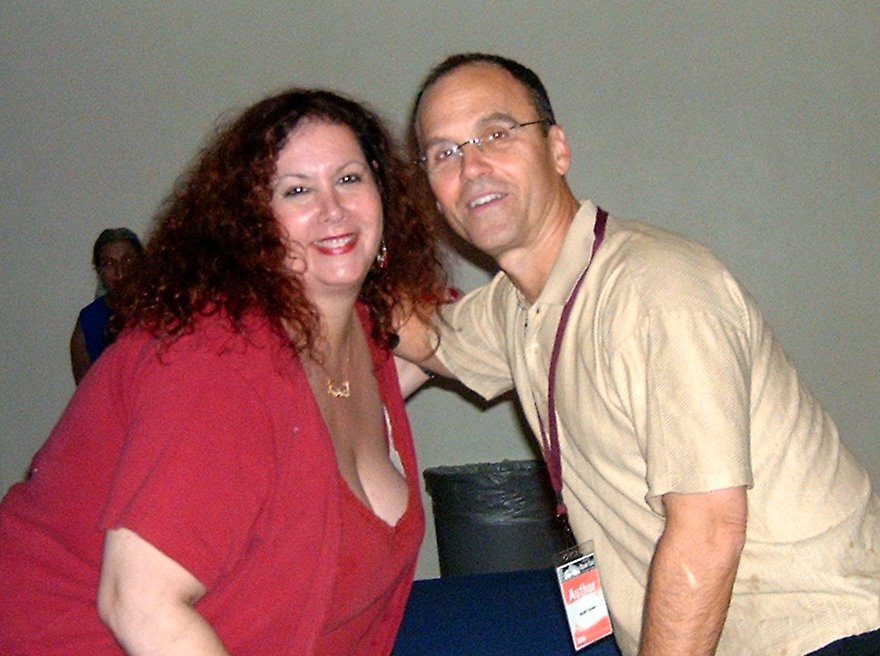
Can't wait 'til next year.
Monday, November 21, 2005
The sorceress' apprentice
Steve Kloves has adapted four of J.K. Rowling's "Harry Potter" tomes, taking them from page to screen. The feat, he found, required more than a little wizardry of his own.
By Mary McNamara
Times Staff Writer
November 20, 2005
ONCE upon a time, when children knew nothing about publishing dates and the most famous wizard was Merlin, writer-director Steve Kloves was asked if he had any interest in adapting a children's book that was very popular in the United Kingdom.
He was torn — he had just finished adapting the dark literary comedy "Wonder Boys," which had been fun. But Kloves, who wrote and directed "The Fabulous Baker Boys" and "Flesh and Bone" and who wrote "Racing With the Moon," wanted to get back to directing. And his own material. Still, he liked this children's book, especially the main character, and was assured by friends with preteens that the movie would be greeted with much enthusiasm. So he said yes.
Four months later, Harry Potter landed on the cover of Time and Kloves found himself on a franchise train that has run with all the speed and pell-mell precision of the Hogwarts Express through four movies, three directors and what will undoubtedly turn out to be more than $3 billion in box office returns just a little more than halfway through the projected seven-book, seven-film series.
And to hear Kloves tell it, it's been wonderful, inspiring, satisfying and all the other adjectives so often evoked by those involved in good moviemaking.
But it's also been six years, man, and that's a long time. When he began working on the first book, and while in the flush of early romance, Kloves said he would adapt all of them, if J.K. Rowling and Warner Bros. would let him. He felt lucky, privileged, blessed. And in a town full of starving, scrabbling screenwriters, many of whom would have gladly put the Imperius Curse on Kloves for a shot at his gig, he was. But work is work, which is why they pay you for it.
For six years, Kloves has left his own kids for weeks at a time to care for his magically challenged foster children in the U.K., put all his other projects on the backburner to take care of Harry. For six years, he has thrashed around in a world created by another writer, teasing movies from complicated books of increasing girth and violence then turning the scripts over to another fellow to direct.
" 'Harry Potter' plots are so torturous to convey to the screen," he says. "Jo has created such a vivid world that you don't want to leave anything out. But you have to. And it's hard." So after spending almost two years on "Harry Potter and the Goblet of Fire," which opened Friday, Steve Kloves did The Unthinkable.
He said "no" to Harry Potter.
"[Goblet of Fire] was very difficult because it was my favorite," Kloves says. "Which always means you have to proceed carefully. And in it the wizard world gets larger — which is great, I loved the way Jo stretched things out. But I still had the same canvas. It couldn't be a four-hour movie." Scheduling issues also interfered — director Mike Newell wasn't available in the beginning stages, which made things a bit difficult. Kloves loved working with Newell, who he found "just as invested in the characters as I am," but still there were many changes even after the final script had been approved.
"Last Christmas, Mike looked at footage and decided he wanted to emphasize certain plotlines," Kloves says. "Not a lot of work, but very meticulous throughout the whole script. I was still writing lines in June and July."
Although Kloves has certainly made plenty of money from the four films, he insists that was never a consideration. "It sounds arrogant," he says, "but I have always sold everything I've written. And in the time it took me to write one 'Harry' script, I could have written two, even three of my own. So … ," he trails off with a you-do-the-math shrug.
In fact, for more than a year he has been trying to write a screenplay for Mark Haddon's "The Curious Incident of the Dog in the Night-time," another project he agreed to do 15 minutes before it became an official Hot Book. And he could never find the time to really get rolling.
"Every time I would get started," he says, "Harry would come knocking." So when it came time to sign on for No. 5, "Harry Potter and the Order of the Phoenix," which will be directed by David Yates, Kloves passed the quill to Michael Goldenberg ("Peter Pan," "Contact").
But then as so often happens after these break-ups, regret set in. His children, now 10 and 13, were not as thrilled that Daddy would be around more as Kloves thought they would be. "I was surprised at how disappointed they were that I wasn't doing No. 5," he says. "They never said, but I guess they thought it was cool that I wrote the movies."
When Kloves read No. 6, "Harry Potter and the Half-Blood Prince," he found himself regretting his decision even more. He mentioned this to Jeff Robinov, production president at Warner Bros., who instantly welcomed him back — because everyone is happy with the work Kloves had done and also because this means Warner Bros. can have two writers working almost simultaneously. Goldberg started on "Phoenix" last year — "Right about now he's realizing he'll be working on it another year," Kloves says with a small smile — and Kloves will soon start "The Half-Blood Prince." "They want to film the two as close to back-to-back as they can," Kloves says. "Because the kids are really starting to grow up. And if we lose the kids, if they have to recast for six or seven, I think we will lose the movies. That's what makes them magic."
Manner belies his mission
THERE is nothing in Kloves' appearance or manner that would suggest he has spent the last six years of his life with at least one foot in a world of wizards, Death Eaters and house elves. But you might be able to pick him out of a Guess Which One's the Screenwriter lineup. If you crossed the guy in the Apple computer billboard with the guy in the Gap billboard, you would have Kloves' wavy brown hair, T-shirt and jeans, intense look and sudden, nice smile. The man sitting against the wall at the party, glancing at his watch.
As much as he loves the characters and the wizarding world — Moaning Myrtle and Quidditch and Bertie Bott's Every Flavor Beans — as much as he loves being part of a movie that requires location work in castles and eerie forests, he is a film industry professional, well-versed in the nuts and bolts of filmmaking. What he does is much more craft than magic.
Few writers have found themselves as emotionally embroiled in another writer's project as Kloves has — Entertainment Weekly recently identified him as "franchise scribe Steve Kloves," which is probably not what he dreamed of becoming in high school. And few directors have worked as closely on a project without actually directing it.
"I don't spend a lot of time on the set," he says. "I never have. Because I think as a director myself I would be too tempted to get in there and mess around." Because he is adapting what is essentially a work in progress, Kloves has had to develop an intuition about where a certain character or theme or plotline is going.
"Jo has been very generous and helpful," he says. "She won't give anything away but occasionally she'll give me a wink, or let me know if I'm picking up on something that is going to become important later." This requires an investment of time and emotion from Kloves that is far beyond the norm. Many screenwriters become attached to the books or stories they are adapting but in most cases, that attachment has a specific duration with, for lack of a better term, a sense of closure.
For Kloves, there is always another book on its way, another chapter in a story over which he has no control — he can literally have some of his favorite characters yanked from underneath him. Not that he is always surprised by the turns in Rowling's plots: The death of Headmaster Albus Dumbledore at the end of "The Half-Blood Prince" did not surprise him.
"This is a coming-of-age story for Harry," he says. "And at some point he has to make the journey alone. Which he can't if Dumbledore is around to protect him." But he has no idea whether Professor Severus Snape is guilty of murdering the beloved Hogwarts headmaster. He is happy that Snape plays such a large role in the sixth book, mainly because he loves writing for Alan Rickman, who plays the professor.
"It's hard because if you look at the books, Snape really just sort of hovers, as a threat, more than actually does something," Kloves says. "And Alan is just a wonderful actor. He always says the lines exactly as I write them, including the ellipses. I have never met an actor who could act out ellipses, but Alan can."
Likewise, he was hoping, for example, that the character of Draco Malfoy would come more into the fore in "Goblet." "Tom Felton [who plays Malfoy] is such a wonderful actor," Kloves says. "I was hoping that Draco would become a little more dangerous." That seems to have happened in "Half-Blood Prince," but again, Kloves has no way of knowing exactly where the character is going. He was pleased to be able to give Rupert Grint, who plays Harry's best friend, Ron Weasley, room to stretch in "Goblet of Fire." Grint, he says, is such a natural-born comedian that the filmmakers have to fight the urge to let him become simply the comic relief. "In 'Goblet' we gave him some brass, which made me very happy. Rupert is amazingly funny, but I didn't want him to become Abbott to Harry's Costello."
During the last five years Kloves has learned that when it comes to adapting a beloved text, you are just not going to please everyone. He has endured criticism that he remained too true to the books (after the first two movies directed by Chris Columbus) and that he took too many liberties (after the third directed by Alfonso Cuarón). In the end, he takes satisfaction from the fact that he is working on a project that takes children seriously, something rare in Hollywood. And the success of the films speaks for itself — critics can say what they may, but children love his work. He knows this from the box office numbers and from what he overhears as he shuttles his daughter and son and their friends around.
"In 'Azkaban,' " he says, "I swear, the thing I heard the most from kids was not how great Buckbeak looked or how scary the Dementors were but how funny they thought it was when Hermione sees herself and asks, 'Is that how my hair really looks from the back?'
"Kids are much less enthralled by dragons than they are by something funny Ron says. Which is great," he adds, "because so am I."
http://www.calendarlive.com/books/cl-ca-kloves20nov20%2C0%2C3933105.story?coll=cl-books


 Posts
Posts


