2007 Edgar Allan Poe Awards Nominations Announced by Mystery Writers of America
New York, NY--January 19, 2007
--Mystery Writers of America is proud to announce on the 198th anniversary of the birth of Edgar Allan Poe, its Nominees for the 2007 Edgar Allan Poe Awards, honoring the best in mystery fiction, non-fiction, television and film published or produced in 2006.
The Edgar Awards will be presented to the winners at our 61st Gala Banquet, April 26, 2007 at the Grand Hyatt Hotel, New York City.
BEST NOVEL
The Pale Blue Eye by Louis Bayard (HarperCollins)
The Janissary Tree by Jason Goodwin (Farrar, Straus and Giroux)
Gentleman and Players by Joanne Harris (HarperCollins – William Morrow)
The Dead Hour by Denise Mina (Hachette Book Group - Little, Brown and Company)
The Virgin of Small Plains by Nancy Pickard (Random House – Ballantine Books)
The Liberation Movements by Olen Steinhauer (St. Martin's Minotaur)
BEST FIRST NOVEL BY AN AMERICAN AUTHOR
The Faithful Spy by Alex Berenson (Random House)
Sharp Objects by Gillian Flynn (Crown - Shaye Areheart Books)
King of Lies by John Hart (St. Martin's Minotaur – Thomas Dunne Books)
Holmes on the Range by Steve Hockensmith (St. Martin's Minotaur)
A Field of Darkness by Cornelia Read (Warner Books – Mysterious Press)
BEST PAPERBACK ORIGINAL
The Goodbye Kiss by Massimo Carlotto (Europa Editions)
The Open Curtain by Brian Evenson (Coffee House Press)
Snakeskin Shamisen by Naomi Hirahara (Bantam Dell Publishing – Delta Books)
The Deep Blue Alibi by Paul Levine (Bantam Dell Publishing – Bantam Books)
City of Tiny Lights by Patrick Neate (Penguin Group – Riverhead Books)
BEST FACT CRIME
Strange Piece of Paradise by Terri Jentz (Farrar, Straus & Giroux)
A Death in Belmont by Sebastian Junger (W.W. Norton and Co.)
Finding Amy: A True Story of Murder in Maine by Capt. Joseph K. Loughlin & Kate Clark Flora (University Press of New England)
Ripperology: A Study of the World's First Serial Killer by Robin Odell (The Kent State University Press)
The Beautiful Cigar Girl: Mary Rogers, Edgar Allan Poe and the Invention of Murder by Daniel Stashower (Dutton)
Manhunt: The 12-Day Chase for Lincoln's Killer by James L. Swanson (HarperCollins – William Morrow)
BEST CRITICAL/BIOGRAPHICAL
Unless the Threat of Death is Behind Them: Hard-Boiled Fiction and Film Noir by John T. Irwin (Johns Hopkins University Press)
The Science of Sherlock Holmes: From Baskerville Hall to the Valley of Fear by E.J. Wagner (John Wiley & Sons)
BEST SHORT STORY
"The Home Front" – Death Do Us Part by Charles Ardai (Hachette Book Group – Little, Brown and Company)
"Rain" – Manhattan Noir by Thomas H. Cook (Akashic Books)
"Cranked" – Damn Near Dead by Bill Crider (Busted Flush Press)
"White Trash Noir" – Murder at the Foul Line by Michael Malone (Hachette Book Group – Mysterious Press)
"Building" – Manhattan Noir by S.J. Rozan (Akashic Books)
BEST JUVENILE
Gilda Joyce: The Ladies of the Lake by Jennifer Allison (Penguin Young Readers – Sleuth/Dutton)
The Stolen Sapphire: A Samantha Mystery by Sarah Masters Buckey (American Girl Publishing)
Room One: A Mystery or Two by Andrew Clements (Simon & Schuster Books for Young Readers)
The Bloodwater Mysteries: Snatched by Pete Hautman & Mary Logue (Penguin Young Readers – Sleuth/Putnam)
The Case of the Missing Marquess: An Enola Holmes Mystery by Nancy Springer (Penguin Young Readers – Philomel/Sleuth)
BEST YOUNG ADULT
The Road of the Dead by Kevin Brooks (Scholastic – The Chicken House)
The Christopher Killer by Alane Ferguson (Penguin YR – Sleuth/Viking)
Crunch Time by Mariah Fredericks (Simon & Schuster – Richard Jackson Books/Atheneum)
Buried by Robin Merrow MacCready (Penguin YR – Dutton Children's Books)
The Night My Sister Went Missing by Carol Plum-Ucci (Harcourt Children's Books)
BEST PLAY
Sherlock Holmes: The Final Adventure by Steven Dietz (Arizona Theatre Company)
Curtains by Rupert Holmes (Ahmanson Theatre)
Ghosts of Ocean House by Michael Kimball (The Players' Ring)
BEST TELEVISION EPISODE TELEPLAY
The Closer – "Blue Blood", Teleplay by James Duff & Mike Berchem (Turner Network Television)
Dexter – "Crocodile", Teleplay by Clyde Phillips (Showtime)
House – "Clueless", Teleplay by Thomas L. Moran (Fox/NBC Universal)
Life on Mars – Episode 1, Teleplay by Matthew Graham (BBC America)
Monk – "Mr. Monk Gets a New Shrink", Teleplay by Hy Conrad (USA Network/NBC Universal)
BEST TELEVISION FEATURE/MINI-SERIES TELEPLAY
Conviction, Teleplay by Bill Gallagher (BBC America)
Cracker: A New Terror, Teleplay by Jimmy McGovern (BBC America)
Messiah: The Harrowing, Teleplay by Terry Cafolla (BBC America)
Secret Smile, Teleplay by Kate Brooke, based on the book by Nicci French (BBC America)
The Wire, Season 4, Teleplays by Ed Burns, Kia Corthron, Dennis Lehane, David Mills, Eric Overmyer, George Pelecanos, Richard Price, David Simon & William F. Zorzi (Home Box Office)
BEST MOTION PICTURE SCREENPLAY
Casino Royale, Screenplay by Neal Purvis, Robert Wade & Paul Haggis, based on novel by Ian Fleming (MGM)
Children of Men, Screenplay by Alfonso Cuarón, Timothy J. Sexton, David Arata, Mark Fergus & Hawk Ostby, based on a novel by P.D. James (Universal Pictures)
The Departed, Screenplay by William Monahan (Warner Bros. Pictures)
The Good Shepherd, Teleplay by Eric Roth, based on a novel by Joseph Kanon (Universal Pictures)
Notes on a Scandal, Screenplay by Patrick Marber (Scott Rudin Productions)R
OBERT L. FISH MEMORIAL AWARD
William Dylan Powell"Evening Gold" – EQMM November 2006 (Dell Magazines)
GRAND MASTER
Stephen King
RAVEN AWARDS
Books & Books (Mitchell Kaplan, owner)
Mystery Loves Company Bookstore (Kathy & Tom Harig, owners)
THE SIMON & SCHUSTER - MARY HIGGINS CLARK AWARD
Bloodline by Fiona Mountain (St. Martin's Minotaur)
Friday, January 19, 2007


Monday, January 15, 2007
Third Annual Palm Beach Poetry Festival
January 24-27, 2007
Schedule of Public Events
Wednesday, January 24
8:00-10:00 p.m. Quincy Troupe & Dorianne Laux Reading*
Thursday, January 25
10:00 a.m.-12:00 noon Craft Talks*: "The Marriage of Music and Meaning" by Dorianne Laux "Love's Artifice and Fernando Pessoa" by Stephen Dunn
8:00-10:00 p.m. Thomas Lux & Heather McHugh Reading*
Friday, January 26
3:00-5:00 p.m. Florida Poets Reading: Barbara Hamby & David Kirby*
8:00-10:00 p.m. Alan Shapiro & Mark Doty Reading*
Saturday, January 27
10:00-10:30 a.m. Palm Beach County High Schools Poetry Contest Awards Ceremony (Public free event)
10:30 a.m.-12:00 noon Reading by Workshop-Participant Poets (Public free event)
3:00-5:00 p.m. Favorite Poems by Others Read and Discussed by Mark Doty, Thomas Lux, Heather McHugh, Alan Shapiro, Quincy Troupe, & Ellen Bryant Voigt*
7:30-9:30 p.m. Ellen Bryant Voigt & Stephen Dunn Reading*
9:30-11:30 p.m. Coffee House where jazz, art and language meet: Featured readers: Jeffrey McDaniel & Patricia Smith**
Tickets now on sale at the Crest Theatre Box Office
51 North Swinton Avenue, Delray Beach, FL 33444
Call 561 243-7922 ext. 1
*Denotes Crest Theatre ticketed event open to public; ** Denotes Vintage Gymnasium event, admission payable at door. Book signings follow every reading.
Saturday, January 06, 2007
Eight authors hit the Richard and Judy jackpot
By Nigel Reynolds, Arts Correspondent, Telegraph.co.uk
Last Updated: 3:03am GMT 05/01/2007
Eight authors were handed virtual blank cheques yesterday when they were chosen as the finalists for this year's Richard & Judy's Book Club Best Read Award, the biggest marketing phenomenon in British book sales.
The eight include the comedian Griff Rhys Jones, a Yale law professor who has previously written only academic books, an American socialite and the British novelist William Boyd.
They are guaranteed huge sales that will push their novels close to the top of the best-selling charts this year.
The Richard & Judy award, which gives plugs for each of the finalists' books on prime-time Channel 4 television, has overtaken better-known — and more highbrow — prizes such as the Man Booker and the Costa (formerly Whitbread) awards in influencing reading habits.
In last week's best-seller list, 21 of the top 100 titles were by authors chosen in the past year on Richard Madeley and Judy Finnigan's show. The 21 titles represented sales of 6.5 million books, or 26 per cent of sales of the top 100 list.
As testament to the influence of the TV couple, Kate Mosse's novel, Labyrinth, picked as best read last year, and Victoria Hislop's debut novel, The Island, winner of Richard & Judy's companion Summer Read competition in 2006, were number one and number two respectively on the list with sales of 851,389 and 625,449.
By contrast, Kiran Desai's The Inheritance of Loss, winner of the 2006 Man Booker, did not even make it to the top 100.
The Best Read gives astonishing power to the selectors. Remarkably, it is concentrated in the hands of one woman, Amanda Ross, 44, sister-in-law of the BBC interviewer Jonathan Ross. Mrs Ross — she is married to Simon Ross, Jonathan's brother — runs Cactus TV with her husband, which makes Richard & Judy for Channel 4. Unlike a traditional literary prize, there are no external judges. Not even Madeley and Finnigan are involved in the books' selection.
Publishers are allowed to enter six titles each, so a total of 750 were entered this year.
Mrs Ross and some of her TV researchers whittle the numbers down by reading publishers' synopses or "a couple of chapters" before picking a shortlist of 50 titles. Only then Mrs Ross reads the remaining contenders in full.
"You can tell a lot about a book by picking it up and having a feel of it, then reading a little bit of it," she said yesterday. "If you think it's worth pursuing, you read a bit more. That way getting rid of the first 200 is easy."
Her principal criteria is that a book must be "a cracking good read".
In a dig at prizes such as the Man Booker, she said: "I don't know what a literary book is. As long as it's got a good story, who cares?"
Though the programme favours more commercial fiction, it does not discriminate against "literary fiction". Cloud Atlas, by David Mitchell, won the Richard & Judy best read prize in 2004. It was shortlisted for the Man Booker and to the surprise of many did not win.
Finnigan said yesterday her prize was for the ordinary reader. She said: "Most literary programmes, which are on late at night and concerned with 'Literature', intimidate lots of people. For some, that a book has been Booker-nominated is actually a turn-off."
The eight books are:
The Interpretation of Murder by Jed Rubenfeld
The Girls by Lori Lansens
Restless by William Boyd
Love in the Present Tense by Catherine Ryan Hyde
Semi-Detached by Griff Rhys Jones
This Book Will Save Your Life by AM Homes
Half of a Yellow Sun by Chimamanda Ngozi Adichie
The Testament of Gideon Mack by James Robertson
Note: Not all of these titles are available in the US yet.
Thursday, January 04, 2007
Murder on the Beach Mystery Bookstore, Delray Beach, Florida
Bestsellers: Year 2006
Hardcover:
1. Dark Light by Randy Wayne White
2. Echo Park by Michael Connelly
3. Murder Unleashed by Elaine Viets
4. Death Dance by Linda Fairstein
5. Eye of Vengeance by Jonathon King
6. Two Minute Rule by Robert Crais
7. Escape Clause by James Born
8. Nature Girl by Carl Hiaasen
9. Big Bamboo by Tim Dorsey
10. Murder by Deadline by Mel Taylor
11. Under Orders by Dick Francis
12. Short Straw by Stuart Woods
13. South Beach Shakedown by Don Bruns
14. Sunstroke by Jesse Kellerman
15. No Good Deeds by Laura Lippman
16. Hostage by W.E.B. Griffin
17. Ethical Assassin by David Liss
18. Curiosity Killed the Cat Sitter by Blaize Clement
19. Human Predator by Katherine Ramsland
20. Whale Season by N.M. Kelby
Paperback:
1. An Unquiet Grave by P.J. Parrish
2. Suspicion of Rage by Barbara Parker
3. Dirty Harriet by Miriam Auerbach
4. High Heels are Murder by Elaine Viets
5. Dead Roots by Nancy Cohen
6. Miami Noir by Les Standiford
7. Pelican Park 2 by Frank Cerabino
8. Shock Wave by James Born
9. Deep Blue Alibi by Paul Levine
10. Entombed by Linda Fairstein
11. Kill All the Lawyers by Paul Levine
12. Deadmans Poker by James Swain
13. Last Witness by Jilliane Hoffman
14. Delilah Complex by M.J. Rose
15. Getting Old is the Best Revenge by Rita Lakin
16. Deadmans Bluff by James Swain
17. Gulf Coast Cookbook by Randy Wayne White
18. To the Power of Three by Laura Lippman
19. The Closers by Michael Connelly
20. Geographers Library by Jon Fasman
Monday, December 25, 2006
Bio-Optic Organized Knowledge Device
Introducing the new Bio-Optic Organized Knowledge device, trade-named "BOOK."
BOOK is a revolutionary breakthrough in technology: no wires, no electric
circuits, no batteries, nothing to be connected or switched on. It's so easy
to use, even a child can operate it. Compact and portable, it can be used
anywhere--even sitting in an armchair by the fire--yet it is powerful enough to hold as much information as a CD-ROM disc.
Here's how it works:
BOOK is constructed of sequentially numbered sheets of paper (recyclable), each capable of holding thousands of bits of information. The pages are locked together with a custom-fit device called a binder which keeps the sheets in their correct sequence.
Opaque Paper Technology (OPT) allows manufacturers to use both sides of the sheet, doubling the information density and cutting costs.
Experts are divided on the prospects for further increases in information
density; for now, BOOKS with more information simply use more pages. Each sheet is scanned optically, registering information directly into your
brain. A flick of the finger takes you to the next sheet.
BOOK never crashes or requires rebooting, though, like other devices, it can become damaged if coffee is spilled on it and it becomes unusable if dropped too many times on a hard surface. The "browse" feature allows you to move instantly to any sheet, and move forward or backward as you wish. Many come with an "index" feature, which pinpoints the exact location of any selected information for instant retrieval.
An optional "Bookmark" accessory allows you to open BOOK to the exact place you left it in a previous session--even if the BOOK has been closed.
Bookmarks fit universal design standards; thus, a single Bookmark can be
used in BOOKs by various manufacturers. Conversely, numerous BOOK markers can be used in a single BOOK if the user wants to store numerous views at once. The number is limited only by the number of pages in the BOOK.
You can also make personal notes next to BOOK text entries with the optional programming tool Portable Erasable Nib Cryptic Intercommunication Language Styli (PENCILS).
Portable, durable, and affordable, BOOK is being hailed as a precursor of a new entertainment wave. BOOK's appeal seems so certain that thousands of content creators have committed to the platform and investors are reportedly flocking to invest. Look for a flood of new titles soon.
America's Hidden Problem: Literature Abuse
by Michael McGrorty
Once a relatively rare disorder, Literature Abuse, or LA, has risen to new levels due to the accessibility of higher education and increased college enrollment since the end of the Second World War. The number of literature abusers is currently at record levels.
Social Costs of Literary Abuse
Abusers become withdrawn, uninterested in society or normal relationships. They fantasize, creating alternative worlds to occupy, to the neglect of friends and family. In severe cases they develop bad posture from reading in awkward positions or carrying heavy book bags. In the worst instances, they become cranky reference librarians in small towns.
Excessive reading during pregnancy is perhaps the number one cause of moral deformity among the children of English professors, teachers of English and creative writing. Known as Fetal Fiction Syndrome, this disease also leaves its victims prone to a lifetime of nearsightedness, daydreaming and emotional instability.
Heredity
It has been established that heredity plays a considerable role in determining whether a person will become an abuser of literature. Most abusers have at least one parent who abused literature, often beginning at an early age and progressing into adulthood. Many spouses of an abuser become abusers themselves.
Other Predisposing Factors
Fathers or mothers who are English teachers, professors, or heavy fiction readers; parents who do not encourage children to play games, participate in healthy sports, or watch television in the evening.
Prevention
Pre-marital screening and counseling, referral to adoption agencies in order to break the chain of abuse. English teachers in particular should seek partners active in other fields. Children should be encouraged to seek physical activity, and to avoid isolation and morbid introspection.
Self-Test for Literature Abusers
How many of these apply to you?
1. I have read fiction when I was depressed, or to cheer myself up.
2. I have gone on reading binges of an entire book or more in a day.
3. I read rapidly, often 'gulping' chapters.
4. I have sometimes read early in the morning, or before work.
5. I have hidden books in different places to sneak a chapter without being seen.
6. Sometimes I avoid friends or family obligations in order to read novels.
7. Sometimes I re-write film or television dialog as the characters speak.
8. I am unable to enjoy myself with others unless there is a book nearby.
9. At a party, I will often slip off unnoticed to read.
10. Reading has made me seek haunts and companions which I would otherwise avoid.
11. I have neglected personal hygiene or household chores until I had finished a novel.
12. I have spent money meant for necessities on books instead.
13. I have attempted to check out more library books than permitted.
14. Most of my friends are heavy fiction readers.
15. I have sometimes passed out from a night of heavy reading.
16. I have suffered 'blackouts' or memory loss from a bout of reading.
17. I have wept, become angry or irrational because of something I read.
18. I have sometimes wished I did not read so much.
19. Sometimes I think my fiction reading is out of control.
If you answered 'yes' to three or more of these questions, you may be a literature abuser. Affirmative responses to five or more indicates a serious problem.
Decline and Fall: The English Major
Within the sordid world of literature abuse, the lowest circle belongs to those sufferers who have thrown their lives and hopes away to study literature in our colleges. Parents should look for signs that their children are taking the wrong path-don't expect your teenager to approach you and say, 'I can't stop reading Spencer.' By the time you visit her dorm room and find the secret stash of the Paris Review, it may already be too late.
What to do if you suspect your child is becoming an English major:
1. Talk to your child in a loving way. Show your concern. Let her know you won't abandon her -- but that you aren't spending a hundred grand to put her through Stanford so she can clerk at Borders, either. But remember that she may not be able to make a decision without help; perhaps she has just finished Madame Bovary and is dying of arsenic poisoning.
2. Face the issue: Tell her what you know, and how: 'I found this book in your purse. How long has this been going on?' Ask the hard question--Who is this Count Vronsky?'
3. Show her another way. Move the television set into her room. Praise her brother, the engineer. Introduce her to frat boys.
4. Do what you have to do. Tear up her library card. Make her stop signing her letters as 'Emma.' Force her to take a math class, or minor in Spanish. Transfer her to a college in Alabama.
You may be dealing with a life-threatening problem if one or more of the following applies:
* She can tell you how and when Thomas Chatterton died.
* She names one or more of her cats after a Romantic poet.
* Next to her bed is a picture of: Lord Byron, Virginia Woolf, Faulkner, or any scene from the Lake District.
Most important, remember, you are not alone. To seek help for yourself or someone you love, contact the nearest chapter of the American Literature Abuse Society, or look under ALAS in your telephone directory.
Tuesday, December 19, 2006
And the best mystery of 2006 is …
by Oline Cogdill
(alphabetical by author)
December 17, 2006
Ordinary people swirl in the tapestry of George Pelecanos' riveting urban crime fiction. Greek immigrants, a proprietor of a diner, a record shop owner, a dog catcher and assorted private investigators and cops live in the nation's capitol, but not within the shadow of politics.
Pelecanos has been acting as a social historian, dealing in a multicultural milieu since 1992 with A Firing Offense. His early novels King Suckerman, which had been optioned by Sean Combs, and The Big Blowdown won Pelecanos a fervent group of fans; his later novels such as Drama City earned him an Edgar nomination and this year's The Night Gardener landed on several best-seller lists.
The author's cinematic approach to his novels also can be seen. He had a stint as a producer, screenwriter and story editor on HBO's brilliant series The Wire, for which he received an Emmy; he will be one of three writers on the upcoming miniseries The Pacific War, a 10-hour sequel to Band of Brothers.
In The Night Gardener, Pelecanos delivers a complex novel that spans 20 years in the lives of three cops whose lives converge at the scene of a murder. The author's 14th novel also illustrates the successes and the fallibility of crime detection, and the far-reaching effects of crime.
The Night Gardener takes the spot for best mystery of 2006, but the two novels in the No. 2 spot could easily have made it a three-way split.
1) The Night Gardener. George Pelecanos. Little, Brown. Three cops whose lives are forever affected by one specific moment vie for redemption in this briskly paced police procedural. Pelecanos continues to display his strength at writing about race and the color lines that divide and unite.
2) The Two Minute Rule. Robert Crais. Simon & Schuster. While the action-packed novel revolves around the life of a former bank robber, The Two Minute Rule explores choices, regrets, rehabilitation and the bonds between parents and children. Giving his wise-cracking private detective Elvis Cole a break, Crais examines a man trying to change his life and reconnect with his son.
2) Echo Park. Michael Connelly. Little, Brown. It's almost becoming a cliche to heap praise on a Michael Connelly novel. In Echo Park, Connelly expounds on the intertwining of politics and police detecting and how a simple mistake made during an investigation can have tragic consequences.
3) No Good Deeds. Laura Lippman. Morrow. No Good Deeds spins on what seems like a simple theme: Is there such a thing as a purely selfless act? The author superbly weaves in a look at class struggle, abuses of government power and media coverage while illustrating the changes and social inequities of Baltimore.
4) Promise Me. Harlan Coben. Dutton. The return of Coben's popular wise-cracking sports agent Myron Bolitar after six years would be, on its own, a cause for celebration. But Coben doesn't rest on his reputation, putting his character into an edgy well-plotted story.
5) Kidnapped. Jan Burke. Simon & Schuster. The corruptive forces of money, power and sibling rivalry meld when a cloistered family's good deeds go horribly wrong, after the publication of an intrepid reporter's story.
6) Piece of My Heart. Peter Robinson. Morrow. Two murders, decades apart, set the plot in motion. But the novel's main thrust is a perceptive view of the generations, of gaps and bonds between parent and child, and how music can unite, or drive a wedge between age groups.
7) Prisoner of Memory. Denise Hamilton. Scribner. Questions of identity, tradition and heritage swirl in Prisoner of Memory as Russian émigrés ignite a reporter's memories about her own background.
8) Stripped. Brian Freeman. Minotaur/St. Martin's Press. Freeman's Immoral was one of 2005's best debuts, so it's doubly exciting that his second novel is just as riveting. Stripped travels through the strata of old and new Vegas society with a solid plot and involving characters.
9) Silence of the Grave. Arnaldur Indridason. Thomas Dunne Books/St. Martin's Press. Technically, Arnaldur Indridason's novel shouldn't be here because Silence of the Grave was published several years ago in Iceland, where it was a best seller. But Americans are just getting a taste of these evocative novels that look at the changing landscape of Iceland and its history.
10) A Garden of Vipers. Jack Kerley. Dutton. Image is everything to a steely matriarch and her unstable sons who come under the scrutiny of Mobile, Ala., detectives Harry Nautilus and Carson Ryder.
11) Killer Instinct. Joseph Finder. St. Martin's Press. Political thrillers and spy novels are tame compared to what goes on in the cubicles and offices of Finder's business thrillers. Unchecked ambition can be a true war.
12) A Long Shadow. Charles Todd. Morrow. A hint of the supernatural settles over Scotland Yard Inspector Ian Rutledge's case as this shattered WWI veteran tries to solve a murder and keep his sanity.
13) White Shadow. Ace Atkins. Putnam. Consider this classic historical Florida noir as Atkins looks at 1955 Tampa, where corruption seeps through the streets, Sicilian and Cuban criminals vie for control of the city, and a retired bootlegger and gambler is bludgeoned in his home.
Debuts
Chinatown Beat. Henry Chang. Soho Press. The police procedural aspects take a distant back seat to the social issues inherent in the various Asian cultures that a Chinese-American cop encounters.
The Merlot Murders. Ellen Crosby. Scribner. Don't be surprised if you crave a soothing, full-bodied glass of wine while reading this story of a woman finding herself, coming to terms with her disability and reconnecting with her fragmented family.
The First Cut. Dianne Emley. Ballantine Books. Emley takes many risks in her debut -- weaving in the paranormal, showing the villain early in the story, and giving the heroine a vulnerability that could overtake her personality. But each gamble pays off.
King of Lies. John Hart. Thomas Dunne Books/St. Martin's Press. The next John Grisham, Hart shapes a legal thriller that is a compelling look at greed, power, cruelty and the vagaries of families.
The Shadow Catchers. Thomas Lakeman. St. Martin's Press. Disappearing children, an isolated Nevada town with too many secrets, and a suspended FBI agent make for a fascinating dark story with touches of the western and horror novels.
The Chinatown Death Cloud Peril. Paul Malmont. Simon & Schuster. A cleverly conceived history of pop culture taps into the pulp era of comic books and making heroes of authors such as Walter Gibson (The Shadow), Lester Dent (Doc Savage), H.P. Lovecraft, L. Ron Hubbard and Chester Himes.
A Field of Darkness. Cornelia Read. Mysterious Press. Read succinctly mixes wit and sarcasm, social commentary on the rich and entitlement, and the eccentricities of family for a character-rich plot set in 1988.
Short story collection
A Merry Band of Murderers. Various authors; edited by Claudia Bishop and Don Bruns; includes CD. Poisoned Pen Press. An impressive array of writers, including Rupert Holmes, Val McDermid, Peter Robinson, Jeffery Deaver and John Lescroart, provides both stories and song, bringing new meaning to each. The stories are sturdy enough to stand on their own; the songs are entertaining enough in their own right.
Copyright © 2006, South Florida Sun-Sentinel
Monday, December 11, 2006
The Evolution of Figurative Writing in Hard-Boiled Detective Fiction,
as examined through three texts: The Maltese Falcon by Dashiell Hammett, The Big Sleep by Raymond Chandler, and Black Money by Ross Macdonald
I recently completed a course in hard-boiled detective fiction. One of the requirements was to write a paper about how the genre evolved over time, using three of the texts we read in class. I am delighted that I got an "A" for the course, and due to a few requests, I'm sharing my paper. Comments and constructive criticism are always welcome. -- Stacy
The hard-boiled detective novel has at its core a certain consistency that has lasted from its inception in the early 1920’s through contemporary times. Unlike its British predecessors that centered on class distinction and formulaic mystery, hard-boiled detective fiction considers much more. These writers often had a political agenda, and by taking into account harsh realities of life in America, and a gloomy outlook along with a new distrust of authority, the genre became known for being believable while still maintaining simplicity, and in some instances for offering more of a sense of realism than that which came before it.
This change was first seen in the stories published in The Black Mask, founded by Henry L. Mencken. The stories reflected heroes who had a strict moral code that may or may not have been widely accepted by society. However, their primary concern was the quest for justice by any means; consequently the heroes of these stories were usually tough guys and loners. Writers like Dashiell Hammett and Raymond Chandler got their start at the pulp magazine but went on to create hard-boiled detective novels that are now considered to be literature worth studying, primarily due to the use of figurative writing.
Dashiell Hammett, with his “blond satan” detective, Sam Spade, in The Maltese Falcon, broke new ground with his harsh hero and the amount of violence portrayed. Hammett used similes and metaphors to create more vivid descriptions and to describe the new genre. He was quickly followed by Raymond Chandler, who took the genre another step forward by using metaphors that emphasized the setting and character motivation, unusual similes and terse dialogue in his Philip Marlowe series. We can see further growth in the genre when we get to Ross Macdonald and his use of thematically related metaphors in the Lew Archer private detective series – a nod to Hammett and the partner Sam Spade lost in The Maltese Falcon.
In The Maltese Falcon, Hammett appealed to the strong masculine image with his hero. He describes Spade in the opening paragraph:
“Samuel Spade's jaw was long and bony, his chin a jutting v under the more flexible v of his mouth. His nostrils curved back to make another smaller v. His yellow-grey eyes were horizontal. The v motif was picked up again by thickish brows rising outward from twin creases above a hooked nose,...He looked rather pleasantly like a blond satan" (3).
He is also described as “wolfish” throughout the novel, and indeed this opening description could be that of a wolf.
Hammett used metaphors and similes sparingly in comparison to the authors who came after him, but when he used them he did so very effectively. He described Flitcraft’s mysteriously quick disappearance: “He went like that,” Spade said, “like a fist when you open your hand” (62). In fact, the Flitcraft parable can be construed as a metaphor for the new hard-boiled genre that appears to be a reaction to the world events and goes off in a new direction, yet ultimately is still detective fiction.
Hammett continues proving Spade’s tough guy masculinity. He has Spade talk about his way of detecting, of gaining new information. He scares Brigid when he tells her, “My way of learning is to heave a wild and unpredictable monkey-wrench into the machinery. It’s all right with me, if you’re sure none of the flying pieces will hurt you” (86).
By using a third person objective narration, we have to rely on the description of Spade’s face to get a hint as to his thoughts, which are never shared with the reader. We learn by reading his facial reactions to what is going on around him: “Spade said nothing in a blank-faced definite way” (43); “Spade’s voice was as empty of expression as his face” (45); “Spade smiled at the boy. His smile was not broad, but the amusement in it seemed genuine and unalloyed” (181).
Hammett used vivid imagery in his character descriptions. Spade confronts a young man who was following him, who is described as having “a voice as colorless and composed and cold as his young face” (93), an alliterative and intuitive description.
Undoubtedly the most memorable description we get is Gutman’s, whose name is a metaphor of his description: “The fat man was flabbily fat with bulbous pink cheeks and lips and chins and neck, with a great soft egg of a belly that was all his torso, and pendant cones for arms and legs. As he advanced to meet Spade all his bulbs rose and shook and fell separately with each step, in the manner of clustered soap-bubbles not yet released from the pipe through which they had been blown” (104). This description is diametrically opposed to Spade’s own, putting even more emphasis on their differences that surpass just looks alone, but go directly to their oppositional mindsets. Using such description as metaphor is one of the defining structural components of the genre.
Building on what Hammett started, Raymond Chandler’s writing is rich with metaphor and simile. In The Big Sleep, we get a detailed opening description of some art: “there was a broad stained-glass panel showing a knight in dark armor rescuing a lady who was tied to a tree and didn’t have any clothes on but some very long and convenient hair. The knight had pushed the vizor of his helmet back to be sociable, and he was fiddling with the knots on the ropes that tied the lady to the tree and not getting anywhere. I stood there and thought that if I lived in the house, I would sooner or later have to climb up there and help him. He didn't seem to be really trying.” (3). The knight is a metaphor for Philip Marlowe, and is self-referential as the novel is written in the first person. He is referred to again later on when Marlowe goes home and finds Carmen nude in his bed, rather like the nude damsel in the stained glass. Instead of focusing on Carmen, we get this: “I looked down at the chessboard. The move with the knight was wrong. I put it back where I had moved it from. Knights had no meaning in this game. It wasn't a game for knights” (156). Then he throws Carmen out of his room, adhering to his chivalrous moral code of not sleeping with the client’s daughter.
Chandler used figurative writing as subtle reminders of his California setting as well. He describes the cabinets in his office as “full of California climate” (56). Eddie Mars’s place has a parquet floor “made of a dozen kinds of hardwood, from Burma teak through half a dozen shades of oak and ruddy wood that looked like mahogany, and fading out to the hard pale wild lilac of the California hills” (135-136). Chandler gets even more specific when writing about the porn industry: “Everybody knows the racket exists. Hollywood’s made to order for it” (81).
Chandler also expanded on a recurring description of a character that first appeared in Hammett’s Red Harvest, “the gray man” (12), and shows up regularly throughout the hard-boiled genre. Chandler took it further: “He was a gray man, all gray, except for his polished black shoes and two scarlet diamonds in his gray satin tie that looked like the diamonds on roulette layouts. His shirt was gray and his double-breasted suit of soft, beautifully cut flannel. Seeing Carmen he took a gray hat off and his hair underneath was gray and as fine as if it had been sifted through gauze. His thick gray eyebrows had that indefinably sporty look. He had a long chin, a nose with a hook to it, thoughtful gray eyes that had a slanted look” (68). In this instance, Chandler is describing the gangster Eddie Mars, but a “gray man” appears in many other hard-boiled detective novels.
Ross Macdonald also used a character that could be described as a “gray man” in Black Money: “A man was sunk in an armchair by the windows, reading a book. His hair was gray, and his face very nearly the same colorless color” (22). Macdonald also used figurative writing in his descriptions, creating instant visual flashes of clarity for the reader.
“The man behind the wheel wore rectangular dark glasses which covered the upper part of his face like a mask” (14).
“A tired–looking hostess offered me the temporary use of her smile” (75).
“His face was swollen tight and mottled, like a sausage” (107).
However, Macdonald often closely tied his metaphors and similes thematically to the plot, bringing the genre to yet another level. A recurring theme running through Black Money is marriage. Mrs. Tappinger is first introduced as, “A woman was bowed over the sink in a passive-aggressive attitude, peeling potatoes” (38). We learn about Archer too, from this: “A married woman with young children wasn’t exactly my dish, but she interested me” (42). Later Archer leaves Bess to take a taxi home: “She looked at me as if I was abandoning her to a fate worse than life” (138).
But marriage isn’t always bad in Archer’s world. Dr. Sylvester says, “the girls with bad cases of romanticism turn into realists. Like my dear wife here” (66). The photographer, Eric Malkovsky, doesn’t want to work late because he and his wife have tickets to a film and he tells Archer, who offers to reimburse him, “That’s not the point. I hate to disappoint her” (70).
Macdonald’s apparent interest in literature is another theme running through Black Money. Tappinger is a professor with “the professional habit of nonstop talking” (39). He is trying to write a book on Stephen Crane and tells Archer, “But that wouldn’t interest you” (39). Later on Archer finds several variations of manuscripts that he describes as “gibberish” and the most recent as a “hopeless manuscript” (231). There is also a reference to the three fates of Greek mythology in a conversation Archer has with Martel.
Finally, an argument about Black Money’s theme of literature and use of metaphor wouldn’t be complete without mentioning that the novel is often viewed as an updated version of The Great Gatsby by F. Scott Fitzgerald. Martel is the Gatsby-esque figure, a dreamer who is young and poor when he falls in love, reinvents himself then comes back, successful, to get the girl. Archer is the Nick Carroway character, the innocent bystander who tells the story.
Archer isn’t as hard-boiled as Spade or Marlowe, at least in Black Money. He doesn’t drink, other than some champagne with Bess Tappinger, and he doesn’t carry a gun unless he needs it. When he does carry it, we get this: “I pushed the front door wide open and walked in, conscious of the gun bulging like a benign tumor in my armpit” (192).
Yet all these private detectives have something in common; a code of honor that is explored and examined throughout each book. Spade, who may or may not be in love with Brigid O’Shaughnessy but nonetheless, has no qualms about turning her in to the police because she was a murderer. Marlowe offers to give the client his money back because he didn’t solve the case the way he intended to, and he throws a naked woman out of his apartment because she’s the client’s daughter. Archer tells us, “It was a moral hardship for me to walk away from an unclosed case” (207).
It is these moral dilemmas that helped shape the hard-boiled detective fiction into a unique genre, while the violence, realism, and politics also add to its mystique. Yet it is the figurative writing found within these detective novels that force them to break free of the shackles of “genre,” and push hard-boiled detective fiction into the wider realm of mainstream literature.
Sources:
Chandler, Raymond: The Big Sleep, Vintage Books
Hammett, Dashiell: The Maltese Falcon, Vintage Crime/Black Lizard
Hammett, Dashiell: Red Harvest, Vintage Crime/Black Lizard
Macdonald, Ross: Black Money, Vintage Crime/Black Lizard
Wednesday, December 06, 2006
Contest winners to get book deals
Associated Press
NEW YORK - A division of Simon & Schuster has agreed to publish the top three winners of the Sobol Award, a new literary contest that offers a $100,000 first prize, but also has been criticized for charging entry fees and requiring that it serve as the winners' agent.
read this article in its entirety:
AP Wire | 12/05/2006 | Contest winners to get book deals
BOOKS -- Exciting new literary terms! (Litrosexual?)
Isn't it about time we had some new reading lingo? asap's Book Pusher, KEVIN SAMPSELL, comes to the rescue with his funny and knowing list of tomorrow's terminology ... today.
PDXGuide.com - read
Tuesday, December 05, 2006
FROM THE PENGUIN BOOK BLOG, UK
YourSpace
According to consumer research conducted on what factors matter to people when they decide whether or not to pick up a book in a bookshop, the cover design comes out as most important. So this might be the stupidest thing we've ever done.
However ... Just over two months ago I was standing in the corridor talking with my boss about books, and suddenly we had a new idea: why not publish our favourite books without front covers?! And that's what we're doing. It's been a secret project with about seven people involved, and from the idea two months ago we now have six books that are ready to go into the shops and onto www.penguin.co.uk at the end of November.
In essence, we've started a new series because if the first six work we'll publish more. The series was named My Penguin by our rather marvellous Creative Director, who came up with the name after about two minutes. The tag line is 'Books by the Greats, Covers by You', and throughout the rush to design the (back) covers, get the right paper, and tell people about them, we've had a really great time. The covers are art-quality paper, and from internal Penguin efforts we know that they hold ink, paint, pencil and glue (see the first efforts here). Each one comes shrink-wrapped so the paper doesn't get dirty, and I hope people might give them as gifts. They're went round Penguin earlier in the week and we've starting an online gallery that will launch with staff efforts at the end of November (no doubt we'll talk about this here). All of the books talk about the gallery on the back cover, because we want anyone and everyone to send in pictures of their own covers so we can put them up too love this project, because there are no rules, and what we want is for it to be fun.
Helen Conford, Senior Commissioning Editor at The Penguin Press
http://thepenguinblog.typepad.com/the_penguin_blog/2006/11/yourspace.html
Wonder if Penguin US will be doing this as well?
Sunday, December 03, 2006
The 10 Best Books of 2006
New York Times
NOTE: This list will run in the Dec. 10 print edition of the Book Review.
FICTION
ABSURDISTAN
By Gary Shteyngart. Random House, $24.95.
Shteyngart's scruffy, exuberant second novel, equal parts Gogol and Borat, is immodest on every level - it's long, crude, manic and has cheap vodka on its breath. It also happens to be smart, funny and, in the end, extraordinarily rich and moving. "Absurdistan" introduces Misha Vainberg, the rap-music-obsessed, grossly overweight son of the 1,238th richest man in Russia. After attending college in the United States, he is now stuck in St. Petersburg, scrambling for an American visa that may never arrive. Caught between worlds, and mired in his own prejudices and thwarted desires, Vainberg just may be an antihero for our times.
THE COLLECTED STORIES OF AMY HEMPEL
Scribner, $27.50.
A quietly powerful presence in American fiction during the past two decades, Hempel has demonstrated unusual discipline in assembling her urbane, pointillistic and wickedly funny short stories. Since the publication of her first collection, "Reasons to Live," in 1985, only three more slim volumes have appeared - a total of some 15,000 sentences, and nearly every one of them has a crisp, distinctive bite. These collected stories show the true scale of Hempel's achievement. Her compact fictions, populated by smart, neurotic, somewhat damaged narrators, speak grandly to the longings and insecurities in all of us, and in a voice that is bracingly direct and sneakily profound.
THE EMPEROR'S CHILDREN
By Claire Messud. Alfred A. Knopf, $25.
This superbly intelligent, keenly observed comedy of manners, set amid the glitter of cultural Manhattan in 2001, also looks unsparingly, though sympathetically, at a privileged class unwittingly poised, in its insularity, for the catastrophe of 9/11. Messud gracefully intertwines the stories of three friends, attractive, entitled 30-ish Brown graduates "torn between Big Ideas and a party" but falling behind in the contest for public rewards and losing the struggle for personal contentment. The vibrant supporting cast includes a deliciously drawn literary seducer ("without question, a great man") and two ambitious interlopers, teeming with malign energy, whose arrival on the scene propels the action forward.
THE LAY OF THE LAND
By Richard Ford. Alfred A. Knopf, $26.95.
The third installment, following "The Sportswriter" (1986) and "Independence Day" (1995), in the serial epic of Frank Bascombe - flawed husband, fuddled dad, writer turned real estate agent and voluble first-person narrator. Once again the action revolves around a holiday. This time it's Thanksgiving 2000: the Florida recount grinds toward its predictable outcome, and Bascombe, now 55, battles prostate cancer and copes with a strange turn in his second marriage. The story, which unfolds over three days, is filled with incidents, some of them violent, but as ever the drama is rooted in the interior world of its authentically life-size hero, as he logs long hours on the highways and back roads of New Jersey, taking expansive stock of middle-age defeats and registering the erosions of a brilliantly evoked landscape of suburbs, strip malls and ocean towns.
SPECIAL TOPICS IN CALAMITY PHYSICS
By Marisha Pessl. Viking, $25.95.
The antic ghost of Nabokov hovers over this buoyantly literate first novel, a murder mystery narrated by a teenager enamored of her own precocity but also in thrall to her father, an enigmatic itinerant professor, and to the charismatic female teacher whose death is announced on the first page. Each of the 36 chapters is titled for a classic (by authors ranging from Shakespeare to Carlo Emilio Gadda), and the plot snakes ingeniously toward a revelation capped by a clever "final exam." All this is beguiling, but the most solid pleasures of this book originate in the freshness of Pessl's voice and in the purity of her storytelling gift.
NONFICTION
FALLING THROUGH THE EARTH
A Memoir.
By Danielle Trussoni. Henry Holt & Company, $23.
This intense, at times searing memoir revisits the author's rough-and-tumble Wisconsin girlhood, spent on the wrong side of the tracks in the company of her father, a Vietnam vet who began his tour as "a cocksure country boy" but returned "wild and haunted," unfit for family life and driven to extremes of philandering, alcoholism and violence. Trussoni mixes these memories with spellbinding versions of the war stories her father reluctantly dredged up and with reflections on her own journey to Vietnam, undertaken in an attempt to recapture, and come to terms with, her father's experiences as a "tunnel rat" who volunteered for the harrowing duty of scouring underground labyrinths in search of an elusive and deadly enemy.
THE LOOMING TOWER
Al-Qaeda and the Road to 9/11.
By Lawrence Wright. Alfred A. Knopf, $27.95.
In the fullest account yet of the events that led to the fateful day, Wright unmasks the secret world of Osama bin Laden and his collaborators and also chronicles the efforts of a handful of American intelligence officers alert to the approaching danger but frustrated, time and again, in their efforts to stop it. Wright, a staff writer for The New Yorker, builds his heart-stopping narrative through the patient and meticulous accumulation of details and through vivid portraits of Al Qaeda's leaders. Most memorably, he tells the story of John O'Neill, the tormented F.B.I. agent who worked frantically to prevent the impending terrorist attack, only to die in the World Trade Center.
MAYFLOWER
A Story of Courage, Community, and War.
By Nathaniel Philbrick. Viking, $29.95.
This absorbing history of the Plymouth Colony is a model of revisionism. Philbrick impressively recreates the pilgrims' dismal 1620 voyage, bringing to life passengers and crew, and then relates the events of the settlement and its first contacts with the native inhabitants of Massachusetts. Most striking are the parallels he subtly draws with the present, particularly in his account of how Plymouth's leaders, including Miles Standish, rejected diplomatic overtures toward the Indians, successful though they'd been, and instead pursued a "dehumanizing" policy of violent aggression that led to the needless bloodshed of King Philip's War.
THE OMNIVORE'S DILEMMA
A Natural History of Four Meals.
By Michael Pollan. The Penguin Press, $26.95.
"When you can eat just about anything nature has to offer, deciding what you should eat will inevitably stir anxiety," Pollan writes in this supple and probing book. He gracefully navigates within these anxieties as he traces the origins of four meals - from a fast-food dinner to a "hunter-gatherer" feast - and makes us see, with remarkable clarity, exactly how what we eat affects both our bodies and the planet. Pollan is the perfect tour guide: his prose is incisive and alive, and pointed without being tendentious. In an uncommonly good year for American food writing, this is a book that stands out.
THE PLACES IN BETWEEN
By Rory Stewart. Harvest/Harcourt, Paper, $14.
"You are the first tourist in Afghanistan," Stewart, a young Scotsman, was warned by an Afghan official before commencing the journey recounted in this splendid book. "It is mid-winter - there are three meters of snow on the high passes, there are wolves, and this is a war. You will die, I can guarantee." Stewart, thankfully, did not die, and his report on his adventures - walking across Afghanistan in January of 2002, shortly after the fall of the Taliban - belongs with the masterpieces of the travel genre. Stewart may be foolhardy, but on the page he is a terrific companion: smart, compassionate and human. His book cracks open a fascinating, blasted world miles away from the newspaper headlines.
The 10 Best Books of 2006 - New York Times
Book World's 10 Best of the Year
Washington Post
Sunday, December 3, 2006
FICTION
After This, by Alice McDermott (Farrar Straus Giroux). There are no excesses, no look-at-me pyrotechnics in this story of a family over several decades in the middle of the 20th century. With the mastery of a fine poet, McDermott distills each life to its essence.
All Aunt Hagar's Children, by Edward P. Jones (Amistad). With this collection of 14 short stories about African Americans in Washington, D.C., Jones has established himself as one of the most important writers of the present day.
The Dream Life of Sukhanov, by Olga Grushin (Putnam). A sophisticated, ironic and witty story about the midlife crisis of a Soviet art critic on the eve of glasnost.
The Road, by Cormac McCarthy (Knopf). An unnamed man and his young son -- two of the last survivors on Earth -- walk through an incinerated wasteland foraging for food and hiding from gangs of cannibals. A frightening, profound tale.
Shahnameh: The Persian Book of Kings, by Abolqasem Ferdowsi (Viking). A new translation, by Dick Davis, of the great epic of ancient Persia, opening with the creation of the universe and closing with the Arab Muslim conquest. A violent and beautiful work.
NONFICTION
The Classical World: An Epic History from Homer to Hadrian, by Robin Lane Fox (Basic). With erudition, drive and wit, an Oxford scholar triumphantly brings the Greeks' and Romans' civilizations to life.
Fiasco: The American Military Adventure in Iraq, by Thomas E. Ricks (Penguin Press). A reporter's bristling, unflinching account shows that the war soured because of blunders made by a thousand fathers.
The Looming Tower: Al-Qaeda and the Road to 9/11, by Lawrence Wright (Knopf). A chilling, beautifully written exploration of the rise of Osama bin Laden, his fanatical deputies and their murderous milieu.
The Omnivore's Dilemma: A Natural History of Four Meals, by Michael Pollan (Penguin Press). This enthralling explanation of the sources of our diet persuades us that we are what we eat.
Stravinsky: The Second Exile -- France and America, 1934-1971, by Stephen Walsh (Knopf). The masterful, elegant conclusion to an epic biography of one of the 20th century's most influential composers.
Book World's 10 Best of the Year - washingtonpost.com
Thursday, November 30, 2006
Dead Plagiarists Society
Will Google Book Search uncover long-buried literary crimes?
By Paul Collins
Posted Tuesday, Nov. 21, 2006, at 12:22 PM ET
Amir Aczel knew just whom to blame. "It seems," the science author complained last month in an irate letter to the Washington Post, "that [Charles] Seife has submitted every sentence in my book to a Google search." Days earlier in a Post book review, Seife exposed what appeared to be embarrassing plagiarisms in Aczel's new book, The Artist and the Mathematician. But if Seife's discovery that Aczel lifted text from the Guggenheim Museum's Web site was instructive, so was the assumption behind Aczel's response. For any plagiarist living in an age of search engines, waving a loaded book in front of reviewers has become the literary equivalent of suicide by cop.
As it turns out, even authors not living in this online age are in trouble. My fellow literary sleuth Alex MacBride recently revealed to me that he'd uncovered an old crime in a new way. MacBride, a linguist employed by Google, idly ran a phrase from England Howlett's 1899 essay Sacrificial Foundations through Google Book Search, his employer's massive digitization of millions of volumes from university libraries. The search had nothing to do with his job—like the rest of us, sometimes Alex just kills time by plugging stuff into Google—and rather than go to the trouble of digging out Howlett's book by name, he'd decided to call it up with a phrase. To his surprise, he got more back than just Howlett: The search also revealed a suspiciously similar passage in Sabine Baring-Gould's 1892 book Strange Survivals. A lot of suspiciously similar passages.
Perhaps it's not too shocking that a small-time amateur like Howlett swiped from Baring-Gould, a frenetically prolific folklore scholar who published hundreds of books and articles. But, the search results revealed, this was not quite the end of the story. "Charmingly," MacBride e-mails, "Baring-Gould seems to have had sticky fingers himself." The wronged author, you see, had in turn used the unattributed quotation from a still earlier work: Benjamin Thorpe's 1851 study Northern Mythology.
We're talking about forgotten writers here: I don't think there will be too many England Howlett fan clubs grappling with disillusionment today. But MacBride's discovery is the first rumble in what may become a literary earthquake. Given the popularity of plagiarism-seeking software services for academics, it may be only a matter of time before some enterprising scholar yokes Google Book Search and plagiarism-detection software together into a massive literary dragnet, scooping out hundreds of years' worth of plagiarists—giants and forgotten hacks alike—who have all escaped detection until now.
But wait, you might ask, don't people accidentally repeat each other's sentences all the time? It seems to me that this should not be unusual. Yet try plugging that last sentence word by word into Google Book Search, and watch what happens.
It: Rejected—too many hits to count
It seems: 11,160,000 matches
It seems to: 3,050,000
It seems to me: 1,580,000
It seems to me that: 844,000
It seems to me that this: 29,700
It seems to me that this should: 237
It seems to me that this should not: 20
It seems to me that this should not be: 9
It seems to me that this should not be unusual: 0
It seems to me that this should not be unusual is itself ... unusual.
Google Book Search contains hundreds of millions of printed pages, and yet after just a few words, the likelihood of the sentence's replication scales down dramatically. And even before our sentence implodes into utter improbability, there's another telling phenomenon at work. The nine books that contain the penultimate It seems to me that this should not be are from a grab bag of subjects: a 2001 study of Freud, an 1874 collection of Methodist camp sermons, minutes from a 1973 hearing of the Senate subcommittee on transportation. So, if replicating the same sentence alone is suspicious behavior, then to also replicate it on the same subject warrants dialing 911.
Read this article in its entirety:
http://www.slate.com/id/2153313/
Wednesday, November 22, 2006
MIAMI BOOK FAIR 2006
I look forward to the fair every year, and this year was no exception. In fact, I was even more excited than usual because Jonathon King had told me that the Mystery Writers of America had kicked in some money and that Sunday was to be MYSTERY SUNDAY at the fair. There were mystery panels all day long, interspersed with shopping the street fair - bliss! Well, almost bliss (scroll down to read "MWA TAKES A HIT AT THE MIAMI BOOK FAIR").
Bob Williamson, president of the Florida chapter of the Mystery Writers of America, moderated almost all the panels. He started the day by introducing Mitchell Kaplan, owner of Books & Books and the founder of the Miami Book Fair. Williamson explained that each year the MWA gives out an award called the Raven, "a special award given for outstanding achievement in the mystery field outside the realm of creative writing." The 2007 award will be going to Kaplan in New York in April. Some of the previous recipients have been Joan Hansen, creator of the Men of Mystery Conference; Bonnie Claeson & Joe Guglielmelli, owners of the Black Orchid Bookshop; Martha Farrington, Owner of Murder by the Book, Houston, TX; and Diane Kovacs and Kara Robinson, founders of the DorothyL listserv.
First panel of the day featured James W. Hall, Jess Walter, Melanie Rehak and Jeff Ford. Walter wrote the 2005 Edgar winner, Citizen Vince, a terrific crime novel set in Spokane, Washington, a month before the 1980 Presidential election. It concerns a Mafioso in the witness protection program who is, with his new identity, now eligible to vote. Walter, a journalist, said he got the idea when he learned through some research that Spokane is apparently quite popular with the witness protection program. One year on Election Day as he was voting, he started thinking about how convicted felons can't vote, but in this program they can, and a story was born. His latest book, The Zero, was a finalist for the National Book Award.
(from left to right: Jess Walter, James W. Hall, Melanie Rehak, Jeff Ford)
Melanie Rehak wrote Girl Sleuth: Nancy Drew and the Women Who Created Her. She was influenced to write the book after she heard an obituary on the radio for Mildred Wert Benson, the first ghost writer as Carolyn Keene, author of the enormously popular Nancy Drew series. She got a fellowship that allowed her a small office in the New York Public Library, which has archived all the papers & correspondence of the Stratemeyer Syndicate, Nancy Drew’s creator. She is currently working on another nonfiction book about restaurants, food & family in America, but says she may eventually write a mystery.
Jim Hall is always entertaining and seeing as we were sitting on the patio, he couldn't resist starting off his remarks by doing a bird call, one of his more unusual gifts. With his PhD in literature, Hall heads the creative writing program at Florida International University in Miami, which has turned out some very fine writers like Dennis Lehane. Hall spoke about how he started out writing "literary novels" except that they were crap. He said he was too stupid to write those, all he was interested in were the "pretty words" and he severely neglected things like plot and character. So he moved on to writing "escapist crap" instead, mysteries. His Thorne series is being blessed with a new addition next March called Magic City. Set in 1963 Miami, Hall gets to share some of Miami's rich history.
Hall is also working on a nonfiction book about the twelve biggest bestsellers of all time, books like Peyton Place, The Godfather, Gone With the Wind, The Da Vinci Code, Jaws, and Valley of the Dolls. He was asked the difference between "literary thrillers" and "thrillers," and responded, "There are good books and books that are not as good."
Jeff Ford has written several science fiction and fantasy books, although he didn’t realize that’s what he was doing. He says the difference between sci-fi and literary fiction is that with a literary novel, there is “$5000 less on the next advance.” He is a big fan of hard boiled fiction, citing Hammett, Chandler and Cain as his biggest influences, especially Hammett’s The Thin Man. He tried to emulate that style in his mystery, The Girl in the Glass and judging by the excellent reviews, he succeeded.
The next panel of the day featured Lee Irby, Marshall Karp and Lisa Jones Johnson. I was so delighted to meet Marshall – I had done a promotion for his first novel, The Rabbit Factory, which has been favorably compared to Evanovich and Hiaasen. I am happy to report that Marshall is as charming and funny as his book would lead you to believe. He says that writing novels is his third and last career, following on the heels of being a “TV whore” and an “advertising whore”, where he worked with another thriller writer – James Patterson. Bloodthirsty, the sequel to The Rabbit Factory,comes out next year.
(from left to right: Lisa Jones Johnson, Lee Irby, Marshall Karp)
Lee Irby is a historian and teacher at Eckerd College with a wickedly self-deprecating sense of humor, and he’s managed to write two novels so far – 7,000 Clams and more recently, The Up and Up. Irby is also a fan of hard boiled fiction, and the historian in him led to research the slang of the era, which is found sprinkled throughout his books. The Up and Up is set in Miami during the 1930’s, when the chief of police was arrested for murder. Although he was eventually acquitted, Irby found enough intrigue there to inspire a novel. He told us he was dyslexic as a child and didn’t decide to try writing until he read Catch-22 by Joseph Heller.
Lisa Jones Johnson is a new-to-me author. She’s written her first novel, A Dead Man Speaks, which is a ghost story of sorts. She wanted to turn a mystery novel on its head and get the story from the perspective of the victim. Luckily, the ghost hooks up with a psychic detective, so his story could be told.
I couldn’t sit anymore after that so I wandered the fair a bit. The beautiful weather brought out thousands of people, and everyone seemed to be in a good mood. The chain bookstores were nowhere to be found, but lots of independents and used book stores were represented. Some of the publishers had booths as well, including Penguin and for the first time, McSweeney’s. In fact, my only purchase of the day was at the McSweeney booth. They have a new series of board books for toddlers that were just adorable. I couldn’t resist Baby Fix My Car, one of the titles in the 'Baby Be of Use' series by Lisa Brown. The other titles in the series are Baby Make Me Breakfast, Baby Mix Me a Drink, and Baby Do My Banking. They are just too cute.
I was late getting back to the Mystery Stage so I was disappointed to miss the first half of the next panel. Featured were Lisa Unger, Elizabeth Becka, Kristy Montee (half of PJ Parrish) and Mel Taylor. Sliver of Truth, the sequel to Unger’s Beautiful Lies comes out in early January and I can’t wait! She was there with her husband and perfectly behaved baby - she slept through the event. Kristy/PJ talked about writing with her sister via email and phone calls and how well it works for them. They will be spinning off a character from their popular Louis Kinkaid series into a new series next spring. 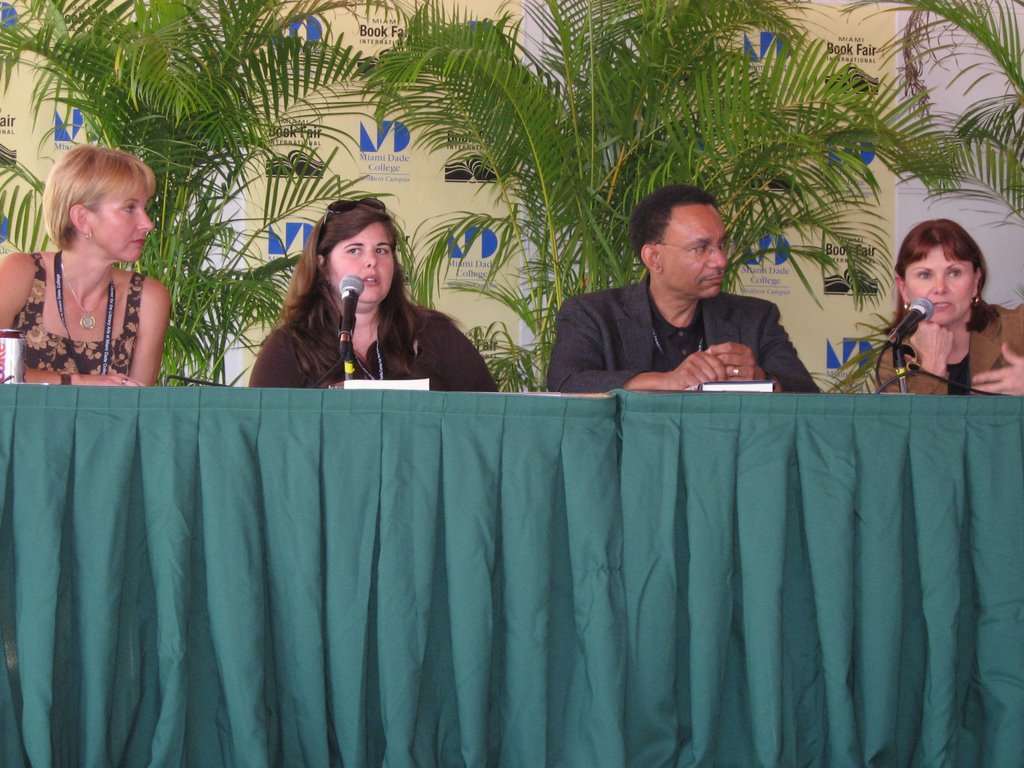
(from left to right: Elizabeth Becka, Lisa Unger, Mel Taylor, P.J. Parrish/Kristy Montee)
I really enjoyed Becka’s Trace Evidence and did not know that she is a practicing forensic scientist who testifies regularly in court. She was asked about the sort of research she does and replied that she has a shelf of text books in her office if she needs them. Mel Taylor is a local news anchor who loves to write. He talked about the difficulties of meeting his deadline last year after Hurricane Wilma hit. He was working twelve hour shifts with no days off and no electricity, but somehow got it done. Murder by Deadline seems like a most appropriate title.
The mystery panels continued with James Grippando, Barbara Parker and Paul Levine. Levine is working on the next book in the hugely popular Solomon vs. Lord series. He called the new book ‘Habeas Porpoise’ but apparently the powers that be (the publisher) didn’t like that name so it’s in limbo at present. Levine talked about writers that influenced him, including John D. MacDonald whose voice in the Travis McGee series, he said, sounded surprisingly like his own. He’s also a fan of Elmore Leonard and Tom Wolfe.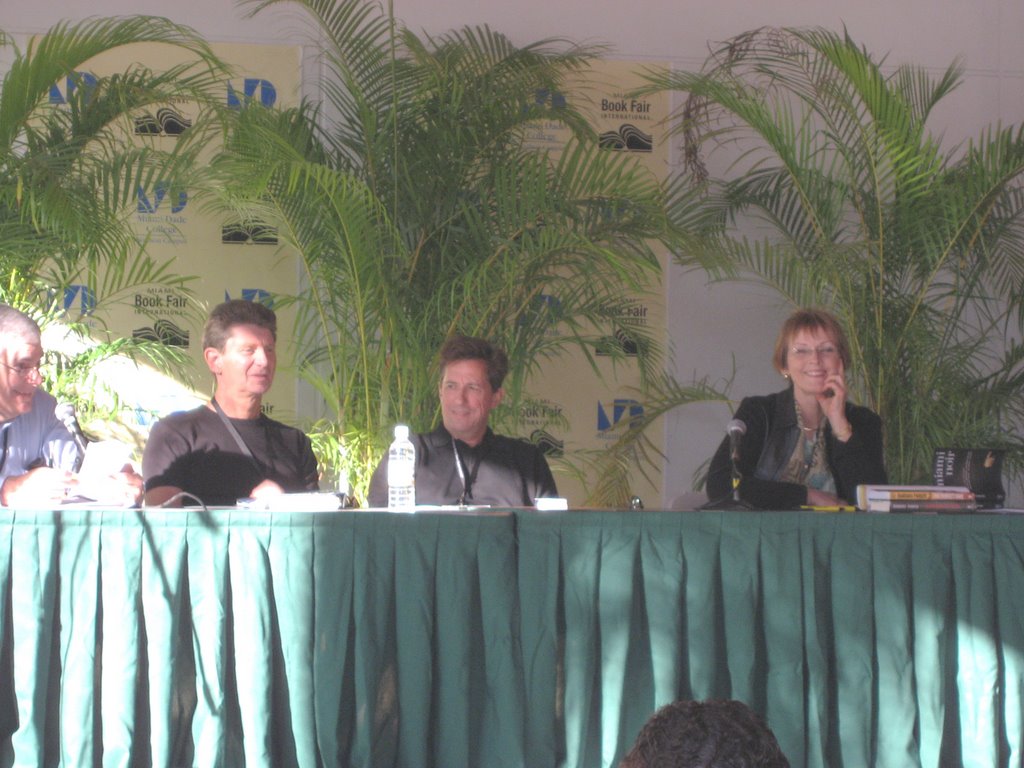
(from left to right: Bob Williamson, Paul Levine, James Grippando, Barbara Parker)
Jim Grippando is a very busy guy. He’s got a stand alone thriller, Lying with Strangers, that is available only through book clubs at present. I asked him about it, wondering if this was going to be a new trend. He said that book clubs have been hurting because their prime customers were always people who either didn’t have access to local bookstores or didn’t care to shop in one. But now those people can buy anything they want online. By making exclusive book deals with authors they are reinventing themselves. Grippando said that James Patterson is doing an exclusive with the book clubs soon, and more are to follow, probably about one or two per year.
Grippando also has a new Jack Swytek book coming in January, and a fantasy thriller for young adults called Leapholes was just released. His childhood was spent reading fantasy, and he especially liked the C. S. Lewis’ The Chronicles of Narnia. With Leapholes, he utilizes time travel to go back in time and meet famous historical figures like Rosa Parks, for example.
Another interesting discussion about the genre brought this tidbit from Grippando that he gleaned while on a panel (elsewhere) with Steve Berry. Grippando says that Berry had written all five of his published novels prior to the publication of the Da Vinci Code, but they had all been rejected. After the Da Vinci Code hit he was then able to get published, and all five of his books have ended up on the NY Times bestseller list.
Parker talked about her next book, The Perfect Fake, and how much she enjoyed doing research for it. An audience member asked about writers block and I loved her response – she said, “The answer to writer’s block is to lower your standards.” Levine wondered if plumbers get "plumber's block".
The last event at the Mystery Stage played to a packed house. Tim Dorsey moderated a panel he affectionately called, “Three Journalists and a Cop”. Dorsey, Jonathon King and Edna Buchanan were the journalists; James O. Born was the cop. These guys are all hilarious and to have them together was a treat. Dorsey started off by reading a sex scene from his latest book, The Big Bamboo, which caused a couple of mothers to hustle their children out of there. 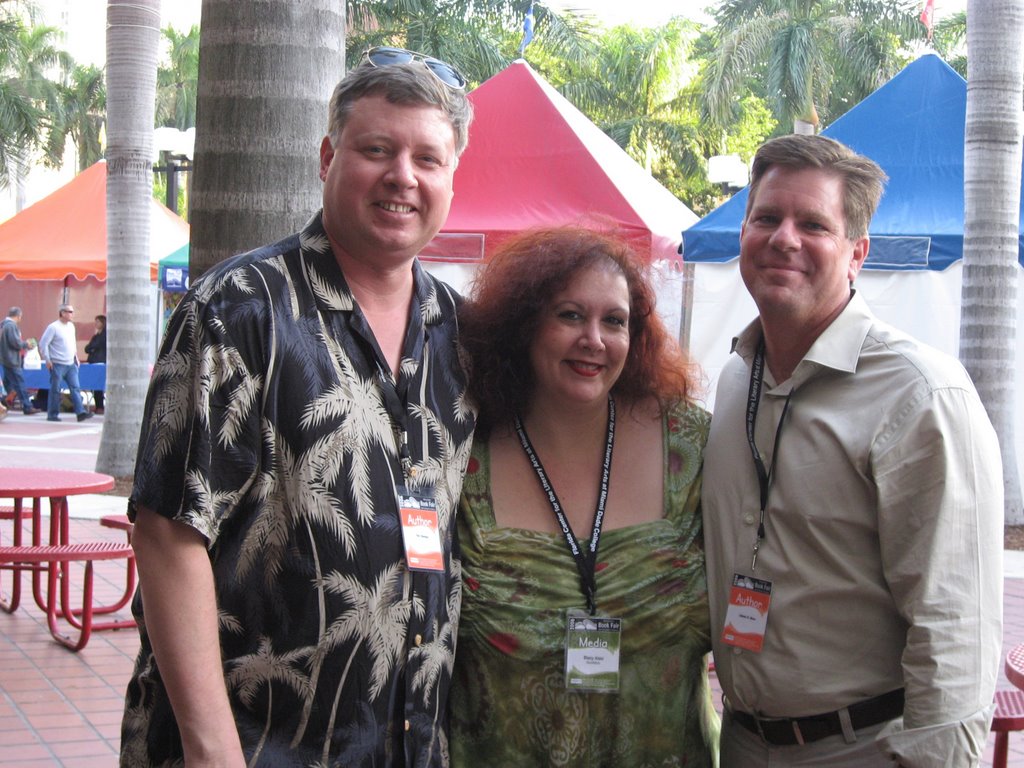
(from left to right: Tim Dorsey, the BookBitch, James O. Born)
King also talked a bit about his research, informing us that the Everglades has the largest population of rattle snakes in the country. Not sure I really needed or wanted to know that! His most recent book is a stand alone thriller called Eye of Vengeance that has had incredible reviews and is in my towering to-be-read pile.
Jim Born was all excited about his next book, a stand alone thriller that has already gotten raves from the likes of Michael Connelly. It’s called Field of Fire and comes out in February. He says it’s got a more serious tone than the Tasker series, but as he does in the Tasker books, he tries to portray cops in a very realistic way. I’m really looking forward to it.
Bob Williamson moderated all the panels, save the last one, and basically asked the same questions each time out. I overheard some people saying that it would have been more interesting had the questions been more specific to the authors on each panel rather than the broad questions asked that could have been asked of any author - mystery, literary or nonfiction. Even more maddening for those of us who were there for more than one or two panels was his cell phone virus joke – a cutesy way of asking people to make sure their cell phones were off. The first time was cute, the second time not so cute, and after that I just cringed each time he repeated it. Even better would be to have different moderators. Surely there are other MWA members available at the book fair who would want to participate.
There were lots of other events going on at the fair. I missed Carl Hiaasen, he was on first thing in the morning and I didn’t make it in time. The problem with the fair is that there are so many fabulous authors it becomes very difficult to choose. So I stuck with what I love best and missed other authors I also wanted to see, like Sara Gruen, Janet Fitch, Melissa Bank, Neal Gabler, Mark Kurlansky, Jay McInerney, Christopher Hitchens, Francine Prose, Katherine Weber and Da Chen. And that was just Sunday! But there’s always next year…


 Posts
Posts


