Laura Lippman on Tour!
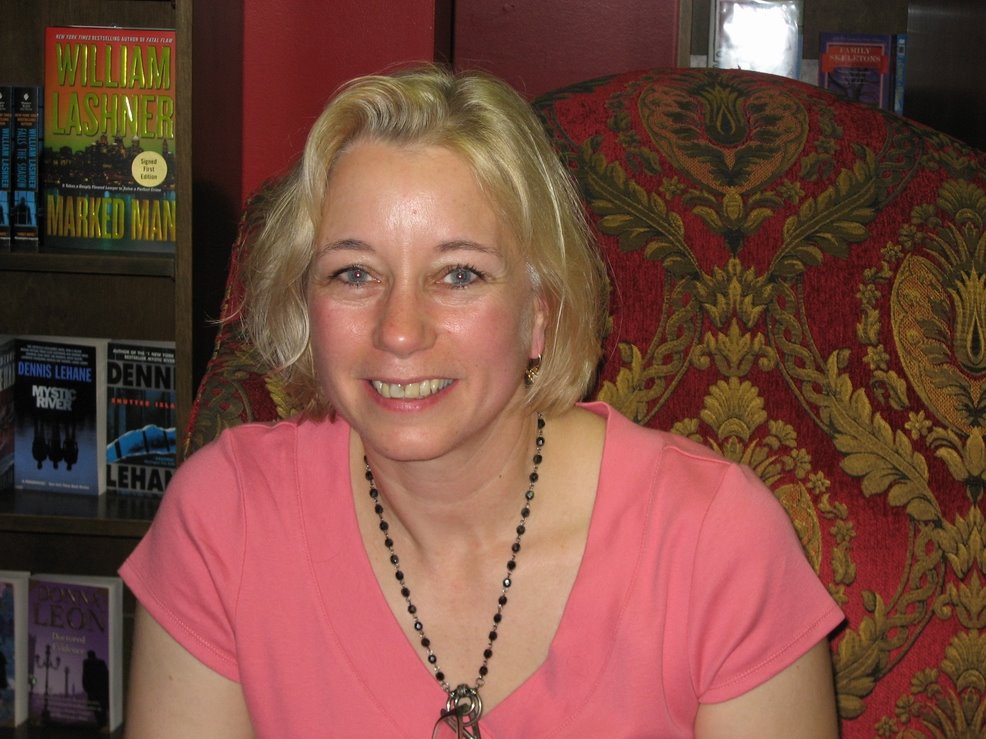
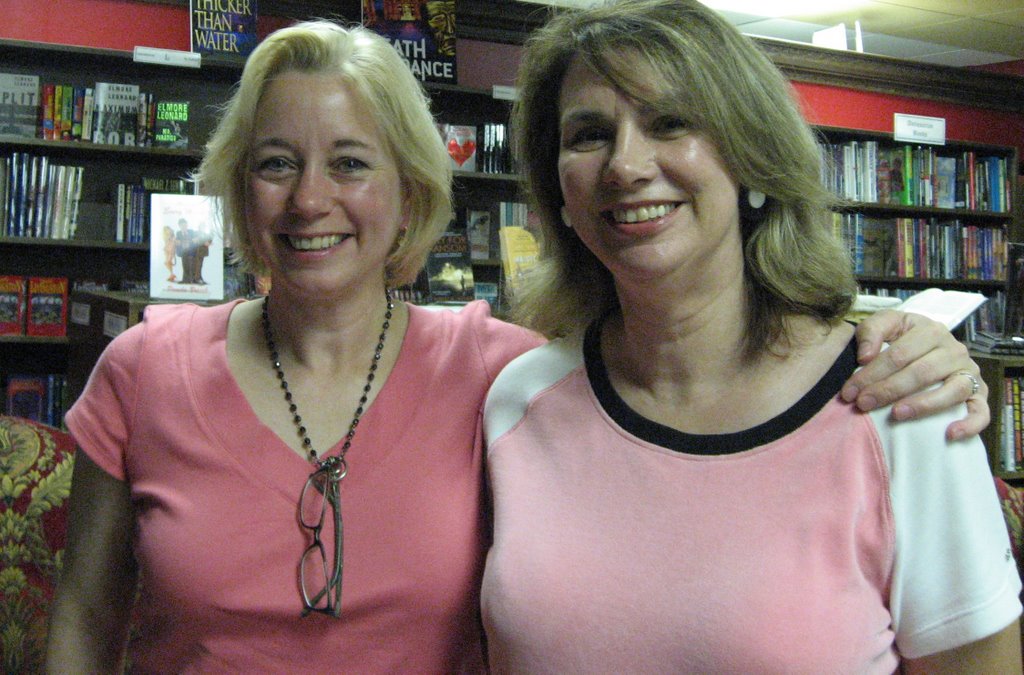
Laura Lippman stopped by Murder on the Beach in Delray Beach, Florida to promote her latest book, NO GOOD DEEDS. It was a standing-room only crowd for the popular author. I was fortunate enough to be able to review her latest entry in the Tess Monahan series for Library Journal and it was terrific.
Lippman spoke about how Robert B. Parker is a huge influence on her writing and how she hides references to his books throughout hers - hiding being the operative word. Apparently most people never get the references! She also spoke about the Baltimore quirkiness of police officers calling themselves a "police", rather than a "police officer." She gets a lot of flak about using the real term in her writing, but it brings a sense of authenticity to her books, as any Baltimore native will tell you.
Everyone who came to see her was a fan, including some local authors - Jonathan King came by, as did Elaine Viets.
One of her fans had a cake made with the cover of the book - I took a not-very-good picture, but hopefully you can get the idea.
As always, it was a pleasure to see her. If she's in your neighborhood, stop by, buy a copy of NO GOOD DEEDS and say hi from the BookBitch!
Sunday, July 23, 2006


Friday, July 21, 2006
Pynchon in the news...
While there is never enough time between novels for me, apparently lots of other folks are in a tizzy about a new Thomas Pynchon novel. It was apparently posted on Amazon and pulled at the request of Penguin, due to some scheduling conflicts or some such thing. But an enterprising blogger managed to snare it so you can read all about it here:
Amazon.com: Customer Discussions: Found It
Book Marketing Goes to the Movies
This is an interesting piece from NPR about trailers - think movie previews - but for books, being shown in movie theaters that are located near bookstores.
NPR : Book Marketing Goes to the Movies
Monday, July 10, 2006
THRILLERFEST!
A serial killer was lurking somewhere near the beautiful Arizona Biltmore. Seriously. I didn’t know about it until I got home, thank goodness, but you have to admit that it is a very strange, even freaky coincidence that something like this would happen at the first convention of the International Thriller Writers organization. About 450 folks showed up for this big party weekend, mostly writers and writer-wannabes, but also some readers, reviewers, editors, agents and publishers. I have to say that it totally exceeded even my wildest expectations. I never even dared dream of having a dashing Russian doctor/novelist, the esteemed Vladimir Lange (Fatal Memories) buy me lunch, along with his publisher and fellow lunchmates Katherine Neville (The Eight) & her husband; Willetta Heising, author of my favorite reference guides, Detecting Men and Detecting Women, and the soon to be published Willetta’s Guide to Police Detective Series; and one of my favorite authors and a genuinely nice guy, Brad Meltzer.
I arrived in 107 degree heat to find a beautiful hotel that some say was designed by either Frank Lloyd Wright or his colleague Albert Chase McArthur. It’s spread out in many buildings with the scenic Camelback Mountain in the backdrop. It involved a five minute hike from the main building to my beautiful room, and as I was trudging along, laptop in tow, I heard, “It’s the BookBitch!” I looked up to find the beautiful M.J. Rose lounging outside the coffee shop with Lee Child. There were a few other people there too, but let’s face it, meeting Lee Child just sort of stopped time for me and I’m embarrassed to say I don’t even remember who else I met there.
I was surprised by the organization of the event and especially by the quality and quantity of the panels. They started Thursday afternoon and ran all day and into the night, usually with three different panels going on at the same time, forcing attendees to make some tough choices. Fans met their favorite thriller writers like Sandra Brown and Clive Cussler. Thriller-writer-wannabes got writing tips from their favorite thriller writers like David Morrell and Douglas Preston. But best of all was how everyone from the superstars to the unknowns, the agents, editors, librarians and fans got to meet and mingle in the halls, by the pool, in the bar (of course, we’re talking writers here!) and even in the coffee shop (Starbucks was even more ridiculously expensive than at home – I am addicted and paid the price).
There were terrific, in depth interviews with several authors as well. An hour long spotlight interview with Sandra Brown revealed a smart, funny lady who is still insecure about her work, and even more gorgeous in person than on her book jackets. She admitted that even after 54 NY Times bestselling novels, she still wakes up every morning and worries that the “bad plot fairies” will have visited her during the night. She also told a great story about buying some property that had an old house on it. They wanted to get rid of the house but it was too expensive to move it so they considered demolition. They ended up gutting the house, filled seven tractor trailers with whatever was salvageable and auctioned it off for charity. Then they offered the house to the "Walker, Texas Ranger" TV show. Their writers put together a two-part episode that involved blowing up a house – guess who’s?
I heard that on Wednesday night, the night before the official start of the conference, Jeffery Deaver showed up in the bar and hung out with fans and at least one tongue-tied newbie writer. Apparently he was in town for a signing and decided to stop by. Other nights found Tess Gerritsen, Lee Child, Michael Palmer and dozens of other authors chatting away in the bar with whoever happened to be around.
The first day of the conference was geared towards writers with Jason Pinter, an editor at Crown, talking about the publishing process, Jim Fusilli discussing setting, David Morrell on dialogue, Jon Land on writing a thrilling screenplay, and Gayle Lynds on the eight elements necessary in writing the big thriller. You can watch a video of the Lynds event at YouTube, with others to follow, thanks to Robert Gregory Browne and David Hewson.
One of the most informative panels of the day, Buzz Your Thriller, featured author M.J. Rose, reviewer David J. Montgomery and publicist Sarie Morrell, offering the useful, albeit painful revelation to the hopeful and the newly published that books are not just a creative endeavor, they are a product and as such, need to be marketed and publicized. I’m afraid that M.J. Rose might have made some new authors cry with her advice to take that entire advance check for the first book – all of it – and use the money towards publicizing the book. On the other hand, she made me laugh – David’s mic wasn’t working and she took hold of the very phallic looking device and muttered, "somehow this feels very comfortable to me."
Sarie Morrell (David’s daughter) is a former publicist with Random House and is now on her own, representing authors like Gayle Lynds and M.J. Rose. She obviously knows her stuff and was willing to share lots of good advice, including the warning to be careful how writers, especially new writers, spend money. The long and short of it is that good publicists are not cheap and that press releases require know how. David J. Montgomery reviews mysteries and thrillers for several major newspapers including the Chicago Sun-Times, Philadelphia Inquirer, Boston Globe and my very own South Florida Sun-Sentinel. He’s also in the unique position of having completed his first thriller, so I’m sure he was paying close attention to his fellow panelists as well.
Rose also told a great story about how she had lost her dog and subsequently adopted another. She hadn’t had a puppy in years so she joined an online group for solace and support with her new puppy. Eventually they asked about her signature touting her first book, Lip Service (which I loved) and she watched her sales spike after that. Internet marketing is something Rose really excels in and talks about in the book she wrote along with Douglas Clegg, Buzz Your Book.
The party officially started Thursday night with the opening celebration that had Jim Fusilli interviewing Douglas Preston to a packed house – which may have had something to do with the free drinks. Preston is a descendant of Emily Dickinson and Horace Greeley and his brother is not a bad writer either - Richard Preston wrote The Hot Zone, which is required reading in many schools, and more recently, The Demon in the Freezer. Preston told a great story about his aunt stealing Benny Goodman’s suits from his widow - they were neighbors in a ritzy NYC apartment building. True, Mrs. Goodman was throwing them out, but still…and Preston wore them! I loved hearing how Preston snuck Lincoln Child, who was then his editor at St. Martins Press, into the American Museum of Natural History one night after closing (Preston worked there), showed him some behind the scenes dinosaurs, and The Relic and a writing partnership was born.
It was a terrific party and twenty-four of the authors who contributed a story to Thriller: Stories to Keep You Up All Night, the first compilation of the ITW, were there to sign books and mingle with each other and the fans. Recently the NY Times published a not-very-favorable review of the book (obviously they are not thriller fans over at the Times) and the authors decided to have a little fun with it. The review was hung up and each author got to shoot a water rifle at it, until the review finally disintegrated. Needless to say, a good time was had by all.
There were also some awards handed out that first night. As a way to thank several of the committee members who put together the event, beautiful awards were ordered and engraved with each of their names. Except that the printer made a tiny mistake - the only one who got an award with his name on it was Steve Berry. In fact, he could have gotten all the awards. They were all inscribed with his name, turning these lovely thank you gifts into the Berry awards. We’ll have to wait and see if they still call them that at future conventions.
Day Two found more panels for writers, but also for readers. Chris Grabenstein hosted a “Thrillers Live Talk Show” where he did an great job interviewing Michael Palmer, Alex Kava and Lee Child. Child informed the audience that he already has the last title in the series picked out, Die Alone, which will feature Jack Reacher not only getting killed, but also dismembered – there will be no bringing him back after Lee’s retirement. Dirk Cussler was a no show for this panel, leaving Grabenstein to quip that he was “diving under the table”.
Michael Palmer explained that he was able to practice medicine and still find time to write because he doesn’t watch television. He also shared that he & Tess Gerritsen give a standing-room-only workshop once a year for doctors who want to write, and that he interned with Robin Cook. Alex Kava was quite excited about having a sandwich named after her at Vinny’s Deli, a local Nebraska restaurant that is featured in her books. They call it the “Alex Kava Mystery Sandwich” and the mystery is that whoever makes it gets to decide what’s on it! She was also honored when One False Move was chosen for the 2006 One Book One Nebraska book.
Lee Child explained why women love Jack Reacher, despite the fact that he is “unhygienic” – it’s because "he shows up, they have intense sex for three days and then he disappears, never to be seen or heard from again. No mess, no divorce, just a few days of fun." He also explained that the character is based on the 2000 year old myth of the “mysterious stranger”, the one who everyone hopes will show up when they are in trouble and rescue them. The authors also discussed how they came up with character names. Palmer offered that there is a random name generator that uses names compiled from the census. Child says he tends to use stationary products – he just looks around his office and finds names like Mead, for instance. The authors on this panel were very forthcoming, Grabenstein was really quick and funny and it was a lot of fun.
There was a lot of talk about a “mock autopsy” that I really had no intention of attending, that is, until Library Journal asked me to cover it for them. (A seriously condensed version of this piece will be published in the August issue.) I wasn’t really sure what to expect but somehow was thinking there would be a body of some sort in the room. Thank goodness I was way off the mark there. “The Gerritsen Files” was an entertaining and educational mixed media presentation of how forensic science plays a part in thrillers: video, interspersed with an informative, extremely graphic slide show presentation by Dr. D. P. Lyle, followed by a panel discussion that also included C.J. Lyons, Grant Blackwood and Allen Wyler on writing medical thrillers.
Fans and writers alike seemed to enjoy a couple of panels that I missed – a discussion of the Da Vinci Code with John Case (Jim Hougan), Robert Liparulo, Rebecca York, Katherine Neville and the very funny James Rollins, was a big hit. There was also a terrific panel called “How the Masters Influence the Next Generation” with some newer authors: the very tall Jonathon King, J. Carson Black, the very cute Jeff Buick, Grant Blackwood, Thomas O’Callaghan, and the very sweet Mark Gimenez. That panel had people buzzing all day.
The “State of the Union” panel had Douglas Preston moderating Gayle Lynds, David J. Montgomery and David Morrell as they discussed what is going on in the thriller genre. Morrell, a former professor at the University of Iowa, explained that there is a “moral bias against thrillers” by reviewers because our society is based on a "Puritanical, Calvinistic society that says fun is bad, easy reading is bad." Gayle Lynds pulled out this quote that Morrell identified as Horace: “The purpose of fiction is to both entertain and enlighten.” These panelists all feel that thrillers accomplish that, and Montgomery pointed out that mysteries and thrillers are what people want to read today, and the best seller lists reflect that.
Lunch offered a spotlight interview with R.L. Stine, who in creating the Goosebumps series says he is “the literary training bra for Stephen King.” Stine said he finds there to be a very thin line between humor and horror, and judging by how funny so many of these thriller writers were, he seems to have hit the mark. He took questions after the interview and Lee Goldberg’s nine-year-old daughter Maddie made her father ask about a book called Deep Trouble. Maddie wanted to know how a mermaid could have tears running down her face while locked up in an aquarium. Stine was a great sport. He said the mermaid had to come up for air at some point, and they created the most talked about moment of the day.
The afternoon panels were an interesting mix, ranging from “Does a Series Have an Expiration Date” to “What Thrills Us” to “Beyond Good and Evil” to “Politics in Thrillers”. One I’m really sorry I missed was “Sex in Thrillers, with Booze” that featured John Lescroart, Steve Berry, M. J. Rose, and the hot, hot, hot Barry Eisler – along with screaming orgasms. (Yes, you may ask - you have my email.)
The highlight of the afternoon for me was “The People v. Jack Reacher.” Lee Child portrayed his character, Jack Reacher, and was defended by the hilarious Paul Levine (Solomon vs. Lord) in this murder trial based on the story in Persuader. Michele Martinez (The Finishing School) was the ferocious prosecutor and her star witness was a law enforcement officer, James O. Born (Escape Clause), with a murky past - something about drunk driving and a bunch of dead nuns? The court was presided over by the honorable M. Diane Vogt and the bailiff, who spent most of the trial napping center stage, was portrayed by David Dun. Despite the fact that there were two juries, one comprised of reviewers and press (including your very own BookBitch), and the other of members of the audience, neither could reach a consensus, thus causing a mistrial. It might have had something to do with the fact that despite several objections from Martinez, Lee Child/Jack Reacher flirted shamelessly with the mostly female jurors, or that Paul Levine warned the jury in his closing remarks that if Reacher were found guilty, there would be no more books. More than one sigh was heard at that remark. Rumor had it that if he had been found guilty, there was a contingent of cardboard-gun toting women willing to break him out of jail.
Day Three featured a few different tracks, including a full day of “Special Operations” that had hands-on demonstrations of street fighting, knife brawling, and “weapons and tactics you don’t see in textbooks”, including James O. Born warning that the next person to say the words, “dry heat” would be shot by a real gun with a real bullet. It actually started the night before when the person I was speaking with started laughing as a body went flying by. Hands on demonstrations were apparently being given in the bar. Fort Lauderdale author Neil Plakcy was kind enough to take notes on all of these and share them on his website: http://www.mahubooks.com/thrillerfest_notes.htm
Another panel was on heroes and featured the brilliant Gregg Hurwitz, the very funny Chris Mooney, Christopher Rice, the adorable son of Anne Rice, and the who-knew-he-was-so-damn-hot Will Staeger, moderated by the lovely and scarily-smart Tess Gerritsen. Rice made an interesting comment that “writing is the ultimate act of arrogance” which Mooney agreed with, saying, “where else can you talk for 400 pages and not be interrupted.” They also talked about rewriting. Rice said that he wrote 900 pages for one of his books, most of which was cut, and Staeger claims that he has 37 drafts of Painkiller. And they keep it all, at least in computer files, if not the actual paper. One of the funniest moments came when Hurwitz said that one of the benefits of reading a Christopher Rice novel while traveling is that he gets hit on by a lot of really good looking men. I wonder how his wife feels about that….
Another panel called “Readers Grill the Authors” had audience members asking Dale Brown, Lee Goldberg, Brad Meltzer and Erica Spindler anything they wanted – the best questions won prizes like an advance reader copy of The Book of Fate by Brad Meltzer (September publication date), a rubber duckie Copycat tie-in from Spindler, and a couple of Lee Goldberg novelizations of Monk and Diagnosis: Murder. Dale Brown offered to name a character after the audience member who won – look for “Ken Phoenix” in his next book. In the process, some interesting things were revealed. Spindler made the jump from romance to thrillers because she says she has a “dark gift.” Meltzer disclosed that he doesn’t read books anymore because while he may enjoy the first hundred pages or so, after that he starts deconstructing them, so he reads comic books instead. Lee Goldberg claimed that “reading energizes me.” Dale Brown flew his own plane in for the afternoon and brought the news of the scrubbed space shuttle launch. He was really sweet and bought me one of those ridiculously expensive coffees, so I got to spend a little extra time with him.
There was lots of excitement in the hall that afternoon as Clive Cussler signed books and chatted with fans for more than an hour. The day was capped off by an hour long interview with Brad Meltzer, after which he acted as auctioneer for a charity auction that featured gift baskets donated by some of the biggest names in the thriller community – Steve Berry, Sandra Brown, Lee Child, Linda Fairstein, Tess Gerritsen, R.L. Stine and many others. The highest bid, $1700, went to a basket from Clive Cussler that included rare manuscript pages, a handwritten letter, photographs, signed books and more.
The first Annual Thriller Awards Banquet was a truly entertaining evening, produced and emceed by the very funny Robert S. Levinson and showcasing the musical talent of the Killer Thriller Band: Blake Crouch, John Lescroart on vocals and lead guitar, Gayle Lynds (on triangle!), David Morrell on keyboard, Scott Nicholson, Michael Palmer on drums, his son David Palmer on amazing harmonica, Dave Simms, Nathan Walpow, F. Paul Wilson and the “Thrillerettes” (or possibly “Killerettes,” they lobbied for a name change): Heather Graham, Harley Jane Kozak and Alexandra Sokoloff. They may have had people dancing in the aisles but the real event of the night was the awards.
There was some controversy a week earlier when Elaine Viets posted a biting essay on the Lipstick Chronicles blog, stating, “It’s tough to define an award-winning thriller, but the new International Thriller Writers has succeeded: It’s anything written by a man.” Are you surprised to hear that as of this writing (July 9) there are 160 comments posted? Read Viets’ rant in its entirety and all those comments here: Lipstick Chronicles
ITW co-president Gayle Lynds responded, “As an author (not as a woman who has spent her life battling sexism), I could complain that no women were nominated. At the same time, I could also complain that no people of color were. I'm not sure whether any Muslims or religions other than Christian or Jewish were nominated, but I think they weren't either. As long as awards are given in whatever field, there are always going to be those who say, "I wish it were otherwise. And because it isn't, it's prejudice." The only time there's really an institutional problem, at least in my mind, is when there is a history of one group of people being disenfranchised. Since this is ITW's first year, the organization can have no track record of institutional prejudice.” Read Lynds’ response in its entirety here:
Sandra Blabber
I read all the responses on the Lipstick Chronicles blog and a few others including Sarah Weinman's, Jason Pinter's and Sandra Ruttan's and miraculously, kept my mouth shut and my typing fingers elsewhere. I didn’t respond for many reasons, but this is my forum so I’ll just throw in a brief comment or two now.
I understand Elaine Viets’ complaint, but I found it completely unjustified. There were some comments made about men not reading women authors and after many years as a bookseller and readers’ advisor I have to tell you it’s true. And to be fair, the converse is true as well; there are many women who won’t read male authors either. I myself have often been accused of reading “guy books.” Furthermore, it is my contention that most thrillers – not mysteries, but thrillers – are written by men. I have no idea of the percentage or actual numbers, but my best guess is that it is a significant number. ITW says that 29% of the submitted titles were written by women, a significant number to be sure but certainly a healthy minority.
I’ve had it pointed out to me that my ‘best books of the year’ lists tend to be heavily favored by male authors. I don’t care. I pick the books that I love most regardless of who wrote them, and I expect that was how the judges did it for ITW as well. If I had to stop and count gender or anything else I’d stop doing it altogether. I didn’t agree with all the choices that the judges made and perhaps I would have included a woman somewhere on those nominating lists, but I would have included some different men on those lists too. The long and short of it is that I wasn’t a judge and I wasn’t asked, and more importantly, I trust the integrity of those who did make those difficult choices.
The awards went on despite the controversy. In fact, James Rollins, the awards chair and a veterinarian who proudly claims to be able to "spay a cat in under five minutes," offered to neuter the winners and level the playing field. The beautiful Thriller awards went to:
Best Novel - THE PATRIOT'S CLUB by Christopher Reich (Delacorte Press)
Best First Novel - IMPROBABLE by Adam Fawer (William Morrow)
Best Paperback Original - PRIDE RUNS DEEP by R. Cameron Cooke (Jove)
Best Screenplay - CACHE (Hidden), screenplay by Michael Haneke
As previously announced, the first ThrillerMaster Award, a lifetime achievement award, went to Clive Cussler for his body of work.
The closing day of ThrillerFest had panels in the morning on, ironically enough, “Gender Issues in Thrillers”, among several others like “What I Love about Thrillers,” “Financial Crimes” and “Writing Killer Settings”. The grand finale was a brunch featuring an in depth interview of the enormously talented John Lescroart, where all the participants learned the correct pronunciation of his name (Less-KWAH).
Final thoughts on ThrillerFest: The hotel did a terrific job of hosting the conference. Yes, the bar was small, and with all the renovating going on it was very warm in places, but the staff was accommodating and the rooms were lovely. The banquet food was terrific – and how often do you get to say that. All the authors were friendly and inclusive. The panels were interesting, enlightening and fun, and the panelists diverse. All in all, I’d have to say that the first convention of the International Thriller Writers organization was a roaring success.
As for next year: "M. Diane Vogt, ITW Board Member and National Events Committee Chair with overall responsibility for ThrillerFest, confirmed the event will be held at the Grand Hyatt in New York City on July 11 -15, 2007." I can’t wait!
I've posted pictures at Kodak Gallery.
Sunday, July 02, 2006
THE 2006 THRILLER AWARDS
The winners of the first ever THRILLER Awards:
Best Screenplay - CACHE (Hidden), screenplay by Michael Haneke
Best First Novel - IMPROBABLE by Adam Fawer (William Morrow)
Best Paperback Original - PRIDE RUNS DEEP by R. Cameron Cooke (Jove)
Best Novel - THE PATRIOT'S CLUB by Christopher Reich (Delacorte Press)
As previously announced, the first ThrillerMaster Award went to Clive Cussler
Congratulations to all the nominees and all the winners.
Wednesday, June 21, 2006
SIBA Book Award Winners Announced
Columbia, SC - May 30, 2006 The Southern Independent Booksellers Alliance (SIBA) is pleased to announce the winners of the 2006 SIBA Book Award, celebrating the best of southern literature, as picked by independent booksellers throughout the South.
The 2006 Winners are:
FICTION: Gods in Alabama by Joshilyn Jackson, Warner Books
“Gods in Alabama is an intriguing, multi-layered mystery wrapped up in a Southern package. Don't miss this one!” Tammy R. Lynn, The Book Basket, Wetumpka, AL
POETRY: What Travels with Us by Darnell Arnoult, LSU Press
“Darnell Arnoult gathers the nourishment for the soul in her poetry. She echoes the past into our future so we know "the place" that we are part of. Immerse yourself in this poetry and wash away all that belongs not to you.” Emoke B'Racz, Malaprops Bookstore & Cafe, Asheville, NC
COOKBOOK:
Being Dead is No Excuse by Gayden Metcalfe & Charlotte Hays, Miramax
"Oh. My. God. If a funeral isn't the time for some good solid southern humor, I don't know what is. These two women have written a funny and smart book about how we act down South when we know the neighbors are watching. Plus recipes! It's to die for!" Elisabeth Grant-Gibson, Windows a bookshop, Monroe, LA
NONFICTION:
Marley & Me by John Grogan, William Morrow
“An incredible tale of canine connection. Grogan will make you laugh, make you cry, and help you to understand that "man's best friend", like all good friends, needs to be appreciated -- warts and all. Even though you know how the book must end, you are in for an incredible journey.” Janet Bollum, The Muse Bookshop, Deland, FL
CHILDRENS:
Rosa by Nikki Giovanni, Henry Holt
“The wonderful Nikki Giovanni brings to life the story of Rosa Parks, an ordinary woman who made a decision that sparked the Montgomery bus boycott and accelerated the struggle for Civil Rights in America. Bryan Collier's realistic yet luminous art lends a dream quality to this beautiful book.” Elisabeth Grant-Gibson, Windows a bookshop, Monroe LA
Each year, hundreds of booksellers across the South vote on their favorite "handsell" books of the year. These are the "southern" books they have most enjoyed selling to customers; the ones that they couldn't stop talking about. The SIBA Book Award was created to recognize great books of southern origin.
Books are nominated in several categories, including fiction, nonfiction, poetry, cooking and children's. For a book to be eligible, it must be set in the South, and it must have been published within the 2005 calendar year. In order to promote diversity in the award, no author can win the award in the same category twice.
Winners will be recognized with a $500 prize at the SIBA Book Award Luncheon, sponsored by Baker and Taylor, at the annual SIBA Trade Show in Orlando at the Gaylord Palms Hotel on September 8th, 2006.
Monday, June 19, 2006
The Macavity Award Nominations 2006
(for works published in the U.S. in 2005)
The Macavity Awards are nominated and voted on by members of Mystery Readers International. Winners will be announced at Bouchercon during opening ceremonies, September 28, 2006.
Best Novel
o One Shot by Lee Child (Delacorte Press)
o The James Deans by Reed Farrel Coleman (Plume)
o The Lincoln Lawyer by Michael Connelly (Little, Brown)
o Vanish by Tess Gerritsen (Ballantine Books)
o Strange Affair by Peter Robinson (William Morrow)
o The Power of the Dog by Don Winslow (Knopf)
o Solomon vs. Lord by Paul Levine (Bantam)
Best First Novel
o Immoral by Brian Freeman (St. Martin's)
o All Shook Up by Mike Harrison (ECW Press)
o Baby Game by Randall Hicks (Wordslinger Press)
o The Firemaker by Peter May (St. Martin's)
Best Nonfiction:
o Tracks to Murder by Jonathan Goodman (Kent State University)
o Behind the Mystery: Top Mystery Writers Interviewed by Stuart Kaminsky; photographed by Laurie Roberts (Hothouse Press)
o New Annotated Sherlock Holmes: The Novels, edited by Leslie S. Klinger (Norton)
o Girl Sleuth: Nancy Drew and the Women Who Created Her by Melanie Rehak (Harcourt)
o Spook: Science Tackles the Afterlife by Mary Roach (Norton)
Best Short Story
o "It Can Happen" by David Corbett in San Francisco Noir, Akashic Books
o "Everybody's Girl" by Robert Barnard
o "The Big Road by Steve Hockensmith (AHMM, May 2005)
o "There Is No Crime on Easter Island" by Nancy Pickard (EQMM, Sept-Oct 2005)
Sue Feder Historical Mystery Award
o In Like Flynn by Rhys Bowen (St. Martin's Minotaur)
o Spectres in the Smoke by Tony Broadbent (St. Martin's)
o The War of the World Murders by Max Allan Collins
o Night's Child by Maureen Jennings (McClelland and Stewart)
o Pardonable Lies by Jacqueline Winspear, (Henry Holt)
Sunday, June 11, 2006
Odd Twist for Hero
Of Popular Thrillers:
Women Like Him, Too
Jack Reacher Breaks Necks
As He Rights Wrongs;
Justice and Vicarious Lust
By JEFFREY A. TRACHTENBERG
June 10, 2006; Page A1
Jack Reacher, the tough-minded hero of a series of best-selling noir thrillers, has all the elements that have made this genre so popular among men for decades. He travels the country dispensing his own form of justice, often violently and without remorse. In one book, "Persuader," he leans over a man sitting in front of a computer monitor and snaps his neck. The man "started clawing at my wrists," he says. "I squeezed harder still."
But despite his brutish ways, Reacher is doing something surprising: winning the hearts of many women readers.
Of the 20,000 fans world-wide that have joined the Reacher Creatures fan club, an estimated 65% are female. Lorri Amsden, a saleswoman at the Poisoned Pen bookstore in Scottsdale, Ariz., said that when Lee Child, the author of the Reacher series, gave a reading at the store last month, 100 fans turned out, of which more than half were female -- far more than other thriller writers garner. Karen Corvello, a store manager at R.J. Julia Booksellers, an independent bookstore in Madison, Conn., that caters primarily to women, says she sells at least 60% of Mr. Child's Reacher books to women. "He's getting more popular with each book," she says.
Mr. Child's first nine Reacher novels have sold 10.3 million copies in 39 world markets, earning him an estimated $18 million before taxes and agent fees. His newest novel, "The Hard Way," is a best-seller and he recently signed a new four-book contract.
Booksellers believe Mr. Child may have tapped into the same audience that has devoured romance novels over the past 20 years, a genre that in recent years has increasingly included more violence and suspense. They say the 9/11 terrorist attacks, coupled with the war in Iraq, have changed what women are willing to read.
"This is not a safe, happy time," observes Vivien Jennings, owner of Rainy Day Books in Fairway, Kan. "Women say they want sensitive men, but in a violent time they don't want men taking a pea shooter to a gun fight."
David Thompson, a salesman at Murder by the Book, a specialty mystery bookstore based in Houston, says several writers are now benefiting from women who are embracing more violent thrillers. He cites Barry Eisler, whose main character is a professional assassin, and the books of Harlan Coben, whose latest title, "Promise Me," features a sports agent with a violent psychopathic sidekick.
"We now have as many women buying the thrillers of Lee Child and Barry Eisler as women buying the books of Agatha Christie and P.D. James," says Mr. Thompson.
Read the article in its entirety:
WSJ.com - Odd Twist for Hero Of Popular Thrillers: Women Like Him, Too
Friday, June 09, 2006
Personalized erotica - bid on eBay
M.J. Rose, whose new erotic novel, Lying in Bed (Spice, $13.95, 0373605080), features a woman who writes love letters for clients, reports that in the interest of charity, she is auctioning off her services--writing services. Rose will write a 2,000-word custom erotic love letter for the highest bidder and donate her 90% share of the proceeds to Reading Is Fundamental.
Sage Vivant of Custom Erotic Source, which writes custom erotic stories for customers, is doing the auction on eBay. Sage Vivant commented: "Opportunities like this are rare indeed. You can actually get a tax write-off for getting turned on!"
Bidding has begun and ends on June 16.
What's in store for chick-lit lovers? Authors
Posted 6/7/2006 9:57 PM ET
By Carol Memmott, USA TODAY
Fiction is in fashion at DKNY — and at Chanel, Saks and other high-end stores that are hosting signings by chick-lit novelists.
More and more, publishers are finding retail store partners where authors — particularly novelists who write about fashion-conscious young women — can mingle with the kinds of people who publishers think will buy their books.
"For me, it's great exposure, because the kind of woman who wears DKNY clothes is the kind of woman who's going to like my book," says author Deborah Schoeneman, whose novel, 4% Famous (Shaye Areheart, $21.95), is about the world of gossip columnists in New York. She has been appearing at DKNY stores across the country.
DKNY spokeswoman Aliza Licht says Schoeneman was a perfect partner for DKNY because of the book's content and because "people love a happening. It's nice for customers already there, and it's a vehicle to get new customers."
It's happening elsewhere:
•Saks stores across the country hosted book signings for authors Jill Kargman and Carrie Karasyov for their novel, Wolves in Chic Clothing.
•Ellyn Spragins did events at Eileen Fisher stores in New York and New Jersey for her book, What I Know Now.
•Bergdorf Blondes author Plum Sykes appeared at Chanel, Ralph Lauren, Frederic Fekkai, Ferragamo, Neiman Marcus and Oscar de la Renta stores for The Debutante Divorcée.
It's paying off.
Cheryl McDowell of Los Angeles was shopping for a black party dress at DKNY at the Beverly Center in Los Angeles where Schoeneman was signing books.
"I came in to shop," McDowell says, "but I'm buying the book. I belong to a book club, and we're always looking for good books to read."
For publishers, McDowell is a dream come true.
"It's tough these days, especially in the major markets, to get a big turnout for bookstore events," says Joanna Pinsker of Broadway Books, which published Wolves in Chic Clothing.
"There are so many competing events, and unless you are a famous author, it's very hard to draw a lot of people to bookstore events," she says. "At these parties, there's a built-in list of people."
Many of these events send invitations to VIP customers.
"It hits our target market," says Marleah Stout of Harlequin. "They like hip clothes, cosmetics and shoes, and they may not go to bookstores."
Harlequin has had success with such events and plans to do more. Last fall, Leeanne Banks, author of Feet First and Underfoot, did an event at the DSW shoe store in New York. This fall, Harlequin plans to hold an event for her new book, Footloose, during Fashion Week.
USATODAY.com - What's in store for chick-lit lovers? Authors
Saturday, May 27, 2006
QUOTE OF THE WEEK
Why I like living in Boca Raton: Reason 1
As anyone who ever watched Seinfeld knows, everyone who lives in New York has to retire to south Florida, specifically, to Boca Raton. And they do - in droves.
Today a patron was checking out the new Philip Roth book, EVERYMAN. She told me that she went to high school with the famous author. I asked if he was very smart in high school, and she said,
"He was a big jerky nerd. I'm not kidding."
You heard it here first.
Signs of Turmoil as Publishing Industry Gathers for Annual Book Expo and Da Vinci Code Film Arrives in Theatres
May 19, 2006 - The life-expectancy of a bestselling novel has halved within the last decade, according to a long-term study of fiction bestsellers. It has fallen to barely a seventh of its level 40 years ago.
The findings of the 50-year study are announced as America's book trade gathers in Washington for Book Expo (May 18-21), its largest annual get-together, while the movie of "The Da Vinci Code," the mother of all recent bestsellers, goes on worldwide release (May 19). The study was conducted by Lulu.com (www.lulu.com), the world's fastest-growing source of print-on-demand books.
The average number of weeks that a new No. 1 bestseller stayed top of the hardback fiction section of the New York Times Bestseller List has fallen from 5.5 in the 1990s, 14 in the 1970s and 22 in the 1960s to barely a fortnight last year -- according to the study of the half-century from 1956-2005.
In the 1960s, fewer than three novels reached No. 1 in an average year; last year, 23 did.
"The blockbuster novel is heading the way of the mayfly," says Bob Young, CEO of Lulu.com, referring to the famously short-lived insect.
The plummeting life-expectancy of a fiction bestseller, says Young, reflects the way that the publishing industry is unravelling, in an age of over-production, plus media fragmentation and now disruptive new technologies such as the Internet and print-on-demand: "The publishing revolution is nigh."
Similar trends are happening in other sectors, from music to movies, adds Young. "It's part of a cultural shift."
The future of publishing, he continues, belongs to "niche-busters" -- books targeting a niche rather than mass market." Over 1,200 new niche-buster titles are now published on Lulu each week.
Although the latest annual book trade figures show the first fall in US book production for years, the period covered by Lulu's 50-year study saw a huge growth in the annual output of new titles. The number of books published in the US almost doubled between 1993 and 2004 -- from 104,124 to 190,078.
Blockbusters, of course, do still exist, concedes Young, who could not do otherwise in the week that the movie of "The Da Vinci Code" opens worldwide. Indeed, the biggest ones today sell more overall than their forerunners. But even uber-blockbusters like "The Da Vinci Code" fail to achieve the sort of unbroken dominance that was once routine.
The three novels to have topped the list for the longest stints during the 50 years studied were "Advise and Consent," a political thriller by Allen Drury, which hit No. 1 on Oct 14, 1959 and stayed there for 57 consecutive weeks; "The Source," an historical epic by James Michener, which reached No.1 on July 11, 1965 and stayed top for 43 weeks; and "Love Story," by Erich Segal, which, from May 10, 1970, bestrode the list for 41 weeks.
The longest unbroken spell that "The Da Vinci Code," by contrast, has topped the list was 13 weeks, between November 16 2003 and February 15 2004 -- or two months less than the average No. 1 bestseller in the 1960s. Dan Brown's novel first hit No.1 on April 6, 2003, but stayed top for just two weeks. It has since lost and regained the top spot over 15 times, for varying periods.
"The market today is more chaotic," says Young. "The churn rate is far higher."
A growing number of bestsellers, says Young, now spend just a single week atop the list. "The New York Times will soon have to publish its bestseller lists daily instead of weekly, in order to stay up-to-date."
_______
The Life Expectancy of Bestsellers:
Additional Data from the Lulu.com Study
THE LONGEST STINT AT NO. 1
FOR EACH DECADE STUDIED
1950s (1956--59) (Decade average: 16.4 weeks)
Advise and Consent by Allen Drury – 57 weeks
Hit #1 on Oct 14, 1959, and stayed there for most of 1960. Drury was a political journalist for The New York Times itself and Advise and Consent told the inside story of a fictional US administration. It won the Pulitzer Prize in 1960 and is credited with inventing the genre of the political thriller.
1960s (Decade average: 21.7 weeks)
The Source by James Michener – 43 Weeks
Hit No. 1 on Jul 11, 1965 and stayed top until it was knocked off the #1 spot by Jacquelin Susann’s Valley of the Dolls on May 8, 1966. The story revolves around an archaeological dig in Israel/Palestine, and takes the reader on a colourful and epic journey through the history of the Jews.
1970s (Decade average: 13.9 weeks)
Love Story by Erich Segal – 41 weeks
Made No. 1 on May 10, 1970 and remained top for 41 consecutive weeks. It started life as a screenplay before a literary agent suggested that Segal make it into a novel. The following year, he turned it back into a script, which in turn spawned the hit 1971 movie of the same name.
1980s (Decade average: 7.2 weeks)
The Covenant by James Michener – 25 weeks
Reached No.1 on November 2, 1980 and stayed there almost six months. Another Michener historical epic, it tells the story of the birth of the Zulu nation.
1990s (Decade average: 5.5 weeks)
The Client by John Grisham – 23 weeks
Reached No.1 on March 21, 1993, staying top for 23 weeks – no other book this decade even got close to this.
This Grisham thriller tells the story of a kid who discovers a terrible secret and finds the Mafia and others on his tail, before a lawyer comes to his aid.
The 2000s (2000--2005) (Decade average: 3 weeks)
Blow Fly by Patrician Cornwell – 16 weeks
Hit No.1 on November 2, 2003. This suspense/crime novel is about a familiar Cornwell character, the forensic pathologist Kay Scarpetta and her ex--FBI friends, here dragged from retirement for a further assignment.
By the 2000s many No. 1s spend just a single week at the top of the list.
AVERAGE ANNUAL NUMBER OF NOVELS
TO REACH NO. 1 PER DECADE STUDIED
50s (1956--59): 3.8
60s: 2.8
70s: 4.4
80s: 7.6
90s: 10.0
00s (2000--05): 18.2
The number of bestsellers per year has increased by over 700 per cent since the 1960s, more than doubled since the 80s and almost doubled since the 90s. If present trends continue, they will have doubled in the 00s compared to the 90s.
LIFE--EXPECTANCY OF NO. 1 BESTSELLERS
PER DECADE STUDIED
50s (1956--59): 16.4
60s: 21.7
70s: 13.9
80s: 7.2
90s: 5.5
00s: 3.0
Life Expectancy of Bestselling Books - Lulu.com
Friday, May 26, 2006
Joe Finder at Levengers
Tuesday, May 23, 2006
A day off. One of my favorite authors in town. Doing a signing at one of my favorite stores. Kismet!
Joe is personable, funny and a very smart guy - graduated from Yale, taught at Harvard, and is a former intelligence officer of the CIA. He spoke a bit about the NSA and the CIA and what is going on today and didn't hold back at all, which was rather refreshing in this day and age, let me tell you. But he mostly talked about the not-quite-glamourous life of a touring author, kiddingly likening it to being a rock star, only his groupies are all librarians! He spoke about the research he does, interviewing CEO's and CFO's and visiting their offices and their warehouses and learning what goes on the various industries he writes about, like the plasma TV business for KILLER INSTINCT. His next book is set in the aeronautical industry and you can bet that one is well researched too. But we have to wait about a year for it!
Meanwhile, run out and get KILLER INSTINCT, (or order it from Amazon and support my site.) If Joe is doing a signing in your neck of the woods, do stop by, he is well worth the visit. Check out his website for a tour schedule.
Monday, May 22, 2006
BookExpo America builds buzz for upcoming titles
By Carol Memmott, USA TODAY
Thousands of booksellers and publishing professionals gathered in Washington, D.C., over the weekend at BookExpo America to look ahead to the big books for fall. Three titles that had the most buzz at the annual convention:
•For One More Day by Mitch Albom, best-selling author of Tuesdays with Morrie and The Five People You Meet in Heaven. Albom says his new novel "focuses on the relationships between mothers and sons." It's about a man who loses his mother and years later is given the chance to spend one more day with her. In stores: Sept. 26.
IN SEARCH OF GOOD READS: More from BookExpo
•Thirteen Moons, Charles Frazier's first novel since 1997's Cold Mountain. Set in the 19th century, Moons is the story of a young white man adopted by members of the Cherokee nation. Publication date: Oct. 3.
•The Innocent Man: A True Story, the first non-fiction title from John Grisham. It's about Ronald Keith Williamson, a second-round draft pick of the Oakland Athletics in 1971 who was convicted in the late 1980s of raping and killing a waitress in Oklahoma. Williamson was five days away from execution in 1999 when he was exonerated by DNA evidence. In stores: Oct. 10.
Robert Taecher, a buyer for the Borders bookstores, says Frazier's novel is one of many "upcoming books by established authors who haven't published new novels in a long time." Taecher says fans of Anna Quindlen, Jane Hamilton, Richard Ford, Jennifer Egan and William Boyd also can expect to find their novels in stores this fall.
Other fiction titles talked up at BookExpo:
•The Interpretation of Murder by Jed Rubenfeld. Historical thriller that imagines what happened when Sigmund Freud visited America in 1909. September.
•The Thirteenth Tale by Diane Setterfield. A mystery revolving around a woman who is invited by a reclusive author to write her biography. It will "be as big as The Historian and The Rule of Four," says Bob Wietrak, vice president of marketing at Barnes & Noble. September.
•After This by Alice McDermott. Follows an American family dealing with the changing world of the mid-20th century. September.
•One Good Turn by Kate Atkinson. Jackson Brodie, protagonist in the author's successful 2004 novel Case Histories, is back. October.
Other hot non-fiction:
•The Audacity of Hope: Reclaiming the American Dream by Barack Obama. The senator from Illinois lays out his vision for the country's political future. October.
•Brainiac: Adventures in the Curious, Competitive, Compulsive World of Trivial Pursuits by Ken Jennings. The author, a certified brainiac - he won on Jeopardy! 75 weeks in a row - writes of his game-show stardom. September.
•The 9/11 Report: A Graphic Adaptation by Sid Jacobson and Ernie Colon. Publisher Hill and Wang is calling this the "most accessible version" of the report.
BookExpo America builds buzz for upcoming titles - Yahoo! News
Monday, May 15, 2006
Scan This Book!
By KEVIN KELLY
Correction Appended
In several dozen nondescript office buildings around the world, thousands of hourly workers bend over table-top scanners and haul dusty books into high-tech scanning booths. They are assembling the universal library page by page.
The dream is an old one: to have in one place all knowledge, past and present. All books, all documents, all conceptual works, in all languages. It is a familiar hope, in part because long ago we briefly built such a library. The great library at Alexandria, constructed around 300 B.C., was designed to hold all the scrolls circulating in the known world. At one time or another, the library held about half a million scrolls, estimated to have been between 30 and 70 percent of all books in existence then. But even before this great library was lost, the moment when all knowledge could be housed in a single building had passed. Since then, the constant expansion of information has overwhelmed our capacity to contain it. For 2,000 years, the universal library, together with other perennial longings like invisibility cloaks, antigravity shoes and paperless offices, has been a mythical dream that kept receding further into the infinite future.
Until now. When Google announced in December 2004 that it would digitally scan the books of five major research libraries to make their contents searchable, the promise of a universal library was resurrected. Indeed, the explosive rise of the Web, going from nothing to everything in one decade, has encouraged us to believe in the impossible again. Might the long-heralded great library of all knowledge really be within our grasp?
Brewster Kahle, an archivist overseeing another scanning project, says that the universal library is now within reach. "This is our chance to one-up the Greeks!" he shouts. "It is really possible with the technology of today, not tomorrow. We can provide all the works of humankind to all the people of the world. It will be an achievement remembered for all time, like putting a man on the moon." And unlike the libraries of old, which were restricted to the elite, this library would be truly democratic, offering every book to every person.
But the technology that will bring us a planetary source of all written material will also, in the same gesture, transform the nature of what we now call the book and the libraries that hold them. The universal library and its "books" will be unlike any library or books we have known. Pushing us rapidly toward that Eden of everything, and away from the paradigm of the physical paper tome, is the hot technology of the search engine.
1. Scanning the Library of Libraries
Scanning technology has been around for decades, but digitized books didn't make much sense until recently, when search engines like Google, Yahoo, Ask and MSN came along. When millions of books have been scanned and their texts are made available in a single database, search technology will enable us to grab and read any book ever written. Ideally, in such a complete library we should also be able to read any article ever written in any newspaper, magazine or journal. And why stop there? The universal library should include a copy of every painting, photograph, film and piece of music produced by all artists, present and past. Still more, it should include all radio and television broadcasts. Commercials too. And how can we forget the Web? The grand library naturally needs a copy of the billions of dead Web pages no longer online and the tens of millions of blog posts now gone — the ephemeral literature of our time. In short, the entire works of humankind, from the beginning of recorded history, in all languages, available to all people, all the time.
This is a very big library. But because of digital technology, you'll be able to reach inside it from almost any device that sports a screen. From the days of Sumerian clay tablets till now, humans have "published" at least 32 million books, 750 million articles and essays, 25 million songs, 500 million images, 500,000 movies, 3 million videos, TV shows and short films and 100 billion public Web pages. All this material is currently contained in all the libraries and archives of the world. When fully digitized, the whole lot could be compressed (at current technological rates) onto 50 petabyte hard disks. Today you need a building about the size of a small-town library to house 50 petabytes. With tomorrow's technology, it will all fit onto your iPod. When that happens, the library of all libraries will ride in your purse or wallet — if it doesn't plug directly into your brain with thin white cords. Some people alive today are surely hoping that they die before such things happen, and others, mostly the young, want to know what's taking so long. (Could we get it up and running by next week? They have a history project due.)
Read this article in its entirety:
Scan This Book! - New York Times


 Posts
Posts


